
Michigan calls SNAP the Food Assistance Program (FAP). If you are looking for Michigan food stamps, the main place to apply is MI Bridges, although the Michigan Department of Health and Human Services (MDHHS) also accepts a paper application.
The process does not end when you click Submit. Most FAP applicants need an interview, and MDHHS may ask for proof of income, housing costs or other case details before making a decision. If approved, benefits are loaded onto a Michigan Bridge Card.
Michigan also has several rules that are easy to miss. Most FAP households no longer have an asset limit, many households use simplified reporting, and Time Limited Food Assistance work requirements changed across much of the state on March 1, 2026. Michigan is also preparing to issue upgraded chip- and tap-enabled Bridge Cards later in 2026.
By FoodStampsApply.com Editorial
Last verified: September 12, 2026
Quick Answer
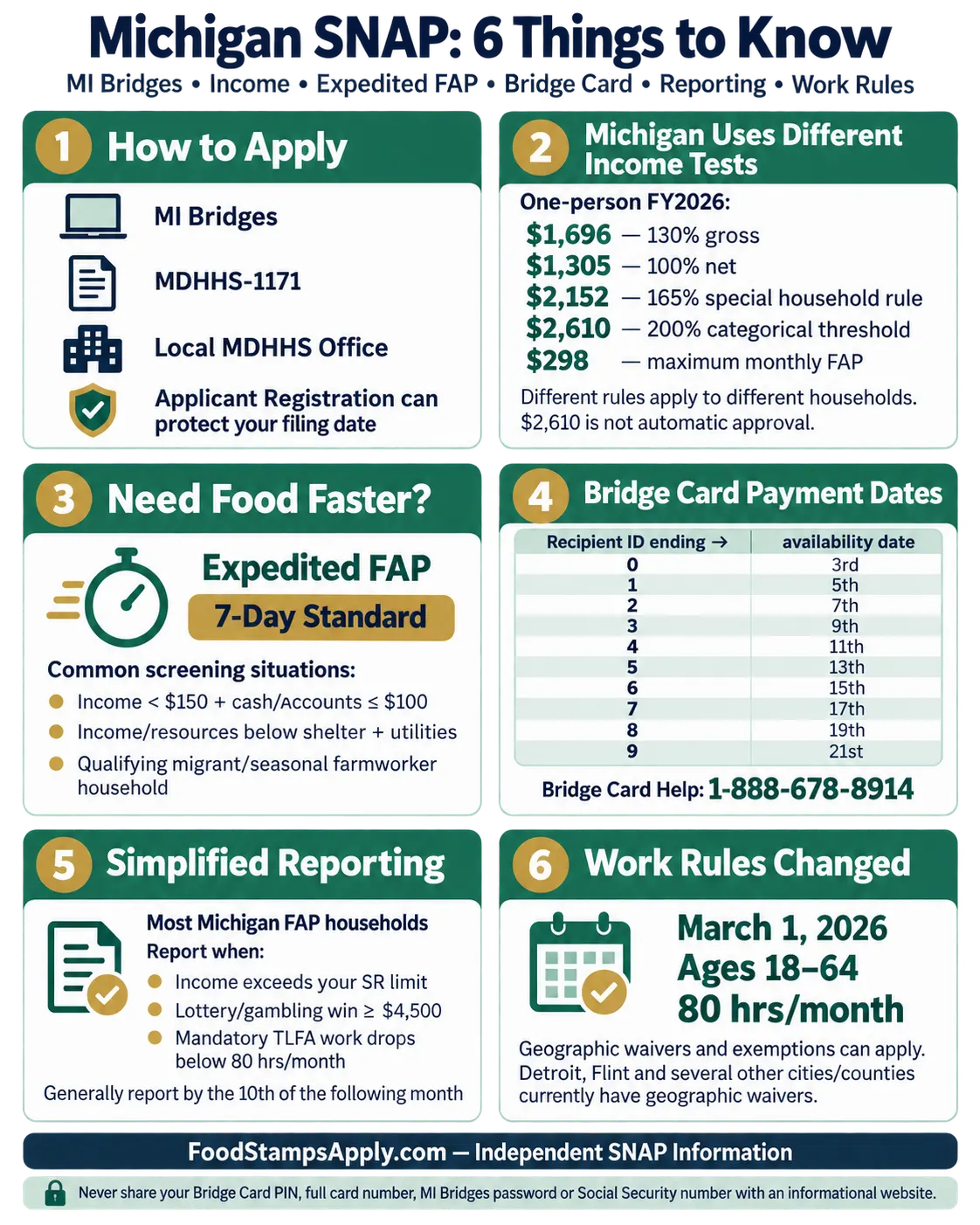
Apply for Michigan Food Assistance through MI Bridges, submit MDHHS-1171 or contact your local MDHHS office. Regular FAP applications have a 30-day processing standard, while qualifying expedited cases have a 7-day standard. For one person, current FY2026 figures include a $1,696 standard gross limit, $1,305 net limit, $2,610 categorical-income threshold and $298 maximum monthly benefit. Approved benefits are issued on a Michigan Bridge Card.
Independent information: FoodStampsApply.com is an independent SNAP information website. We do not operate MI Bridges, access MDHHS cases, issue Bridge Cards or decide FAP eligibility. Never send an informational website your Social Security number, MI Bridges password, Bridge Card PIN, full card number or private case documents.
Michigan SNAP Income Limits and Maximum Benefits for 2026
Michigan’s current Food Assistance Program income standards are effective October 1, 2025 through September 30, 2026.
Michigan publishes several income figures because different tests apply to different households. A single number should not be treated as a universal approval or denial cutoff.
| Household Size | 130% Gross* | 100% Net | 165% Special Rule** | 200% Categorical*** | Maximum FAP |
|---|---|---|---|---|---|
| 1 | $1,696 | $1,305 | $2,152 | $2,610 | $298 |
| 2 | $2,292 | $1,763 | $2,909 | $3,526 | $546 |
| 3 | $2,888 | $2,221 | $3,665 | $4,442 | $785 |
| 4 | $3,483 | $2,680 | $4,421 | $5,360 | $994 |
| 5 | $4,079 | $3,138 | $5,177 | $6,276 | $1,183 |
| 6 | $4,675 | $3,596 | $5,934 | $7,192 | $1,421 |
| 7 | $5,271 | $4,055 | $6,690 | $8,110 | $1,571 |
| 8 | $5,867 | $4,513 | $7,446 | $9,026 | $1,789 |
| Each additional person | +$596 | +$459 | +$757 | +$918 | +$218 |
*Michigan policy says the 130% gross-income column applies to FAP groups without a senior, disabled or disabled-veteran member and does not apply in the same way to categorically eligible groups.
**The 165% figure is used for a narrower household-composition rule involving certain senior-impaired individuals. It is not a general Michigan SNAP income limit.
***The 200% figure is Michigan’s categorical-income threshold. Meeting it does not by itself guarantee eligibility.
Why You May See a $2,610 Michigan SNAP Income Limit
For one person, Michigan’s standard 130% gross-income limit is $1,696, but its categorical-income threshold is $2,610.
Both numbers are real. They apply to different parts of Michigan FAP policy.
Michigan uses broad categorical eligibility tied to an enhanced authorization under its Food Assistance rules. When a household is categorically eligible and its gross income is at or below 200% of the federal poverty level, the ordinary gross, net-income and asset tests do not apply in the usual way.
Categorical eligibility does not mean automatic SNAP approval. The household still has to meet the other applicable Food Assistance rules.
Do not self-deny from one income chart. If your income is above $1,696 but below Michigan’s $2,610 one-person categorical threshold, let MDHHS determine which rules apply to your household.
Your Expenses Can Change the Benefit Amount
Michigan considers allowable expenses when determining the final FAP benefit.
Depending on the household, these can include:
- rent or mortgage;
- heating and utility costs;
- dependent care;
- legally obligated child support; and
- certain medical expenses for a person who is at least 60 or has a disability.
Current FY2026 Michigan standards include a $209 standard deduction for households of one to three people and a $744 maximum excess shelter deduction where the cap applies.
Two households with the same paycheck can therefore receive different FAP amounts because their allowable deductions are different.
Does Michigan SNAP Have an Asset Limit?
For most Michigan Food Assistance households, no.
Michigan removed the FAP asset test for most groups effective March 1, 2024.
Certain noncategorically eligible households still have an asset limit, including some cases involving an Intentional Program Violation, a fleeing-felon disqualification or an employment-and-training disqualification involving the head of household.
For affected households, the current resource limits are generally:
- $3,000 for a non-senior/disabled group; or
- $4,500 when the group contains someone age 60 or older or a person with a disability.
Having an ordinary checking or savings account therefore does not automatically disqualify most Michigan FAP applicants.
Who Counts as Your Michigan FAP Household?
Michigan generally treats people who live together and purchase and prepare food together as part of the same Food Assistance group.
That matters for roommates. If you share an apartment but normally buy and prepare food separately, explain that accurately on the application and during the interview.
Spouses and certain children have additional SNAP household rules, so give MDHHS the actual living arrangement and let the agency determine the final group composition.
How to Apply for Michigan SNAP/FAP
Step 1: Apply Online Through MI Bridges
MI Bridges is Michigan’s main online benefits portal.
You can use it to apply for Food Assistance, view case information, see appointments, upload verification, read notices and report changes.
MDHHS also provides an application tracker in MI Bridges for users who have completed identity proofing and are listed as head of household.
Have basic information ready about:
- household members;
- jobs and other income;
- rent or mortgage;
- utilities;
- child care; and
- other expenses requested by MDHHS.
Step 2: Protect Your FAP Filing Date
Do not delay filing simply because every verification document is not ready.
Michigan’s MDHHS-1171 Assistance Application contains an Applicant Registration filing page. If you cannot finish the full application that day, MDHHS says you may return the filing page first.
For FAP, it generally needs:
- your name;
- your address, unless you are experiencing homelessness; and
- your signature.
If you are found eligible, Michigan says FAP benefits are issued from the filing date.
Step 3: Use MDHHS-1171 if You Prefer Paper
Michigan’s main assistance application is:
MDHHS-1171 — Assistance Application
A paper application can be mailed or delivered to a local MDHHS office.
Michigan also publishes a central fax number for benefit applications:
517-346-9888
Step 4: Find Your Local MDHHS Office
Michigan has MDHHS offices throughout the state.
Find Your Michigan MDHHS Office
Local offices can help with:
- FAP applications;
- interviews;
- verification;
- case-status questions;
- reported changes;
- renewals;
- work requirements; and
- hearing requests.
Michigan’s Universal Caseload System
In Universal Caseload areas, one named worker may not handle every part of your case. Teams can process different tasks.
Case help: 1-844-4MI-DHHS (1-844-464-3447)
The automated system can provide case-specific information such as verification received, verification still needed and current benefit amounts before offering the option to speak with a worker.
Step 5: Complete the Michigan FAP Interview
A Food Assistance interview is generally required before MDHHS approves the application.
Most FAP application interviews are conducted by telephone, although you can request an in-person interview.
Be prepared to discuss:
- who lives with you;
- who buys and prepares food together;
- employment and other income;
- rent or mortgage;
- utility expenses;
- child care;
- child support; and
- medical expenses when applicable.
Keep your phone number current in MI Bridges. If an expected interview call does not happen, check the newest MDHHS notice and contact the department rather than assuming the interview requirement disappeared.
Step 6: Send the Verification MDHHS Requests
MDHHS can verify some information electronically and ask you to prove other information.
Common requests include:
- pay stubs;
- employer statements;
- Social Security or other income;
- housing costs;
- utility expenses;
- identity information; or
- other case-specific documents.
Michigan generally gives applicants about 10 days to provide requested verification.
For many people, the easiest method is MI Bridges. You can photograph a document with your phone and upload it to your case.
Keep the submission confirmation. Uploaded does not necessarily mean the document has already been reviewed.
Step 7: Use the Right Michigan Phone Number
Michigan has different contacts for case problems and MI Bridges website problems.
FAP eligibility or case-processing question: contact your local MDHHS office or, where Universal Caseload applies, call 1-844-464-3447.
MI Bridges login or technical problem: 1-844-799-9876.
MI Bridges Help Desk TTY: 1-833-285-5910.
The MI Bridges Help Desk can troubleshoot portal errors. It does not decide whether you qualify for Food Assistance.
Step 8: Check the Existing Application Before Starting Over
Michigan’s current standards of promptness are:
- Regular Food Assistance: 30 days
- Expedited Food Assistance: 7 days
Use the MI Bridges application tracker where available before submitting another application.
If the 30-day deadline is approaching and you have completed the interview and supplied everything requested, contact MDHHS with your filing date and document-submission dates ready.
Need Food Quickly? Ask About Expedited Michigan FAP
Michigan can process a qualifying Food Assistance application within 7 days.
Expedited processing can apply when:
- monthly gross income is less than $150 and the household has $100 or less in cash/accounts;
- combined monthly gross income and available cash/accounts are less than the household’s rent or mortgage plus utilities; or
- a qualifying migrant or seasonal farmworker household has stopped income and no more than $100 in cash/accounts.
To receive expedited processing, you still need to complete the interview, verify identity and finish the required application process.
If groceries are already running out, answer the expedited-screening questions accurately. Do not minimize how little income or cash your household currently has.
Michigan SNAP Help Where You Live
Detroit and Wayne County
Wayne County has multiple MDHHS offices, and the appropriate location can depend on where you live.
Check Current Wayne County MDHHS Offices
Wayne County residents can also use 1-844-464-3447 for many benefit-case questions.
Flint and Genesee County
Use the MDHHS county-office directory for current Genesee County case locations.
If you need groceries before MDHHS finishes the case, the Food Bank of Eastern Michigan serves Flint and surrounding communities.
Grand Rapids and West Michigan
Use the official MDHHS directory for your current Kent County benefits office.
Feeding America West Michigan operates pantry and mobile-food resources throughout much of western and northern Michigan.
Lansing and Mid-Michigan
Residents in the Lansing area can use the Ingham County MDHHS office for FAP case questions.
Greater Lansing Food Bank is another option for emergency groceries while a Food Assistance application is pending.
Anywhere in Michigan: Call 211
Call: 211
Toll-free: 1-844-875-9211
Text: your ZIP code to 898211
Michigan 211 can connect you with food pantries, meal programs, housing, utilities and other community services.
Need Help Using MI Bridges?
Registered MI Bridges Navigation Partners can provide one-on-one assistance using the portal and finding local resources. This can be especially useful if you have limited internet access or repeatedly get stuck in the online application.
What Happens After Michigan Approves FAP?
Approved Food Assistance benefits are issued through a Michigan Bridge Card.
Bridge Card Customer Service: 1-888-678-8914
Hours: 24 hours a day, 7 days a week
Michigan Relay: 711
Call if:
- the card is lost or stolen;
- you forgot or need to change the PIN;
- the card is not working;
- you need the current balance; or
- you suspect unauthorized transactions.
New Chip-and-Tap Michigan Bridge Cards Are Coming
MDHHS says upgraded chip- and tap-enabled Bridge Cards are coming later in 2026.
Make sure the mailing address on the FAP case is current so a future replacement card does not go to an old address.
If you moved, use Report Changes in MI Bridges.
Michigan SNAP Payment Dates
Regular Michigan FAP benefits are issued from the 3rd through the 21st based on the last digit of the recipient ID number.
| Recipient ID Ends In | Payment Date | Recipient ID Ends In | Payment Date |
|---|---|---|---|
| 0 | 3rd | 5 | 13th |
| 1 | 5th | 6 | 15th |
| 2 | 7th | 7 | 17th |
| 3 | 9th | 8 | 19th |
| 4 | 11th | 9 | 21st |
Example: if the recipient ID ends in 7, the normal monthly availability date is the 17th.
Use the recipient ID—not the long number printed across the Bridge Card—to identify the regular FAP schedule.
Your Michigan FAP Deposit Did Not Arrive?
Check:
- the latest MI Bridges letter or notice;
- whether MDHHS requested a report, redetermination or verification; and
- your current Bridge Card balance.
Call 1-888-678-8914 to confirm the EBT balance.
If no benefit was issued into the account, contact MDHHS rather than repeatedly replacing the card.
Can You Buy Groceries Online With Michigan SNAP?
Yes. Michigan Bridge Card users can buy eligible groceries online from participating SNAP retailers.
SNAP pays for eligible food items, not delivery, service or other non-food fees. Retailer participation can change, so check SNAP payment availability before building a large online order.
Stretch Your Bridge Card With Double Up Food Bucks
Double Up Food Bucks can help participating Michigan SNAP households buy more fruits and vegetables.
The program operates at hundreds of participating Michigan grocery stores, farmers markets and other food retailers. Rules and the way matching benefits are earned or redeemed can vary by location.
Find a Michigan Double Up Food Bucks Location
Double Up help: 1-866-586-2796
Check the location finder before shopping. Kroger, Meijer and Walmart currently do not participate in Michigan Double Up Food Bucks. The program primarily works with participating independent and regional stores and farmers markets.
Michigan Restaurant Meal Program
Michigan also operates a Restaurant Meal Program (RMP) that allows certain SNAP recipients to use the Bridge Card for prepared meals at participating restaurants.
For a household to use the program, all FAP group members must meet an RMP category such as:
- age 60 or older;
- qualifying disability;
- experiencing homelessness; or
- being the spouse of an eligible participant.
A separate RMP application is generally not required for the SNAP recipient. MDHHS uses case information to identify eligible participants.
Not every restaurant accepts SNAP through RMP.
Check Michigan Restaurant Meal Program Locations
Keeping Michigan FAP: Simplified Reporting
Most Michigan Food Assistance groups are assigned to simplified reporting.
For a simplified-reporting household, current MDHHS policy generally requires a report when:
- actual gross monthly income exceeds the simplified-reporting income limit for the household size;
- someone in the FAP group receives a single lottery or gambling winning of $4,500 or more; or
- a mandatory TLFA participant works fewer than 20 hours per week or 80 hours per month.
The required change generally must be reported by the 10th day of the following month, or the next business day when the 10th falls on a weekend or holiday.
Your MDHHS notice identifies the simplified-reporting income threshold for your case.
Michigan’s Six-Month Contact
Many simplified-reporting households receive a 12-month FAP benefit period with a semi-annual contact form sent during the fifth month and due during the sixth month.
The report can ask about changes in:
- address and housing costs;
- household members;
- child-support obligations;
- income; and
- certain assets when an asset test applies to the group.
If earned or unearned income changed by more than $125 from the amount shown on the report, current MDHHS instructions can require proof of current income.
Return the required report even if little has changed. Failing to complete a mandatory semi-annual contact can close the FAP case.
Michigan FAP Redetermination
MDHHS reviews eligibility again when the certification period ends. Michigan calls this a redetermination.
The process can require updated household information, current income, requested verification and an interview when applicable.
Most FAP redeterminations require an interview, although Michigan provides a limited exception for some households with no earned income where all adult members are elderly or disabled and there are no unresolved questions.
Watch MI Bridges and your mail for the deadline. Do not wait until the Bridge Card stops loading before checking whether a redetermination is due.
Michigan SNAP Work Requirements in 2026
Michigan’s Time Limited Food Assistance (TLFA) rules expanded across much of the state beginning March 1, 2026.
Current MDHHS guidance says many able-bodied adults ages 18 through 64 who do not have a dependent child under age 14 can be subject to the time-limit requirement unless an exemption, deferral or geographic waiver applies.
Someone subject to TLFA can generally meet the requirement through:
- employment averaging at least 80 hours per month;
- qualifying employment and training;
- qualifying community service; or
- another qualifying combination allowed by MDHHS.
A person subject to the time limit can generally receive only three countable months in a three-year period without meeting the requirement or qualifying for an exception.
Some Michigan Counties and Cities Are Currently Waived
The TLFA rule does not currently operate the same way everywhere in Michigan.
Current waived counties:
Alcona, Alger, Arenac, Cheboygan, Iosco, Iron, Luce, Mackinac, Montmorency, Oceana, Ogemaw, Oscoda, Presque Isle, Roscommon and Schoolcraft.
Current waived cities:
Bay City, Detroit, Eastpointe, Flint, Jackson and Saginaw.
Location matters. An adult living inside Detroit can therefore have a different TLFA situation from someone elsewhere in Wayne County.
You May Qualify for an Exemption or Deferral
Health, disability, pregnancy, caregiving, treatment, education/training and other circumstances can affect whether the TLFA requirement applies.
Because these rules changed during 2026, use the current MDHHS work-requirement notice for your case rather than relying on an old article or an old exemption list.
Case questions: 1-844-464-3447
For the broader distinction between SNAP general work requirements and time-limit rules, see our SNAP work requirements guide.
Michigan and Ohio Use Different SNAP Systems
SNAP is federally funded, but application portals, EBT systems, work-rule administration and local case procedures differ by state.
If you are moving between the two states or comparing procedures, see our latest Ohio SNAP guide. Ohio uses Ohio Benefits and the Direction Card rather than MI Bridges and the Michigan Bridge Card.
What If MI Bridges Looks Wrong?
Do not treat every dashboard message as a final eligibility decision.
- Check Letters or the newest official MDHHS notice.
- Review the MI Bridges application tracker.
- Check for requested verification.
- Confirm that the required interview was completed.
- Contact MDHHS if the case information still does not make sense.
For a portal or login problem, call the MI Bridges Help Desk at 1-844-799-9876.
For eligibility or case processing, contact MDHHS. The website and the benefit case are two different things.
What If Michigan Denies, Reduces or Stops Your FAP?
Read the MDHHS notice before submitting another application.
If you disagree with the decision, you have the right to request an administrative hearing.
Michigan allows a Food Assistance hearing request to be made verbally or in writing through the local MDHHS office.
The general deadline is 90 days from the notice of case action. FAP-only hearing cases generally have a 60-day final-action standard after MDHHS receives the request, subject to permitted delays.
If an existing benefit is being reduced or terminated, the notice can contain an earlier deadline that matters if you want to request continued benefits while the hearing is pending. Read the notice promptly.
Michigan Public-Assistance Hearing Information
Keep:
- the decision notice;
- application confirmation;
- interview dates;
- verification-upload confirmations; and
- copies of documents you submitted.
Michigan SNAP/FAP FAQs
Where do I apply for Michigan food stamps?
Apply through MI Bridges, submit MDHHS-1171 or contact your local Michigan Department of Health and Human Services office.
What is SNAP called in Michigan?
Michigan calls SNAP the Food Assistance Program, usually shortened to FAP.
What is the Michigan SNAP income limit for one person in 2026?
Through September 30, 2026, Michigan’s standard 130% gross-income figure is $1,696 and the 100% net figure is $1,305. Michigan also has a $2,610 categorical-income threshold. Different household rules determine which tests apply.
How much SNAP can one person get in Michigan?
The current FY2026 maximum Food Assistance benefit is $298 per month for one person. The actual amount can be lower depending on countable income and allowable deductions.
How long does Michigan FAP take?
Regular Food Assistance applications have a 30-day processing standard. Qualifying expedited applications have a seven-day standard.
Does Michigan SNAP have an asset limit?
Most Michigan FAP households do not have an asset limit. Specific noncategorically eligible households can still face a $3,000 resource limit, or $4,500 when the group contains a person age 60 or older or a person with a disability.
What is the Michigan Bridge Card phone number?
Call 1-888-678-8914 for balance information, PIN problems, a lost or stolen card, card problems and suspected unauthorized transactions.
When does Michigan load SNAP benefits?
Regular FAP benefits are generally available from the 3rd through the 21st based on the last digit of the recipient ID. A recipient ID ending in 0 receives the normal monthly benefit on the 3rd; one ending in 9 receives it on the 21st.
What number do I call if MI Bridges is not working?
For MI Bridges technical problems, call 1-844-799-9876. For FAP eligibility or processing questions, contact MDHHS or use 1-844-464-3447 where Universal Caseload applies.
Can I use a food pantry while waiting for FAP?
Yes. Using a food pantry does not prevent you from applying for Michigan Food Assistance. Call 211, use Michigan 211 or contact a regional food bank if groceries are short while the application is pending.
Did Michigan SNAP work requirements change in 2026?
Yes. Michigan expanded Time Limited Food Assistance rules across much of the state on March 1, 2026. Many adults ages 18–64 without a child under 14 may be subject to an 80-hour-per-month rule unless an exemption, deferral or geographic waiver applies.
How long do I have to appeal a Michigan FAP decision?
The general administrative-hearing deadline is 90 days from the notice of case action. Michigan allows FAP hearing requests to be made orally or in writing through the local MDHHS office.
Sources & Verification
- Michigan MDHHS — Food Assistance
- Michigan FAP Eligibility
- MI Bridges
- MDHHS-1171 Assistance Application
- Michigan Food Assistance Work Requirements
- Michigan Food Assistance Payment Information
- Michigan Restaurant Meal Program
- USDA Food and Nutrition Administration — Michigan SNAP
For more about how FoodStampsApply.com verifies benefits information, see our source methodology.
Conclusion: File First, Then Follow the Michigan Case
If Michigan Food Assistance could help your household buy groceries, start with MI Bridges or MDHHS-1171 and protect the filing date. Then focus on the next required step instead of trying to solve the whole process at once.
Complete the interview, submit the exact verification MDHHS requests and keep confirmation that you sent it. Once approved, check the recipient-ID payment schedule and keep your mailing address current for Michigan’s upcoming upgraded Bridge Cards.
If something goes wrong, use the right contact: the MI Bridges Help Desk for website problems and MDHHS for the benefit case itself.
If groceries are short while the case is pending, Michigan 211 and local food banks can help you find food nearby without affecting your right to apply for FAP.