
North Carolina calls its regular SNAP program Food and Nutrition Services (FNS). The program helps eligible households buy groceries using an Electronic Benefit Transfer, or EBT, card. Most people apply online through ePASS, although you can also submit North Carolina’s DSS-8207 Food and Nutrition Services application through your county Department of Social Services.
North Carolina also has several rules that are easy to miss. Many households can qualify through the state’s 200% expanded categorical-eligibility rules, the monthly EBT date is based on the last digit of the head of household’s Social Security number, and updated work requirements now affect more adults ages 18–64.
This guide follows the process in the order you are most likely to deal with it: eligibility, application, interview, verification, EBT payments, recertification, and case problems.
By FoodStampsApply.com Editorial
Last verified: September 14, 2026
Quick Answer
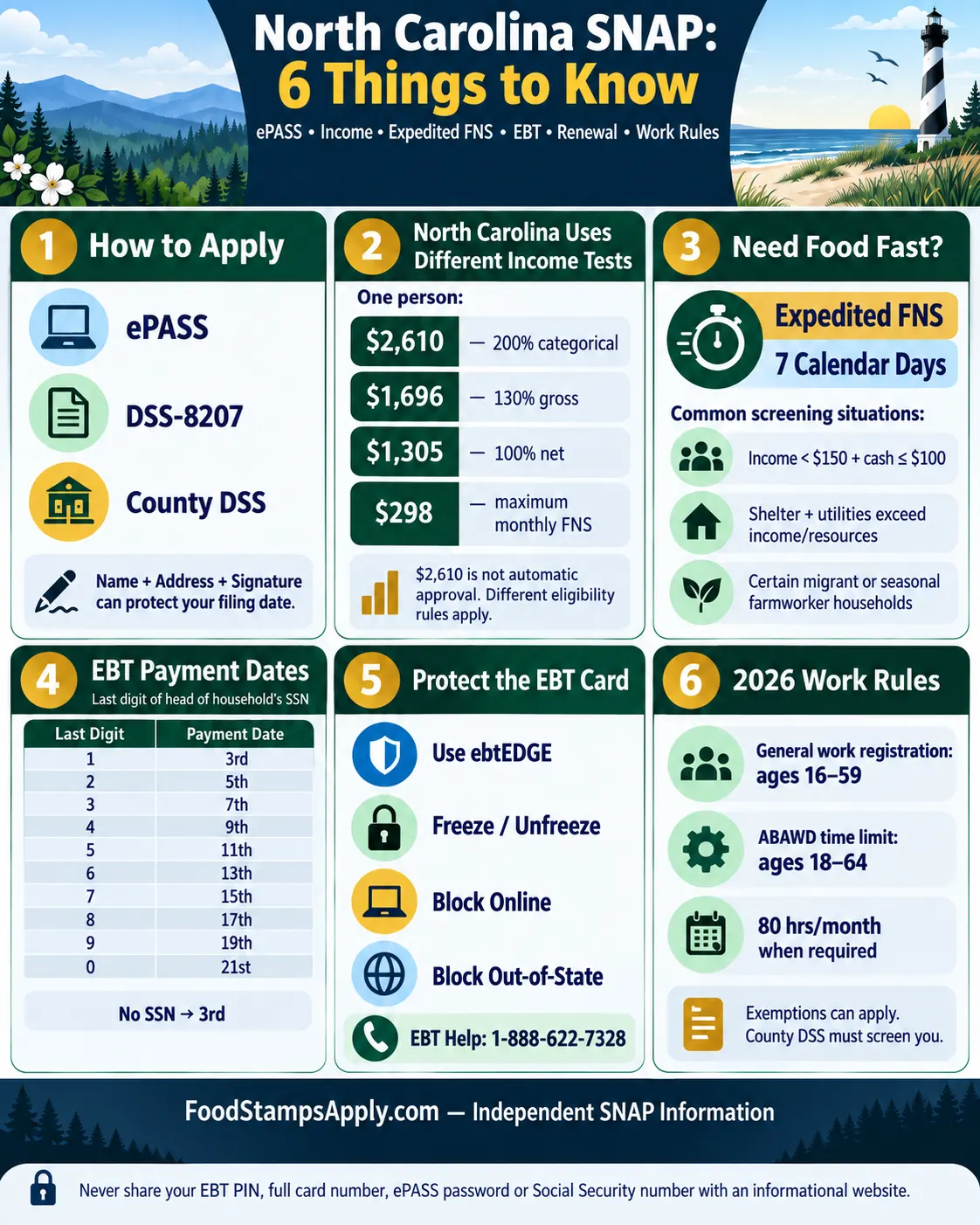
Apply for North Carolina Food and Nutrition Services through ePASS, submit DSS-8207, or contact your county DSS. Regular applications can take up to 30 days, while qualifying expedited households can receive FNS within 7 days. For one person, current FY2026 figures include a $2,610 expanded categorical-income level, $1,696 standard gross limit, $1,305 net limit, and $298 maximum monthly benefit.
Independent information: FoodStampsApply.com is an independent SNAP information website. We do not operate ePASS, access county DSS cases, issue North Carolina EBT cards or decide FNS eligibility. Never give an informational website your Social Security number, ePASS password, EBT PIN, or full card number.

North Carolina SNAP/FNS Income Limits for 2026
North Carolina’s current Food and Nutrition Services standards took effect October 1, 2025, and remain in effect through September 30, 2026.
| Household Size | 200% Categorical Gross | 130% Gross | 100% Net | Maximum FNS |
|---|---|---|---|---|
| 1 | $2,610 | $1,696 | $1,305 | $298 |
| 2 | $3,526 | $2,292 | $1,763 | $546 |
| 3 | $4,442 | $2,888 | $2,221 | $785 |
| 4 | $5,360 | $3,483 | $2,680 | $994 |
| 5 | $6,276 | $4,079 | $3,138 | $1,183 |
| 6 | $7,192 | $4,675 | $3,596 | $1,421 |
| 7 | $8,110 | $5,271 | $4,055 | $1,571 |
| 8 | $9,026 | $5,867 | $4,513 | $1,789 |
| Each additional person | +$918 | +$596 | +$459 | +$218 |
Eligible one- and two-person households have a current minimum monthly allotment of $24.
Why Does North Carolina Have a $2,610 and a $1,696 Income Limit?
Both numbers can be correct because North Carolina uses expanded categorical eligibility for many households.
For one person:
- $2,610 is the current 200% categorical gross-income level.
- $1,696 is the ordinary 130% gross-income standard.
- $1,305 is the 100% net-income standard.
Once a household qualifies as categorically eligible, North Carolina’s current policy says the normal resource, gross-income, and net-income tests do not apply.
Practical takeaway: if a one-person household earns more than $1,696 but less than $2,610, do not automatically assume FNS is unavailable. Let the county DSS determine whether expanded categorical eligibility applies.
Households containing an elderly or disabled person also have special income-testing rules. A noncategorical household with a qualifying elderly or disabled member is generally subject to the net-income test rather than both the ordinary gross and net tests.
A Separate 165% Rule Also Exists
North Carolina’s current policy also publishes a 165% FPL standard for a narrower household-composition rule involving certain elderly or disabled people who may qualify to be treated as a separate FNS unit.
For one person, the FY2026 165% amount is $2,152. This is not another general income cutoff for every applicant.
Does North Carolina FNS Have an Asset Limit?
Categorically eligible households do not have the normal FNS resource limit.
For noncategorically eligible households, current resource limits are generally:
- $3,000 for most households; or
- $4,500 when the FNS unit contains someone age 60 or older or a qualifying person with a disability.
Do not assume that owning a vehicle or having money in a bank account automatically makes you ineligible. The county must determine whether a resource test applies and which resources count.
Expenses Can Change the Benefit Amount
North Carolina’s benefit calculation can include deductions for qualifying household expenses.
Current FY2026 policy includes:
- a 20% earned-income deduction;
- a $209 standard deduction for households of one to three people;
- qualifying dependent-care expenses;
- eligible shelter and utility expenses; and
- a maximum excess-shelter deduction of $744 where the cap applies.
That is why gross income alone does not tell you the final FNS benefit amount.
North Carolina Has Another Program Also Called SNAP
There is one terminology trap worth knowing.
North Carolina’s regular federal SNAP program is called Food and Nutrition Services (FNS). But the state also operates a smaller program called the Simplified Nutritional Assistance Program (SNAP) for certain people age 65 or older who receive SSI.
That special one-person program is different from ordinary FNS.
How to Apply for North Carolina SNAP/FNS
North Carolina offers several application methods:
- online through ePASS;
- paper DSS-8207;
- in person through county DSS;
- by mail or fax; and
- telephone application in some counties.
Step 1: Apply Online Through ePASS
ePASS is North Carolina’s online public-benefits portal.
It helps to have information about:
- household members;
- birth dates and Social Security numbers for people applying;
- jobs and other income;
- rent or mortgage;
- utilities;
- child care;
- child support; and
- medical expenses for elderly or disabled household members.
NCDHHS specifically advises applicants not to delay filing merely because every verification document is not ready.
Step 2: Protect Your North Carolina FNS Filing Date
North Carolina’s DSS-8207 gives applicants an important filing-date protection.
If you cannot complete the entire application immediately, you can establish the application date with:
Name
Address
Signature
The county uses the date it receives that basic application as the FNS filing date. If you qualify for benefits in the application month, the filing date can affect the first month’s amount.
If groceries are already running short, file first. Do not lose several days waiting for one missing pay stub.
Step 3: Use DSS-8207 if You Prefer Paper
North Carolina’s regular Food and Nutrition Services application is:
DSS-8207 — Application for Food and Nutrition Services
The form can be mailed, faxed or taken to your county agency.
Keep your own copy. If you fax the application, save the fax confirmation.
Step 4: Find Your County DSS
Every North Carolina county has a local social-services agency.
Find Your North Carolina County DSS
Your county is usually the right contact for:
- interviews;
- a pending application;
- missing documents;
- recertification;
- income or household changes;
- work-rule questions;
- benefit notices; and
- fair hearings.
Step 5: Complete the FNS Interview
After DSS receives the application, a caseworker generally interviews you or an authorized representative.
North Carolina currently allows the interview to be completed:
- in person;
- by telephone; or
- by video conference.
Expect questions about:
- who lives with you;
- who buys and prepares food together;
- jobs and other income;
- resources when applicable;
- rent or mortgage;
- utilities;
- child care; and
- medical expenses when relevant.
Keep your phone number current. If several days pass and an expected interview does not happen, contact the county DSS rather than assuming the interview requirement disappeared.
Step 6: Send the Verification DSS Requests
You do not need to send every possible document before filing. Provide what DSS specifically requests.
Common verification can include:
- identification;
- pay stubs;
- employer information;
- other benefit income;
- rent or mortgage;
- child-care expenses; and
- medical expenses when applicable.
Keep proof of everything you send. Save upload screenshots, fax confirmations or copies of paperwork delivered to the DSS office.
Step 7: Check the Existing Application Before Applying Again
A normal North Carolina FNS application can take up to 30 days.
If it remains pending, contact the county handling the existing application and have these details ready:
- filing date;
- interview date;
- documents requested;
- dates the documents were submitted; and
- any application or case number shown in ePASS.
That gives the worker something specific to trace instead of creating a duplicate application.
Need Food Quickly? North Carolina Expedited FNS
North Carolina can issue qualifying Food and Nutrition Services within 7 calendar days.
DSS-8207 screens for an emergency when, for example:
- gross monthly income is less than $150 and cash or money in the bank is $100 or less;
- rent, mortgage and utilities are more than gross monthly income plus cash or money in the bank; or
- the household includes a qualifying migrant or seasonal farmworker and meets the applicable emergency conditions.
If you have very little money available and shelter bills are due, answer the expedited-screening questions completely when you apply.
North Carolina FNS Help Where You Live
Charlotte and Mecklenburg County
Mecklenburg County currently accepts FNS applications through ePASS, by telephone and at two Community Resource Centers:
- Ella B. Scarborough Community Resource Center: 430 Stitt Road, Charlotte, NC 28213
- Valerie C. Woodard Community Resource Center: 3205 Freedom Drive, Suite 1000, Charlotte, NC 28208
Phone: 704-336-3000
The former Catherine M. Wilson Center lobby at 301 Billingsley Road is closed to customers, so do not rely on an older listing that sends you there.
Raleigh and Wake County
Wake County residents can apply through ePASS and use the county DSS for interviews, verification and case-specific help. Because office locations and submission methods can change, check the current state DSS directory before traveling.
Greensboro and Guilford County
Phone: 336-641-3000
Fax: 844-837-5835
Documents can also be uploaded through Guilford County’s secure portal, mailed to P.O. Box 3388, Greensboro, NC 27402, or delivered to county offices in Greensboro or High Point.
Durham County
Durham County DSS
414 E. Main Street
Durham, NC 27701
Phone: 919-560-8000
Fax: 919-560-8501
Current listed hours: 7:30 a.m.–5:30 p.m.
Free FNS Application Help
The Food Bank of Central & Eastern North Carolina has a Benefits Outreach Team that helps households understand eligibility and complete FNS applications.
Phone: 1-800-358-8189
Text: 910-216-4096
Email: BenefitsOutreach@FoodBankCENC.org
The food bank can help with the application process, but county DSS makes the official eligibility decision.
Need Food While the Application Is Pending?
NC 211: dial 211
Toll-free: 1-888-892-1162
Free, confidential and available 24/7/365.
What Happens After North Carolina Approves FNS?
Approved Food and Nutrition Services benefits are loaded onto a North Carolina EBT card.
North Carolina EBT Card Help: 1-888-622-7328
Use this number for balance questions, lost or stolen cards, replacement cards and card-related problems.
North Carolina SNAP/FNS Payment Dates
Regular FNS benefits are issued based on the last digit of the head of household’s Social Security number.
Benefits are available after 6 a.m. on the scheduled day, including weekends and holidays.
| SSN Ends In | Deposit Date | SSN Ends In | Deposit Date |
|---|---|---|---|
| 1 | 3rd | 6 | 13th |
| 2 | 5th | 7 | 15th |
| 3 | 7th | 8 | 17th |
| 4 | 9th | 9 | 19th |
| 5 | 11th | 0 | 21st |
If the head of household does not have a Social Security number, benefits are available on the 3rd of the month.
Do not use the last digit of the EBT card number.
Protect Your North Carolina EBT Card With ebtEDGE
NCDHHS recommends the official ebtEDGE cardholder portal and mobile app.
Current protections include:
- freezing and unfreezing the card;
- blocking online transactions;
- blocking out-of-state transactions;
- checking the balance; and
- reviewing transactions.
A useful habit is to freeze the EBT card when you are not shopping and unfreeze it shortly before a purchase.
Use the official ebtEDGE system. NCDHHS warns that other benefits apps may not provide the card-freezing and transaction-blocking controls available through ebtEDGE.
What If FNS Benefits Are Stolen?
- Freeze the card through ebtEDGE.
- Call 1-888-622-7328 for a replacement card.
- Change the PIN.
- Block online or out-of-state transactions if you do not need them.
- Consider reporting the theft to law enforcement.
Current NCDHHS guidance says stolen FNS benefits cannot be replaced. That makes card security especially important.
How to Renew North Carolina FNS
FNS does not continue indefinitely without another eligibility review. Before the certification period ends, DSS sends a recertification notice.
North Carolina uses DSS-2435 — Food and Nutrition Services Notice of Expiration and Interview Recertification Form as part of the renewal process.
Can You Renew Through ePASS?
Yes, when the case is eligible for online renewal.
Current ePASS rules generally require:
- an active or suspended FNS case;
- the case to be due for renewal;
- no other recertification already in progress;
- an enhanced and linked ePASS account; and
- the current date to be on or after the first day of the certification-ending month.
If you receive FNS but not Medicaid, you may need your county DSS or caseworker to help enhance and link the ePASS account.
A recertification can also involve an interview and updated verification when required.
Do not wait until the EBT deposit stops. Check ePASS and your mail as the certification end date approaches.
North Carolina SNAP Work Requirements in 2026
North Carolina has two different SNAP work-rule systems. They should not be treated as the same rule.
1. General Work Registration — Ages 16–59
People ages 16 through 59 generally must register for work unless an exemption applies.
This can include requirements such as:
- registering for work;
- accepting suitable employment; and
- not voluntarily quitting or reducing qualifying work without good cause.
People can be exempt for reasons such as working enough hours, caregiving, physical or mental inability to work, participating in certain treatment programs or being a qualifying student.
2. ABAWD Time Limit — Ages 18–64
The expanded North Carolina ABAWD rules took effect December 1, 2025.
A person can be subject to the three-month time limit when all of these are true:
- age 18 through 64;
- no child under age 14 lives in the FNS household; and
- the person is physically and mentally able to work.
A nonexempt adult generally needs 80 hours per month—about 20 hours per week—of qualifying work, volunteering or approved activities.
Without meeting the requirement or qualifying for an exemption, FNS can generally be limited to 3 countable months in the current 36-month period.
Important age distinction: someone age 60–64 is exempt from general work registration, but can still be subject to the separate ABAWD 80-hour rule unless another exemption applies.
Who May Be Exempt From the ABAWD Time Limit?
Current NCDHHS guidance includes exemptions for circumstances such as:
- under age 18 or age 65+;
- living with a child under age 14;
- pregnancy;
- receiving qualifying disability benefits;
- being physically or mentally unfit for employment;
- certain caregiving situations;
- chronic homelessness when it creates a qualifying barrier to employment;
- domestic violence circumstances; and
- some adults age 55–64 with multiple employment barriers.
County DSS must screen applicants for exemptions at application and recertification. If proof is required, current NCDHHS guidance says you must generally receive at least 10 days to provide it.
If work hours for a person subject to the ABAWD rule fall below 80 in a month, report that change by the 10th of the following month.
For a broader explanation, see our SNAP work requirements guide.
North Carolina and Georgia Use Different SNAP Systems
Federal SNAP rules apply nationwide, but states use different application portals, EBT schedules, renewal systems and local case procedures.
If you are moving between the states or comparing procedures, see our latest Georgia SNAP guide. Georgia uses Georgia Gateway and a Client ID-based EBT schedule, while North Carolina uses ePASS and an SSN-based schedule.
What If ePASS Looks Wrong?
Start with the actual notices and case requests rather than relying only on a dashboard status.
A pending status does not tell you whether DSS is waiting on:
- an interview;
- verification;
- recertification paperwork; or
- a worker action.
If the issue concerns eligibility or case processing, contact the county DSS handling your case.
If you are trying to renew or report changes online, also check whether the ePASS account is enhanced and linked.
What If North Carolina Denies, Reduces or Stops FNS?
You have the right to request a fair hearing when you disagree with an FNS eligibility or benefit decision.
For most FNS actions, the hearing request must be made within 90 calendar days of the action or loss of benefits.
North Carolina’s hearing policy also generally requires the hearing and decision process to be completed within 60 calendar days from the state-level hearing request.
If benefits are being reduced or stopped before the certification period ends, requesting a hearing within the 10-day advance-notice period can allow benefits to continue at the prior level while the dispute is pending. Continued benefits can later have to be repaid if the final decision is not in your favor.
Continuation does not apply in the same way after the certification period expires or when the issue comes from recertification.
Keep:
- the decision notice;
- application confirmation;
- interview dates;
- verification copies; and
- upload or fax confirmations.
Legal Aid of North Carolina: 1-866-219-5262 for people who may qualify for free legal help.
North Carolina SNAP/FNS FAQs
Where do I apply for North Carolina SNAP?
Apply through ePASS, submit DSS-8207 to your county DSS or apply in person. Some counties also allow telephone applications and local upload or fax options.
What is SNAP called in North Carolina?
The regular federal SNAP program is called Food and Nutrition Services, or FNS. North Carolina also has a separate Simplified Nutritional Assistance Program called SNAP for certain people age 65 or older who receive SSI.
What is the North Carolina SNAP income limit for one person in 2026?
The standard 130% gross-income limit is $1,696 per month and the 100% net-income limit is $1,305. North Carolina also uses a $2,610 200% gross-income figure for expanded categorical eligibility.
How much can one person get in North Carolina FNS?
The FY2026 maximum is $298 per month through September 30, 2026. Eligible one- and two-person households have a current minimum allotment of $24.
Does North Carolina FNS have an asset limit?
Categorically eligible households are not subject to the normal FNS resource limit. For noncategorical households, the current limit is generally $3,000, or $4,500 when the household contains a person age 60 or older or a qualifying person with a disability.
Can I apply before I have all my documents?
Yes. DSS-8207 allows you to establish an application date with your name, address and signature. The county can request additional information afterward.
How long does North Carolina FNS take?
Regular applications can take up to 30 days. Households meeting expedited-service rules can receive FNS within seven calendar days.
What is the North Carolina EBT phone number?
Call 1-888-622-7328 for EBT balance information, lost or stolen cards and replacement-card help.
What day does North Carolina load SNAP?
Regular FNS benefits are available from the 3rd through the 21st based on the last digit of the head of household’s Social Security number. If the head of household does not have an SSN, benefits are available on the 3rd.
Can I renew North Carolina FNS online?
Yes, when the case is eligible for online recertification and the ePASS account is enhanced and linked to the case. You must also be within the allowed renewal period and not already have a recertification in progress.
Who is affected by North Carolina’s 2026 SNAP work rules?
General SNAP work registration generally covers ages 16–59. The separate ABAWD time limit can apply to adults ages 18–64 who are able to work and do not live with a child under age 14, unless another exemption applies.
Can I use a food pantry while my FNS application is pending?
Yes. Using a food pantry does not prevent you from applying for FNS. Dial 211 or 1-888-892-1162 to find local food assistance in North Carolina.
How long do I have to appeal a North Carolina FNS decision?
The normal FNS fair-hearing period is 90 calendar days. If current benefits are being reduced or stopped and you want them continued during the appeal, a much shorter advance-notice deadline can apply.
Sources & Verification
This article was reviewed against current North Carolina Department of Health and Human Services public guidance and Food and Nutrition Services policy.
- NCDHHS Food and Nutrition Services
- Apply for North Carolina FNS
- North Carolina ePASS
- DSS-8207
- North Carolina Local DSS Directory
- North Carolina EBT Information
- North Carolina SNAP Work Requirements
- Online FNS Recertification
For more about how FoodStampsApply.com verifies benefit information, see our source methodology.
Conclusion: File First, Then Follow Up With Your County DSS
If Food and Nutrition Services could help your household buy groceries, start through ePASS or DSS-8207 and protect the filing date. Do not unnecessarily wait until every document is ready.
After applying, complete the interview, send the exact verification DSS requests and keep proof of what you submitted.
Once approved, use the last digit of the head of household’s Social Security number to find the regular EBT payment date and use ebtEDGE security controls to help protect the benefit balance.
If the application stalls, follow up with the county handling the existing case before starting another application.