SNAP Work Requirements 2026: ABAWD Rules, 80-Hour Requirement & Exemptions
SNAP work requirements can be confusing because there are multiple work rules. Some adults are subject to the general SNAP work requirements, while a smaller group can also be subject to the separate ABAWD time limit. This generally requires 80 hours of qualifying work or activity per month to continue receiving SNAP beyond three countable months in 36 months.
The rules changed significantly in 2025, so older guidance may no longer fit your situation. Your age, work hours, caregiving responsibilities, health, pregnancy, location, and other circumstances can all affect which rule applies.
This guide separates the two federal work rules, explains the current 2026 ABAWD age and exemption changes, shows what can count toward the 80-hour requirement, and explains waivers, good cause, reporting and how someone may regain SNAP after using the time-limited months.
By FoodStampsApply.com Editorial
Last verified: August 24, 2026
Quick Answer
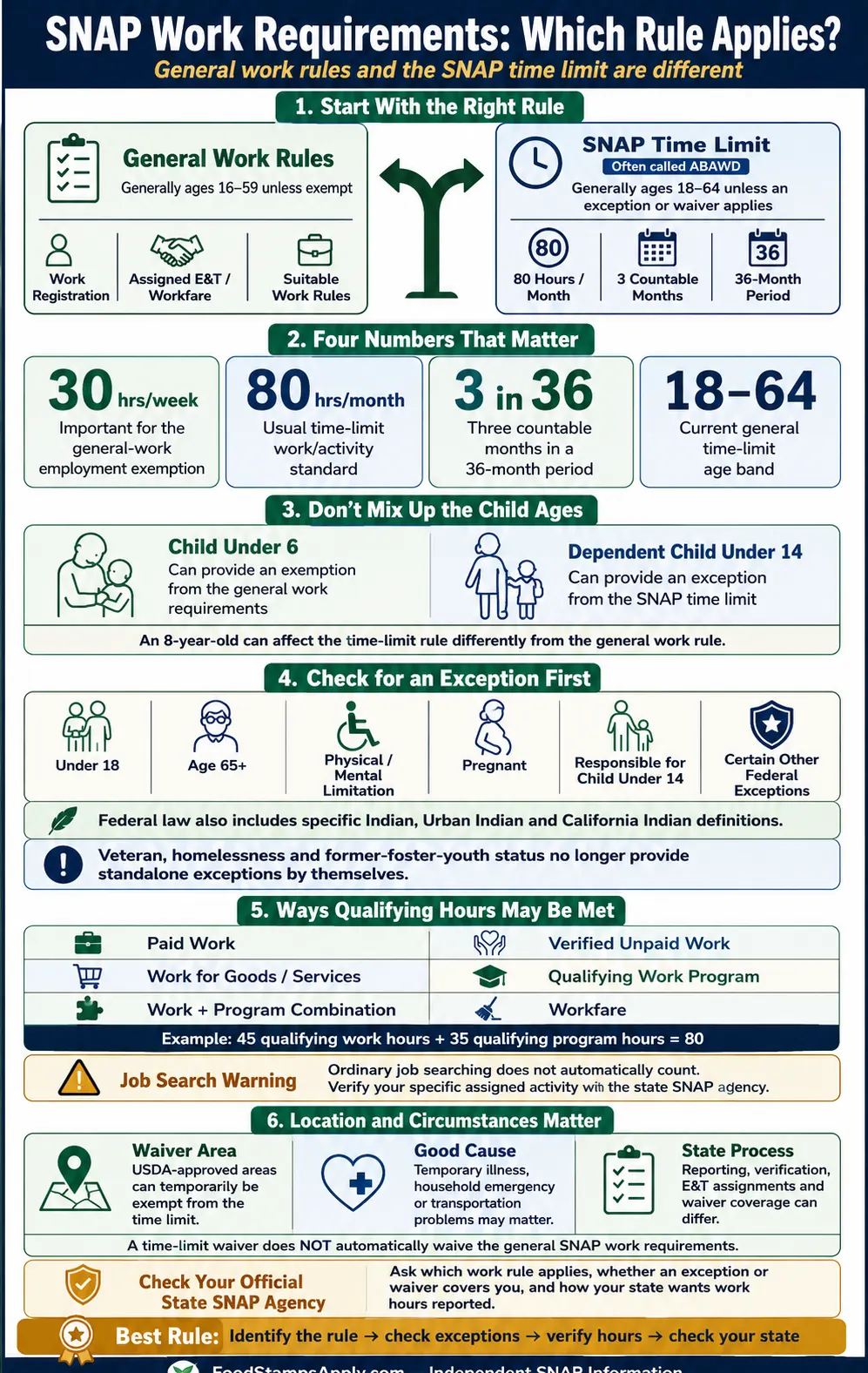
SNAP has two different federal work-rule systems. General work requirements usually apply to able-to-work adults ages 16–59 unless exempt. The separate ABAWD/time-limit rule can generally affect adults ages 18–64. Someone subject to that time limit generally needs 80 hours of qualifying work or activity per month to avoid using one of three countable SNAP months in 36 months, unless an exception, discretionary exemption or approved geographic waiver applies.
Independent information: FoodStampsApply.com SNAP resources explain SNAP rules and help readers locate official resources. We do not determine whether a person is exempt, assign SNAP Employment and Training activities, approve waivers or make individual eligibility decisions. Your state SNAP agency applies the rules to your case.
Current-source note: the One Big Beautiful Bill Act of 2025 changed the SNAP time-limit rules effective July 4, 2025. Some older USDA materials still reflect previous ABAWD ages and exceptions. For the changed rules in this guide, we used USDA Food and Nutrition Administration’s current 2025 law implementation resources, including its ABAWD exceptions implementation memorandum.

SNAP Has Two Different Work Requirements
The two rules overlap, but they are not interchangeable. Someone can be exempt from one rule and still need to check the other.
| SNAP Rule | Who It Can Affect | Main Requirement |
|---|---|---|
| General work requirements | Generally able-to-work adults ages 16–59, unless exempt | Register for work, comply with applicable E&T/workfare requirements, accept suitable work and avoid voluntarily quitting or reducing qualifying work without good cause |
| ABAWD/time limit | Generally adults ages 18–64, unless an exception, discretionary exemption or approved waiver applies | Meet the qualifying work/activity rule, generally 80 hours monthly, or risk using one of three countable months in the applicable 36-month period |
- Age 18–59: a person can potentially be subject to both sets of rules.
- Age 60–64: a person is normally outside the general work-registration age range but can still fall within the current ABAWD/time-limit age range.
- Age 65 or older: a person is outside the current ABAWD age range as well.
Work rules are only one part of SNAP eligibility. Income, household composition and other rules still matter. See our SNAP income limits guide for the separate financial screening rules.
What Changed for SNAP Work Requirements in 2026?
The major current changes came from the One Big Beautiful Bill Act of 2025. USDA FNA subsequently issued implementation materials for state agencies and additional 2026 time-limit guidance.
| Rule | Earlier Rule | Current Rule Used for 2026 |
|---|---|---|
| Upper ABAWD age | Generally through age 54 | Generally through age 64 |
| Child-related time-limit exception | Responsibility for a dependent child under 18 | Responsibility for a dependent child under 14 |
| Veterans | Temporary standalone exception existed | Standalone veteran exception removed; another current exception may still apply |
| People experiencing homelessness | Temporary standalone exception existed | Standalone homelessness exception removed; another current exception may still apply |
| Certain former foster youth | Temporary standalone exception existed | Standalone former-foster-youth exception removed; another current exception may still apply |
| Certain American Indian categories | No equivalent special ABAWD provision | New statutory exceptions for people meeting qualifying Indian, Urban Indian or California Indian definitions |
| Geographic waivers | Could also use the broader “lack of sufficient jobs” route | Generally requires an unemployment rate over 10%, with an additional statutory route for Alaska and Hawaii |
Do not rely on an old 18–54 chart. USDA FNA says the 2025 law changed who must follow the SNAP time limit as of July 4, 2025. Older guides may also still show the previous under-18 child rule or the former standalone veteran, homelessness and foster-youth exceptions.
General SNAP Work Requirements
The general SNAP work rules usually apply to physically and mentally fit adults over age 15 and under age 60 who do not meet an exemption. In practical age terms, that is generally ages 16 through 59.
What Do the General Work Rules Require?
An adult subject to the general work rules may have to:
- register for work when applying and again as required under SNAP’s work-registration rules;
- participate in SNAP Employment and Training (E&T) if assigned under the state’s program;
- participate in workfare if assigned;
- provide requested information about employment and availability for work;
- report to a suitable employer when appropriately referred;
- accept a bona fide offer of suitable employment;
- avoid voluntarily quitting qualifying employment without good cause; and
- avoid voluntarily reducing work effort below 30 hours per week without good cause when the federal voluntary-reduction rule applies.
The federal rules also protect participants from being required to accept employment that does not qualify as suitable employment.
For example, suitability rules can consider unreasonable health or safety risks, physical or mental inability to perform the work, transportation and commuting problems, and certain conflicts with religious observance.
The general work-registration provisions are found in the federal SNAP regulation at 7 CFR § 273.7.
Who Is Exempt From the General SNAP Work Requirements?
A person generally does not have to follow the federal general work requirements while one of the applicable exemptions is met.
| General Work Exemption | When It Can Apply |
|---|---|
| Age 60 or older | General SNAP work-registration requirements normally apply only through age 59 |
| Working enough already | Working at least 30 hours per week or receiving weekly earnings at least equal to the federal equivalent specified in the rule |
| Caring for a child under 6 | Responsible for a dependent child younger than 6 |
| Caring for an incapacitated person | Responsible for someone who requires care because of incapacity |
| Unable to work | A physical or mental condition makes the person unfit for employment under SNAP rules |
| Drug/alcohol treatment | Regular participation in a qualifying treatment or rehabilitation program |
| School or training | Enrollment at least half-time in a qualifying school, training program or institution, subject to the separate SNAP student rules where applicable |
| Other program work rules | Compliance with applicable TANF or unemployment-compensation work requirements can provide a federal work-registration exemption |
Important distinction: these are exemptions from the general SNAP work requirements. The separate ABAWD/time-limit rules use different age and child standards. Do not assume an exemption from one rule automatically answers every question about the other.
What Is the ABAWD SNAP Time Limit?
ABAWD stands for Able-Bodied Adult Without Dependents. USDA’s newer materials also commonly describe the provision simply as the SNAP time limit.
The federal rule limits SNAP participation for certain adults who do not meet a qualifying work or activity requirement and do not have an applicable exception, discretionary exemption or approved geographic waiver.
Basic Federal Time Limit
3 Countable Months in 36 Months
After three countable months are used, an affected person can become ineligible for SNAP unless the person begins meeting the requirement, regains eligibility, becomes covered by an exception, receives another allowable exemption or lives in an area covered by an approved waiver.
What Makes a Month Count?
A full SNAP benefit month can generally become a countable time-limit month when the person:
- is subject to the time limit;
- does not meet the required work/activity level;
- does not qualify for a current exception;
- is not covered by an approved geographic waiver; and
- has not received another applicable exemption for that month.
A month in which SNAP benefits are prorated because it is the initial application month is generally not treated as a countable month under the federal regulation.
The 36-Month Clock Can Differ by State
States can use a designated 36-month tracking period under federal rules, and implementation can differ. That is one reason a person should not assume their countable-month history is identical to a friend’s history in another state.
If you need to know how many countable months your agency has recorded, ask the state SNAP agency rather than estimating from an old calendar.
Who Is Excepted From the ABAWD Time Limit in 2026?
Under the current federal framework, the SNAP time limit does not apply while a person meets one of the applicable statutory exceptions.
Under Age 18 or Age 65 and Older
The current time-limit age band generally covers adults ages 18 through 64. A person younger than 18 or age 65 or older is outside that age band.
Unable to Work Because of a Physical or Mental Limitation
A person who is physically or mentally unfit for employment can be excepted from the time limit. Receiving Social Security disability benefits is not the only possible way for a state to establish that a person is not fit for work.
Depending on the circumstances and state procedure, federal rules allow work-fitness determinations to use information such as an obvious limitation, certain disability information or appropriate medical verification. Potential medical sources can include a:
- physician;
- physician assistant;
- nurse;
- nurse practitioner;
- psychologist;
- social worker; or
- other medical professional accepted under the state’s verification procedure.
Do not assume you must already have a federal disability award before asking the SNAP agency how it evaluates a physical or mental limitation.
Responsible for a Dependent Child Under 14
This is one of the most important current changes. Responsibility for a dependent child under age 14 can provide an exception from the time limit.
The previous under-18 threshold should not be used for the current 2026 screening rule.
Pregnant
Pregnancy remains a specific federal exception from the SNAP time limit.
Otherwise Exempt Under Applicable General Work Rules
The federal statute also connects the time-limit exceptions with certain exemptions from the general SNAP work requirements.
Depending on the specific exemption, relevant circumstances can include:
- qualifying caregiving;
- half-time school or training;
- qualifying drug or alcohol treatment participation;
- certain TANF or unemployment work-rule circumstances; and
- sufficient ongoing employment.
The exact result depends on which federal exemption applies and how the state verifies it.
Qualifying Indian, Urban Indian or California Indian Definition
The 2025 law added time-limit exceptions for people who meet specific statutory definitions of:
- Indian;
- Urban Indian; or
- California Indian.
These are legal definitions referenced in federal law, so a state agency should determine whether a person’s circumstances meet the applicable definition rather than relying on a generic label alone.
Veterans Are No Longer Automatically Excepted Solely Because They Are Veterans
Veteran status by itself no longer provides the standalone time-limit exception that existed under the temporary 2023 changes.
The 2025 law also removed the temporary standalone exceptions that had specifically covered:
- people experiencing homelessness; and
- certain former foster youth.
A person in one of these groups may still avoid the time limit if another current exception applies—for example, a qualifying physical or mental limitation, pregnancy, caregiving situation or applicable geographic waiver.
The Under-6 and Under-14 Child Rules Are Different
Two child-age numbers now appear prominently in SNAP work rules, but they do different jobs.
| Child Age | Which Rule It Affects |
|---|---|
| Dependent child under 6 | Responsibility for the child can provide an exemption from the general SNAP work requirements |
| Dependent child under 14 | Responsibility for the child can provide an exception from the ABAWD/time-limit rule |
For example, someone responsible for an 8-year-old may be excepted from the ABAWD time limit under the under-14 rule but would not qualify for the separate general-work exemption solely because that child is under 6.
Age 60–64 Is Another Important Difference
The two work rules also use different age limits.
- A person who is 62 is normally outside the general work-registration age range because that federal age-based rule stops at age 60.
- The same 62-year-old can still fall within the current 18–64 SNAP time-limit range if no other exception applies.
- At age 65, the person is outside the current time-limit age band as well.
This is why simply hearing that “people over 60 are exempt from SNAP work requirements” can now be misleading without identifying which work rule is being discussed.
How to Meet the 80-Hour ABAWD Work Requirement
For most people who are subject to the SNAP time limit and are meeting it through work or another qualifying activity, the standard is:
20 Hours Per Week Averaged Monthly
≈ 80 Hours Per Month
Federal rules allow more than one type of qualifying activity. Paid payroll employment is not the only possible route.
| Activity | Can It Count? |
|---|---|
| Paid employment | Yes |
| Qualifying self-employment/work for money | Can count when it meets applicable work and verification rules |
| Work in exchange for goods or services | Can count as work under the federal definition |
| Verified unpaid/volunteer work | Can count when properly verified |
| Qualifying work-program component | Yes when it is a federally qualifying activity |
| Combination of work + qualifying program | Yes when the combined qualifying hours satisfy the requirement |
| Workfare | Yes; assigned hours are calculated under separate workfare rules |
Paid Work Is Not the Only Option
Federal rules recognize work for money, work in exchange for goods or services, and verified unpaid work. A person therefore does not necessarily need 80 hours of conventional payroll employment if another qualifying activity is allowed and properly documented.
Work and Qualifying Program Hours Can Be Combined
Example
45 qualifying work hours + 35 qualifying program hours = 80 hours
That combination can satisfy the monthly standard when both activities count under the applicable federal and state program rules.
SNAP Employment and Training programs can include employment preparation, training and work-experience components. Learn more from USDA FNA’s current SNAP Employment and Training resource.
Workfare Uses a Different Hours Calculation
A person assigned to workfare does not necessarily have an 80-hour workfare assignment every month.
Federal workfare rules generally determine the required household hours by dividing the household’s SNAP allotment by the applicable minimum wage used under the rule.
That calculation can produce a workfare obligation below 80 hours.
Does Job Search Count Toward the 80 Hours?
Do not assume that ordinary job searching counts. Hours spent independently applying for jobs generally do not become qualifying ABAWD work hours merely because a person is actively looking for employment.
There is also an important distinction inside employment programs. Standalone job search in SNAP E&T is not automatically a qualifying time-limit activity. Job-search activity can be treated differently when it is a permissible subsidiary part of another qualifying component or when it occurs through another federally recognized work program that qualifies under the ABAWD rule.
If your plan relies on job-search or job-search-training hours, ask the state SNAP or E&T program whether the specific assigned component counts toward your time-limit requirement instead of calculating the hours yourself.
What Happens If Work Falls Below 80 Hours?
A month below 80 qualifying hours is important for someone subject to the time limit, but it does not automatically become a countable month in every situation.
Federal rules recognize good cause for temporary circumstances outside the person’s control.
Examples of Good Cause
Federal examples include circumstances such as:
- personal illness;
- illness of another household member that requires the person’s presence;
- a household emergency; or
- unavailable transportation.
If a person normally would have fulfilled the requirement but temporarily missed hours because of an accepted good-cause circumstance, the state agency can determine that the work requirement was met for that period.
Good Cause Is Different From an Exemption
An exception or exemption generally means the time-limit rule does not apply while the qualifying circumstance exists.
Good cause instead addresses a temporary failure to complete the required activity while the person otherwise remains subject to the rule.
For example, someone may normally be subject to the 80-hour requirement but temporarily miss work because of an illness. The state agency determines good cause and may request verification depending on the situation.
Reporting a Drop in Work Hours
A person who is subject to the federal time limit has a specific reporting responsibility when work hours fall below 20 hours per week averaged monthly.
Federal reporting rules make this change reportable even for households that otherwise use simplified or periodic reporting systems.
When Is the Change Due?
The exact reporting deadline and trigger depend on the household’s reporting system and state procedure. Federal rules use 10-day timeframes for many reportable changes, but the starting point can differ based on the type of reporting system and the event being reported.
Follow the deadline and reporting method on your state notice rather than assuming one national portal or deadline applies everywhere.
The federal change-reporting rule is available at 7 CFR § 273.12.
Work Hours May Need Verification
Work or activity used to meet the time limit may need to be documented. Depending on how the requirement is being met, the agency may verify employment, program participation, workfare or another qualifying activity.
Keep records such as pay information, employer verification, program attendance or another document your state says it can use. Our SNAP application documents guide also explains why it helps to keep copies of material submitted to the agency.
What Are ABAWD or SNAP Time-Limit Waivers?
A geographic waiver temporarily removes the SNAP time limit for qualifying people living in a USDA-approved area.
A time-limit waiver does not automatically remove the general SNAP work requirements. Someone living in a waived area can still need to check whether the separate general work-registration rules apply.
Current Waiver Standard
The 2025 law narrowed the ordinary geographic-waiver criteria.
For most states, USDA FNA says an area generally must have an unemployment rate over 10% to qualify for a time-limit waiver. The previous waiver route based generally on a lack of sufficient jobs was removed.
Special Waiver Route for Alaska and Hawaii
Federal law provides an additional route for Alaska and Hawaii. USDA FNA states that those states can also request a waiver for an area where unemployment is 1.5 times the national average, subject to the applicable federal rules.
Federal law also contains temporary authority connected with good-faith implementation in Alaska and Hawaii, with that special authority limited by statute and scheduled to expire no later than December 31, 2028.
Waivers Can Cover Only Part of a State
A waiver does not necessarily mean an entire state is exempt from the time limit.
Depending on what USDA approves, a waiver may cover:
- a county;
- a group of counties;
- another approved geographic area; or
- a broader area that meets the federal standard.
This is why old internet lists claiming that an entire state has “no SNAP work requirement” can be misleading.
Check USDA FNA’s current FY 2025–2029 SNAP time-limit waiver page for current federal waiver materials and state responses.
States Also Receive Limited Discretionary Exemptions
Geographic waivers are not the only flexibility available to state SNAP agencies.
Federal law also gives states a limited allocation of discretionary time-limit exemptions. For FY 2026, USDA FNA continues to use the current statutory 8% allocation framework.
Each discretionary exemption generally extends eligibility for one individual for one month. These exemptions are limited and assigned at the state’s discretion; they are not automatically given to every person who is about to use a third countable month.
USDA FNA maintains the current allocation information in its SNAP Work Requirement Policy Resources.
What Happens If You Don’t Meet the Work Requirements?
Two different consequences can occur because the general work-rule sanction system and the ABAWD/time-limit system are not the same.
General Work-Requirement Violation
A person who fails an applicable general SNAP work requirement without good cause can be disqualified.
Federal law establishes minimum disqualification periods that become longer with repeated violations:
- First violation: at least 1 month;
- Second violation: at least 3 months; and
- Third or later violation: at least 6 months.
States have options within federal law regarding longer sanction periods, and federal law permits a state to make a third or subsequent disqualification permanent in some circumstances.
ABAWD Time-Limit Ineligibility
The time-limit rule works differently.
After three countable months in the applicable 36-month period, a person who remains subject to the time limit and does not meet the requirement can become ineligible for SNAP.
That is a time-limit consequence, not the same thing as a sanction for violating the general work-registration rules.
Does One Person Losing ABAWD Eligibility End SNAP for the Whole Household?
Not automatically. When one household member becomes ineligible under the time limit, the state recalculates the SNAP household under the federal rules that apply to an ineligible household member.
The remaining eligible household members may continue receiving SNAP if the household remains eligible. Income treatment can change when a member becomes ineligible, so the new household allotment should come from the state agency’s calculation rather than a simple subtraction of one person’s share.
How Can Someone Regain SNAP After the ABAWD Time Limit?
Federal rules allow a person who lost eligibility under the time limit to regain eligibility after meeting a qualifying requirement during a 30-day period.
Depending on the route, that can generally involve:
- working 80 or more qualifying hours during the relevant 30-day period;
- participating in a qualifying work program for the required hours;
- using a combination of qualifying work and program hours;
- meeting the applicable workfare requirement; or
- becoming covered by a current exception.
Federal rules also contain a limited additional three-month eligibility provision for certain people who regain eligibility through work or qualifying activity and later stop meeting the requirement. That additional period is subject to specific conditions and is generally available only once during the relevant 36-month period.
Because the state maintains the countable-month history and applies its chosen tracking system, ask your SNAP agency what it has recorded instead of trying to reconstruct your eligibility solely from past EBT deposits.
If you recently applied and the portal is still unclear about whether a work-rule task, interview or verification is holding the case, see our latest guide on how to check your SNAP application status.
College Students Have Separate SNAP Rules
Work requirements are only one part of SNAP eligibility for college students.
Someone enrolled at least half-time in qualifying school or training may be exempt from the general SNAP work-registration rule. However, a student enrolled at least half-time in an institution of higher education can also be subject to separate federal student eligibility restrictions.
An exemption from general work registration does not automatically mean a college student qualifies for SNAP. Student eligibility can separately involve work hours, work-study, caregiving, disability and other federal exceptions.
What Actually Varies by State?
Federal law sets the overall framework, but important administrative details are handled by state SNAP agencies.
Mandatory or Voluntary SNAP E&T
State SNAP E&T programs differ in who must participate, which participants can volunteer, and which training, education or work components are available.
ABAWD Waiver Areas
One county or geographic area may be covered by an approved time-limit waiver while another part of the same state is not.
36-Month Tracking
States administer their designated 36-month time-limit periods under the federal framework. Your agency can tell you which months it has recorded as countable.
Reporting Method
Work hours or changes may be reported through a benefits portal, change form, phone system, local office or another state-approved route.
Verification
States establish procedures for documenting employment, volunteer activity, work-program participation, exceptions and physical or mental fitness.
General Work Sanctions
Federal minimums apply, but states have options regarding the duration of certain general-work disqualification periods.
Discretionary Time-Limit Exemptions
A state decides how to use its limited federal discretionary exemption allocation within applicable federal rules.
Find the Rules for Your State
Use our SNAP information by state section for state-specific SNAP resources that have been published on FoodStampsApply.com.
You can also use USDA FNA’s official SNAP State Directory to locate the agency responsible for administering SNAP where you live.
Not sure which rule applies to you?
Start with the state SNAP agency and ask whether you are subject to the general work rules, the SNAP time limit, both, or neither—and whether an exception or waiver applies to your case.
Frequently Asked Questions About SNAP Work Requirements
Does everyone on SNAP have to work 20 hours a week?
No. The 20-hours-per-week averaged monthly or 80-hours-per-month standard is mainly associated with adults who are subject to the SNAP time limit and do not have an applicable exception, discretionary exemption or waiver. The separate general SNAP work requirements do not impose the same universal 80-hour rule on everyone.
What is the ABAWD age limit in 2026?
The current SNAP time limit can generally apply to adults ages 18 through 64 unless another exception, allowable exemption or approved geographic waiver applies. This is different from older guidance showing an upper age of 54.
How many hours do you have to work for SNAP?
Someone subject to the ABAWD/time-limit rule generally needs 80 hours of qualifying work or activity per month, which is equivalent to 20 hours per week averaged monthly. General SNAP work requirements are a different set of rules and do not impose the same 80-hour standard on every participant.
Are parents exempt from SNAP work requirements?
It depends on which rule is being considered. Responsibility for a dependent child under 6 can provide an exemption from the general work requirements. Responsibility for a dependent child under 14 can provide an exception from the current SNAP time limit.
Are veterans automatically exempt from the ABAWD rule in 2026?
No, not solely because of veteran status. The specific standalone veteran exception created in 2023 was removed by the 2025 law. A veteran may still be excepted from the time limit for another reason, such as a qualifying physical or mental limitation, pregnancy, caregiving or an applicable waiver.
Does volunteer work count toward the 80 hours?
Verified unpaid work can count under the federal definition of work when it satisfies the applicable rules and is documented as required by the state SNAP agency. Ask the agency how it wants the hours verified.
Does job searching count toward the 80-hour requirement?
Do not assume it does. Ordinary independent job searching does not automatically count, and standalone SNAP E&T job search is not automatically a qualifying ABAWD activity. Job-search activity can be treated differently as part of certain qualifying program arrangements, so verify the specific assigned component with your state agency.
What happens if I work less than 80 hours one month?
The month may become countable if you are subject to the time limit and no exception, waiver or other exemption applies. However, a temporary circumstance outside your control may qualify as good cause. A drop below 20 hours per week averaged monthly is also a reportable change for someone subject to the time limit.
Does an ABAWD waiver remove every SNAP work requirement?
No. A geographic time-limit waiver removes the ABAWD/time-limit restriction for covered people in the approved area. USDA FNA specifically notes that it does not automatically waive the separate general SNAP work requirements.
Can I get SNAP again after using my three time-limited months?
Potentially, yes. Federal rules allow a person who lost eligibility under the time limit to regain eligibility by meeting a qualifying work or activity requirement during a 30-day period or by becoming covered by an applicable exception. Ask the state agency how its records show your remaining countable months.
Are people ages 60–64 exempt from SNAP work rules?
They are normally outside the age range for the general SNAP work-registration requirement, but they can still fall within the separate SNAP time-limit age range through age 64 unless another exception or waiver applies.
Sources & Verification
Important current federal sources used to verify this guide include:
- USDA FNA One Big Beautiful Bill Act implementation resources, including current Section 10102 SNAP work-requirement guidance.
- USDA FNA ABAWD Exceptions Implementation Memorandum for the current age and exception changes.
- USDA FNA ABAWD Waivers Implementation Memorandum for the changed waiver criteria.
- USDA FNA Time Limit Waivers FY 2025–2029 for current state requests, approvals and waiver materials.
- USDA FNA SNAP Work Requirement Policy Resources for implementation guidance and discretionary exemptions.
- USDA FNA SNAP Employment and Training.
- 7 CFR § 273.7 for general work requirements, exemptions, suitable employment and E&T/workfare provisions.
- 7 CFR § 273.24 for time-limit mechanics, qualifying activities, countable months, good cause and regaining eligibility. Current statutory and USDA implementation changes control where older regulatory exception language has not yet been updated.
- 7 CFR § 273.12 for applicable change-reporting rules.
For information about how FoodStampsApply.com selects and verifies public-benefit sources, see our source methodology.
Conclusion: Remember Which SNAP Work Rule You Are Checking
The biggest mistake is treating every SNAP work rule as the same 20-hour-a-week requirement. They are not.
The general SNAP work requirements usually affect able-to-work adults ages 16–59 and cover work registration, applicable E&T or workfare assignments, suitable employment, and rules about voluntarily quitting or reducing work.
The separate ABAWD/time-limit rule can generally affect adults ages 18–64. Someone subject to that rule can receive only three countable months in a 36-month period without meeting the qualifying work/activity requirement, unless an exception, discretionary exemption or approved waiver applies.
Four numbers worth remembering
30 hours/week: important to the general-work employment exemption and voluntary reduction rule.
80 hours/month: the usual ABAWD/time-limit work or qualifying activity standard.
3 months in 36 months: the federal time limit when requirements are not met.
Ages 18–64: the current general age band for the SNAP time limit.
Also remember that the child rules are different: under 6 matters for one general-work exemption, while responsibility for a dependent child under 14 can matter for the time-limit exception.
Before assuming you are required to work 80 hours—or assuming you are exempt—check the current rule, your circumstances and your location with the state SNAP agency responsible for your case.