Documents Needed for SNAP Application 2026: Complete Checklist
Applying for SNAP should not turn into a search for every document you have ever owned.
Most households need to verify a few basic things: who is applying, where the household lives, how much income comes in, and any expenses that could affect the SNAP eligibility or benefit calculation.
The exact proof depends on your circumstances and the requirements used by your state SNAP agency.
Just as important, you generally do not need every supporting document in hand before starting the application. Federal SNAP rules require states to provide a way to begin filing with the applicant’s name, address, and signature. Additional verification can be completed during the application process.
Use this guide as a practical document-preparation list. It explains what is commonly requested, when particular proof matters, how current the information should be, and what you can do if a normal document is lost, expired, or unavailable.
By FoodStampsApply.com Editorial
Last verified: August 19, 2026
Quick Answer
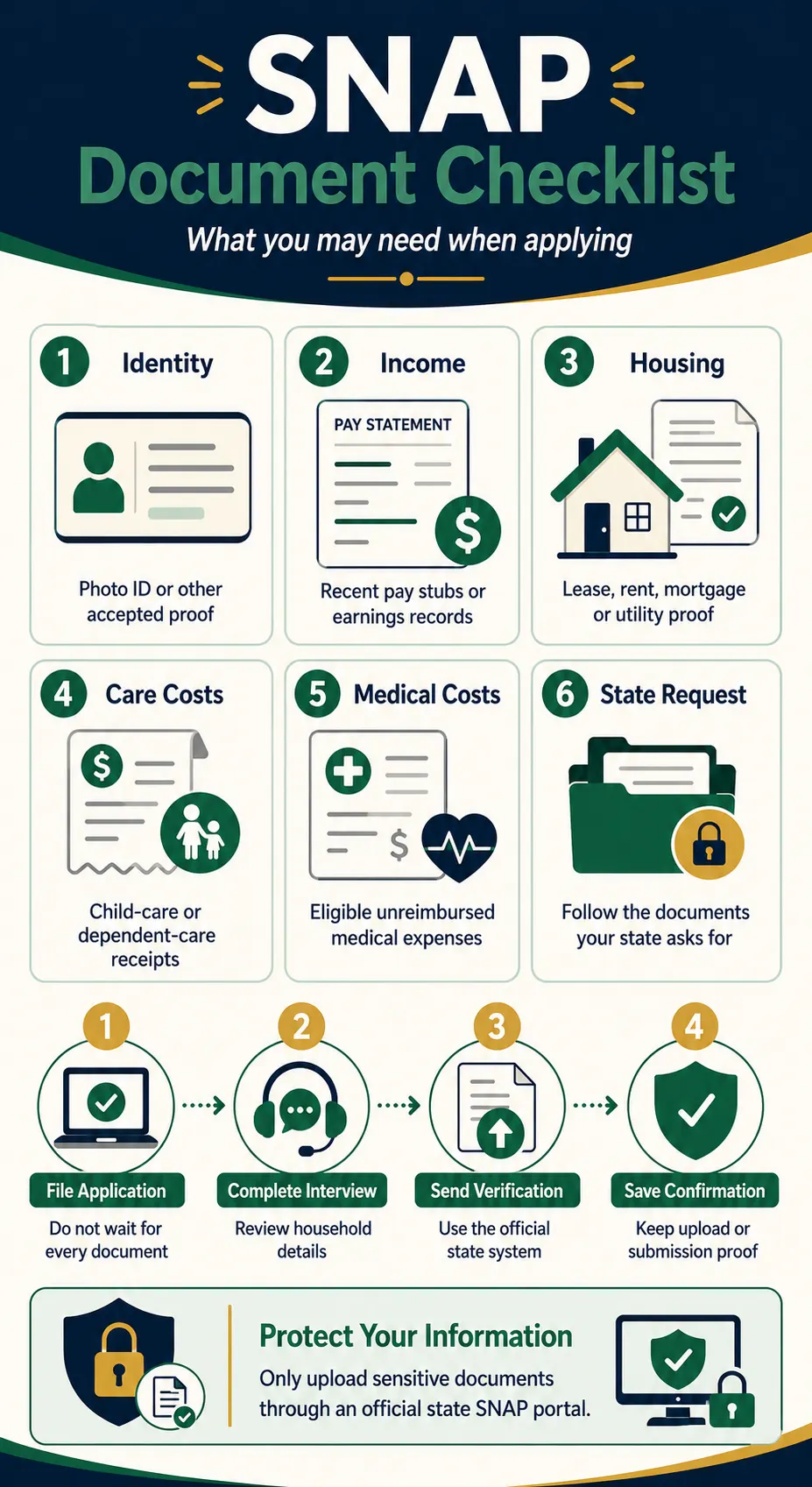
Common SNAP verification can include proof of identity, current income, address or residency, housing costs, dependent-care costs, and qualifying medical expenses. Self-employed applicants may need business income and expense records. Non-citizens applying for benefits may need applicable immigration documentation. You generally can start a SNAP application before every document is ready, then provide the specific verification requested by your state.
Protect your information: FoodStampsApply.com SNAP resources are independently published informational content. We do not process SNAP applications. Do not send FoodStampsApply.com your Social Security number, government-benefit login, bank credentials, immigration documents, EBT card number, or confidential case records. Submit requested verification only through your responsible state or local agency’s official process.
Quick SNAP Document Checklist
You may not need every document below. Think of this as a preparation checklist rather than a universal list that every household must submit.
| What May Need Verification | Common Examples of Proof |
|---|---|
| Identity | Driver’s license, state ID, work or school ID, benefits-program ID, voter registration card, birth certificate, or another form of reasonable identity verification |
| Address / residency | Lease, rent receipt, utility bill, mortgage record, current mail, landlord verification, or other reasonable residency evidence |
| Employment income | Recent pay stubs, payroll records, employer statement, earnings record |
| Self-employment | Business ledger, invoices, sales records, payment-processor records, current income and expense records |
| Unearned income | Current Social Security, SSI, unemployment, pension, veterans benefit, or other applicable benefit information |
| Housing and utilities | Lease, rent receipt, mortgage statement, utility records, or other current housing-cost proof |
| Dependent care | Child-care or dependent-care bill, receipt, payment history, or provider statement |
| Medical expenses | Qualifying unreimbursed bills, receipts, insurance premiums, prescription records, or other allowable expenses for eligible elderly or disabled household members |
| Immigration status | Applicable current immigration documentation for non-citizens who are applying for SNAP |
Your state’s verification request is the best guide to what your household actually needs to provide. Federal SNAP regulations also allow verification methods other than one specific document in a number of circumstances.
Can You Apply for SNAP Before Every Document Is Ready?
Yes, you generally can start the application before gathering every piece of verification.
Federal SNAP rules require states to provide a way for a household to immediately begin the application process with:
- the applicant’s name;
- the applicant’s address; and
- a signature from a responsible household member or authorized representative.
The application, interview and verification process still must be completed before regular eligibility is determined, but waiting to collect every possible document before filing can unnecessarily delay the application date.
Missing paperwork does not always mean you should postpone filing.
If a pay stub, lease, ID replacement, or another document is not immediately available, start the official application process and follow your agency’s instructions for completing verification afterward.
Why the Application Date Matters
If the household is ultimately found eligible, the application date can affect when SNAP benefits begin. USDA FNA explains that eligible households generally receive benefits based on the date the application was submitted.
For official application information, use the USDA FNA applicant and participant state selector or your responsible state SNAP agency.
Identity, Address and Household Documents
1. Proof of Identity
SNAP must verify the identity of the person making the application. If an authorized representative applies for the household, additional identity verification applies to that arrangement.
Examples of documents that may reasonably establish identity include:
- driver’s license;
- state-issued identification;
- work or school ID;
- an ID issued for another health, assistance, or social-services program;
- voter registration card;
- wage or earnings records that reasonably establish identity;
- birth certificate; or
- another reasonable identity record accepted by the state.
SNAP does not impose one universal rule requiring every applicant to produce a driver’s license or birth certificate. Federal regulations say reasonable identity evidence must be accepted and prohibit imposing a birth certificate as the one required identity document.
Does your ID have to be unexpired?
A current government-issued ID is often convenient, but an expired ID does not automatically mean you should delay filing. Ask what alternative proof your state can accept if your usual ID is expired or being replaced.
Lost your state ID?
You can request replacement identification through the state motor-vehicle or licensing agency. In the meantime, ask the SNAP agency whether another reasonable form of identity verification can be used.
Lost your birth certificate?
If a certified birth record is actually needed, request another copy from the appropriate state or territorial vital-records office. A document’s age alone does not necessarily make it unusable, although an agency may require an appropriate certified copy.
2. Proof of Address and Household
Your state may need to verify where you currently live and information about who belongs in the SNAP household.
Common residency evidence can include:
- lease;
- rent receipt;
- utility bill;
- mortgage record;
- ID showing a current address;
- current mail or other documentation; or
- a collateral contact or another reasonable method when normal records are unavailable.
No lease?
That does not necessarily prevent residency or housing costs from being verified. Ask whether a landlord statement, rent receipt, or another record connecting you to the address can be used.
Recently moved?
Use information that reflects where you live now. An old utility bill from a previous address may not reasonably establish current residency or current housing costs.
Homeless or without a permanent address?
Federal rules specifically recognize situations where traditional residency verification cannot reasonably be completed, including some homeless households. A traditional lease or utility bill should not be treated as the only possible method of establishing residency.
For household composition, the state may ask about:
- names;
- relationships;
- who lives in the home;
- who is applying for SNAP; and
- who normally purchases and prepares food together.
Do not assume that every household member needs the same document or that a birth certificate is universally required for every person in the home.
Income and Self-Employment Documents
3. Proof of Employment Income
Income is one of the most important parts of SNAP verification because the agency needs a reasonable picture of current or anticipated household income.
Common proof can include:
- recent pay stubs;
- payroll records;
- earnings statements;
- employer verification; or
- another reliable current income record.
How many pay stubs do you need?
There is no single national rule requiring every SNAP applicant to submit exactly two or four pay stubs.
As a practical preparation approach, have roughly the most recent month of earnings available unless your agency asks for a different period.
| State Example | Current Official Example |
|---|---|
| California CalFresh | State application materials reference earned income for the past 30 days, such as recent pay stubs or an employer statement. |
| New York SNAP | The current state checklist gives paycheck stubs for the last four consecutive weeks as an example of monthly-income proof. |
These examples show why you should follow the exact verification period requested by your state or local agency.
What if your hours recently changed?
Tell the SNAP agency if older pay records no longer represent your current or expected income.
This can matter if:
- your work hours were reduced;
- you started or stopped receiving overtime;
- you changed jobs;
- you recently stopped working; or
- your schedule varies significantly.
Federal verification rules recognize that outdated pay stubs may fail to provide an accurate picture of household income.
Lost your pay stubs?
Possible alternatives include:
- employer payroll portal;
- payroll app;
- HR or payroll department;
- current employer earnings statement; or
- direct employer verification when permitted by the state.
Federal rules require states to assist cooperating households in obtaining needed verification when appropriate.
What if your job ended?
Use information showing that the income stopped, such as:
- final pay stub;
- termination or separation notice;
- HR or employer statement; or
- another reliable record showing the final work date or final earnings.
If the employer closed or will not respond, explain that to the SNAP agency and ask what alternative verification can be used.
4. Self-Employment Income
Self-employed applicants often do not have traditional pay stubs, so records showing both current business income and applicable business expenses can be important.
Useful records may include:
- business ledger;
- invoices;
- sales records;
- payment-processor reports;
- business expense records;
- banking or accounting records where applicable; and
- recent tax records.
Do not rely only on last year’s tax return
A prior tax return may be useful, but it may not accurately describe current self-employment income when the business has changed. Be prepared to provide more recent business activity if your state requests it.
Social Security, SSI and Other Benefit Documents
5. Social Security, SSI and Other Unearned Income
State agencies may be able to verify some Social Security and Supplemental Security Income information electronically. Federal SNAP regulations specifically allow state data exchanges to be used for this purpose.
If you are asked to provide your own proof, use current documentation showing the applicable benefit amount.
Lost your Social Security benefit letter?
The Social Security Administration lets beneficiaries obtain a current benefit verification letter through a personal my Social Security account.
Use the official SSA benefit verification letter service rather than an unofficial document service.
6. Do You Need the Physical Social Security Card?
SNAP rules require people applying for benefits to provide a Social Security number or follow the applicable process for obtaining one. The federal SNAP requirement is centered on the SSN itself and its verification, not a universal requirement that every applicant hand over the physical Social Security card.
If you know your Social Security number but no longer have the card, follow your state’s verification instructions rather than automatically delaying your SNAP application.
Need a replacement Social Security card?
SSA states that replacement Social Security cards are free and also notes that people who know their Social Security number may not always need a physical replacement card.
Use the official SSA replacement Social Security card service.
Housing, Child-Care and Medical Expense Documents
7. Rent, Mortgage and Utility Documents
Housing expenses can matter because qualifying shelter and utility costs may affect the SNAP net-income and benefit calculation.
Rent
Common proof can include:
- lease;
- rent receipt;
- landlord statement; or
- another current record of the housing cost.
If the lease is missing, ask the landlord or property manager for another copy or ask the state whether another form of housing-cost verification can be accepted.
Mortgage
Common proof can include:
- current mortgage statement;
- payment record; or
- other current housing-cost documentation.
Duplicate statements may be available through the lender’s official online account.
Utilities
When actual utility verification is relevant, records may include current:
- electric bill;
- heating or cooling bill;
- water bill; or
- other qualifying utility documentation.
Some states use standard utility allowances rather than relying solely on every household’s exact utility expenditure. Follow the calculation method and documentation request used by your state.
8. Child-Care or Dependent-Care Costs
Qualifying dependent-care expenses may affect SNAP net income when the care is necessary for applicable work, training, or education purposes.
Useful proof can include:
- current bill;
- receipt;
- payment history; or
- provider statement.
Lost the child-care receipts?
Ask the provider for a current statement showing information such as:
- the current charge;
- how frequently it is paid; and
- who receives the care.
Current information is generally more useful than an old receipt if the cost has changed.
9. Medical Expenses
Medical-expense documentation is particularly relevant for households with a member who meets SNAP’s elderly or disability rules because qualifying unreimbursed medical expenses can affect the net-income calculation.
Depending on the expense, proof may include:
- prescription receipts;
- medical or dental bills;
- health-insurance premiums;
- Medicare-related out-of-pocket expenses;
- medical transportation records where allowable; or
- other qualifying unreimbursed medical costs.
Lost the medical bill?
Request another statement from the medical provider, pharmacy, insurer, or other appropriate source.
The important issue is normally proving the qualifying expense, not keeping one particular original piece of paper forever.
Why Expense Documents Can Affect Your SNAP Benefit Amount
Expense verification is not just administrative paperwork. Certain allowable expenses can reduce the SNAP net income used in the benefit calculation.
This can include qualifying:
- shelter expenses;
- dependent-care costs; and
- medical expenses for qualifying elderly or disabled household members.
Federal rules allow a state that has chosen to verify a deductible expense to determine the case without the claimed deduction when the expense cannot be verified within applicable processing rules.
That can sometimes mean the household remains eligible but receives a lower calculated benefit than it would receive if an allowable deduction were verified.
For more detail on how deductions connect to the actual monthly allotment, see our guide to SNAP benefit amounts and calculations.
Immigration Documents for SNAP Verification
Immigration-status verification is relevant to non-citizens who are applying for SNAP benefits. A person who is not applying for benefits is not necessarily required to provide the same immigration documentation as an applicant household member.
The appropriate document depends on the person’s actual immigration status and record.
Documents used in government benefit verification can include, depending on the situation:
- Permanent Resident Card, Form I-551;
- Arrival/Departure Record, Form I-94;
- Employment Authorization Document, where relevant;
- foreign passport and visa in applicable cases; or
- other current immigration documentation accepted for the person’s status.
Government benefit agencies can use USCIS’s Systematic Alien Verification for Entitlements (SAVE) system to verify immigration-status information when legally authorized to do so. SAVE verifies status information; the benefit agency remains responsible for deciding SNAP eligibility.
Lost your Green Card?
Lawful permanent residents generally use Form I-90, Application to Replace Permanent Resident Card, for applicable Green Card replacement situations.
Use the official USCIS Form I-90 information.
Need your I-94 record?
U.S. Customs and Border Protection provides electronic I-94 access for many travelers. CBP explains that people can retrieve and print their most recent I-94 through the official I-94 system or CBP Link app.
Use CBP’s official Form I-94 information.
Privacy reminder: immigration records and identification documents should be provided only through the responsible government agency’s approved process. Do not upload them to FoodStampsApply.com.
How Recent Should SNAP Documents Be?
There is no one expiration rule for every type of SNAP verification.
A useful way to think about document recency is whether the record still reasonably proves the fact the agency needs to verify.
| Type of Information | What Usually Matters |
|---|---|
| Pay / earnings | Should reasonably reflect current or anticipated income |
| Rent / mortgage | Should reasonably establish current housing cost when the cost is being verified |
| Utilities | Current information may matter when actual utility costs need verification |
| Dependent care | Should show the current recurring qualifying expense |
| Medical expenses | Should support applicable current or allowable unreimbursed expenses |
| Identity | Must reasonably establish the applicant’s identity under applicable verification procedures |
| Birth record | Issuance date alone does not necessarily make the record unusable; an appropriate certified copy may be requested |
| Social Security number | The SSN remains the identifying number even if the physical card is missing |
Always follow the exact verification request in your own case because it should tell you what information is needed and the deadline for providing it.
What Happens at the SNAP Interview?
The SNAP interview gives the eligibility worker an opportunity to review the application, clarify household circumstances, explain responsibilities, and identify verification that is still needed.
Have the documents that actually relate to your household available when possible.
- If you work: current or recent earnings information.
- If a job recently ended: final pay or other reliable proof that income stopped.
- If you pay qualifying dependent care: current cost information.
- If an elderly or disabled member has qualifying medical expenses: current applicable expense records.
- If you recently moved: current address and housing-cost information.
You do not need to build a giant folder containing every possible document mentioned in this guide. Focus on what applies to your household and what the agency actually asks you to verify.
Missing a SNAP Document? Try These Alternatives
| Problem | Possible Next Step |
|---|---|
| No pay stubs | Ask payroll or HR for an earnings statement, or ask SNAP whether employer verification or another record can be used |
| Job ended | Use final pay, separation documentation, employer statement, or another reliable record showing income stopped |
| No lease | Ask whether landlord verification, rent receipts, or other residency/housing evidence can be used |
| Lost utility bill | Download or request another statement from the utility provider |
| Missing child-care receipt | Ask the provider for a current payment statement |
| Missing medical bill | Request another statement from the provider, pharmacy, or insurer |
| Normal documentary proof unavailable | Ask the SNAP agency whether another reasonable document, collateral contact, or other permitted verification method can be used |
How Long Do You Have to Provide Missing SNAP Verification?
Federal SNAP regulations generally require state agencies to give households at least 10 days to provide required verification.
Your own verification notice should show the deadline that applies to your application. Do not assume that every deadline is exactly 10 calendar days, because the notice may provide additional time depending on the application and processing circumstances.
If you cannot obtain a requested item before the deadline:
- Contact the SNAP office promptly.
- Explain what verification is unavailable and why.
- Ask what alternative evidence or agency assistance may be available.
- Keep a record of your communication.
Do not simply allow a verification deadline to pass without contacting the agency.
After You Submit SNAP Documents, Save the Proof
Submitting a document and seeing it attached to the correct case are not always the same thing.
Keep a record showing:
- what you submitted;
- when you submitted it; and
- how you submitted it.
Useful records can include:
- online upload confirmation;
- screenshot;
- confirmation or tracking number;
- fax confirmation;
- mailing or delivery record; or
- office receipt.
If the agency later says the verification was not received, this record can help you explain when and how it was submitted.
What If the Online Portal Is Not Working?
If a technical issue prevents you from uploading requested verification, do not keep retrying the same failed process until the deadline passes.
Contact the SNAP agency and ask which other official submission methods are available. Depending on the state, they may include:
- another official upload process;
- fax;
- mail; or
- local-office submission.
Keep proof of the method you use.
What If SNAP Still Shows a Document as Missing?
Have your submission details ready when you contact the agency.
| Information | Example |
|---|---|
| Document | Recent pay stubs |
| Submitted | Date submitted |
| Method | Official online portal |
| Proof | Upload confirmation or tracking record |
Ask the agency to check whether the document was attached to the correct application or case.
If an official SNAP decision is made and you disagree with it, review the fair-hearing or appeal information provided with the agency notice.
Using an Authorized Representative for a SNAP Application
If you have difficulty completing the SNAP application process yourself, federal rules allow a qualifying non-household adult to be designated as an authorized representative for application-processing purposes.
The representative should be sufficiently familiar with the household’s circumstances, and the application-process designation generally must be made in writing by the head of household, spouse, or another responsible household member.
The state may need information such as:
- written authorization;
- identity verification; and
- information showing that the representative understands the relevant household circumstances.
Ask your state SNAP agency for its current authorized-representative procedure.
Examples of Official State SNAP Document Portals
Application and document-upload systems differ by state. The examples below are current official or state-authorized benefit systems.
| State | Official / Authorized System |
|---|---|
| California | BenefitsCal |
| New York | myBenefits; New York City applicants may also use city-specific systems where directed |
| Texas | Your Texas Benefits |
| Florida | MyACCESS |
| Pennsylvania | COMPASS |
| Illinois | ABE / Manage My Case |
Portal features can change. Some systems allow applications, document uploads, notices, renewals, case-status viewing, or other benefit-management functions.
For states not shown above, use our SNAP information by state or the USDA FNA SNAP State Directory.
Before uploading sensitive documents: confirm that you are using the official state or state-authorized benefits system. Do not submit confidential SNAP verification to a website merely because it appeared in a search result.
What Happens After SNAP Approval?
Application documents and your future EBT card serve different purposes. Verification is used during SNAP eligibility and benefit administration, while Electronic Benefit Transfer is the system used to access approved benefits.
If you are approved and need help with activation, balances, PIN security, lost cards, or official EBT customer service, see our EBT card guide.
Frequently Asked Questions About SNAP Documents
Do I need every document before applying for SNAP?
No. Federal rules require states to provide a way to start filing with the applicant’s name, address, and signature. You still need to complete the application, interview, and required verification, but you generally do not need every possible supporting document before establishing an application date.
How many pay stubs do I need for SNAP?
There is no single national number for every SNAP applicant. A useful preparation approach is to have roughly the most recent month of earnings available, but follow the exact period requested by your state or local agency.
Can I apply for SNAP if my ID is expired?
Do not automatically delay filing solely because your usual ID is expired. SNAP requires identity verification, but federal rules do not impose one universal identity document. Ask your state what other reasonable identity evidence it can accept.
Do I need a lease to apply for SNAP?
Not necessarily. A lease can be useful for residency and housing-cost verification, but other reasonable records or verification methods may be available. Ask your agency what it accepts in your circumstances.
Do I need bank statements for SNAP?
Not every applicant is universally required to submit the same bank records. Resource and financial-verification requirements depend on household circumstances and state policy. Follow the verification request issued for your case.
What if my employer will not provide pay records?
Tell the SNAP agency. Ask whether another earnings record, employer statement, direct employer verification, or other permitted evidence can be used. Federal rules also require the state to assist cooperating households with needed verification in appropriate circumstances.
What if I already uploaded a SNAP document?
Keep the upload confirmation or another submission record. If the agency still shows the document as missing, contact it with the document name, submission date, method, and confirmation information.
What if I lost my Social Security card?
SNAP applicants generally need to provide their Social Security number or follow the applicable SSN process. A missing physical card does not automatically mean you should delay applying. SSA offers free replacement cards when a physical replacement is actually needed.
How long do I have to submit missing SNAP verification?
Federal rules generally require the state agency to provide at least 10 days for required verification. Follow the specific deadline in your verification notice and contact the agency promptly if you cannot obtain a requested item.
Sources & Verification
This guide was reviewed against current federal and state sources, including:
- 7 CFR § 273.2 for filing rights, interviews, identity, residency, verification procedures, alternative evidence, and verification timeframes.
- USDA FNA Applicant/Participant resources for application and state-agency navigation.
- USDA FNA SNAP Interview Toolkit for the role of interviews and verification.
- Social Security Administration benefit verification service.
- Social Security Administration replacement-card information.
- USCIS SAVE and official USCIS document-replacement resources for immigration-status verification context.
For information about how FoodStampsApply.com checks public-benefit information, see our source methodology.
Conclusion
Preparing for SNAP does not require building a huge folder containing every possible document. Focus first on the information that actually applies to your household.
Use current records where the amount can change, such as wages, self-employment income, rent, dependent-care costs, or qualifying medical expenses.
If a normal document is missing, ask whether another reasonable verification method can be used instead of automatically delaying the application or paying for replacement paperwork that may not be necessary.
And after you submit verification, keep your confirmation or other submission record until the application and document review are complete.
Your state or local SNAP agency determines which verification is required for your case and makes the official eligibility and benefit decision.