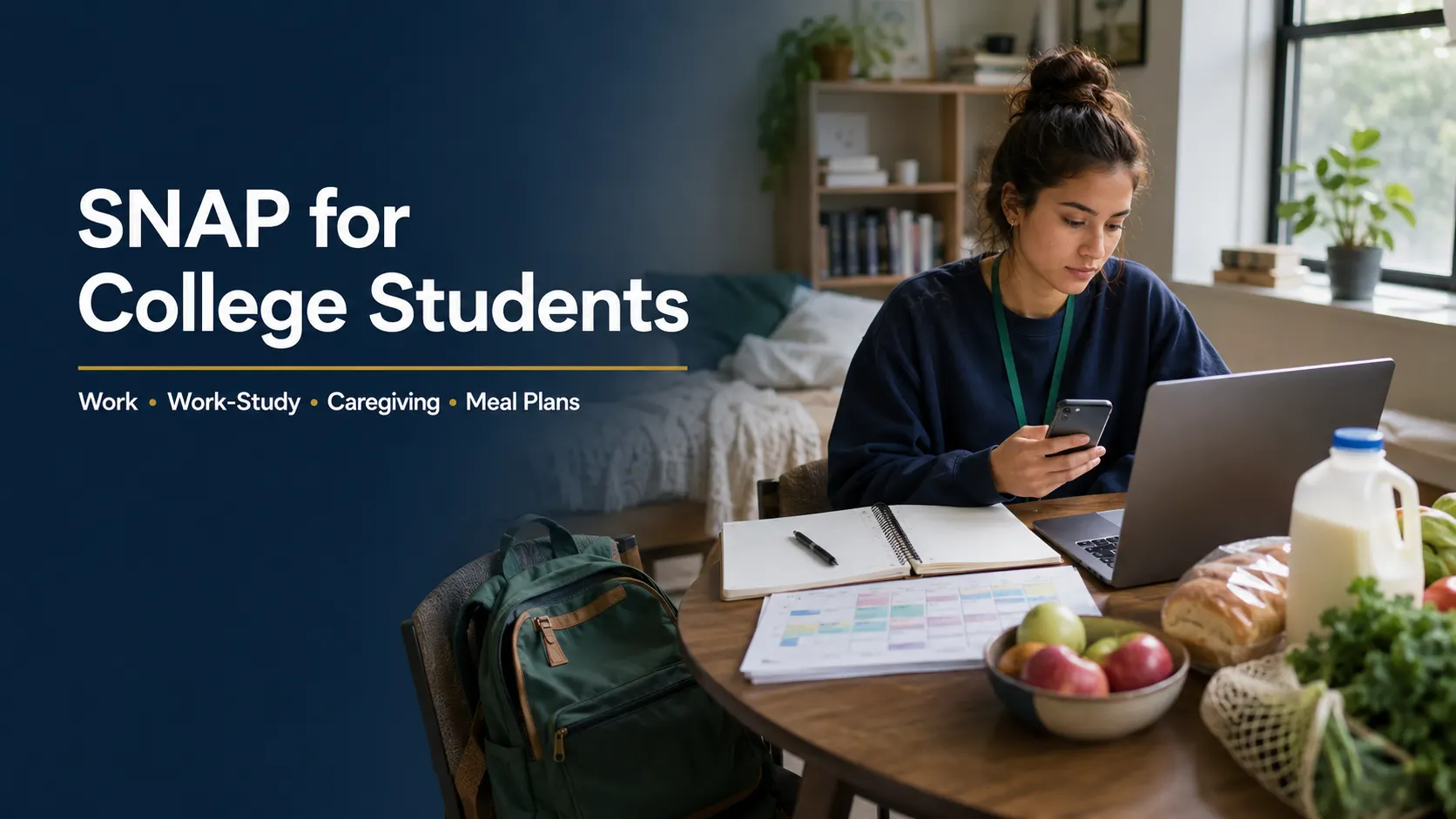
SNAP for College Students 2026: Eligibility, Exemptions & How to Apply
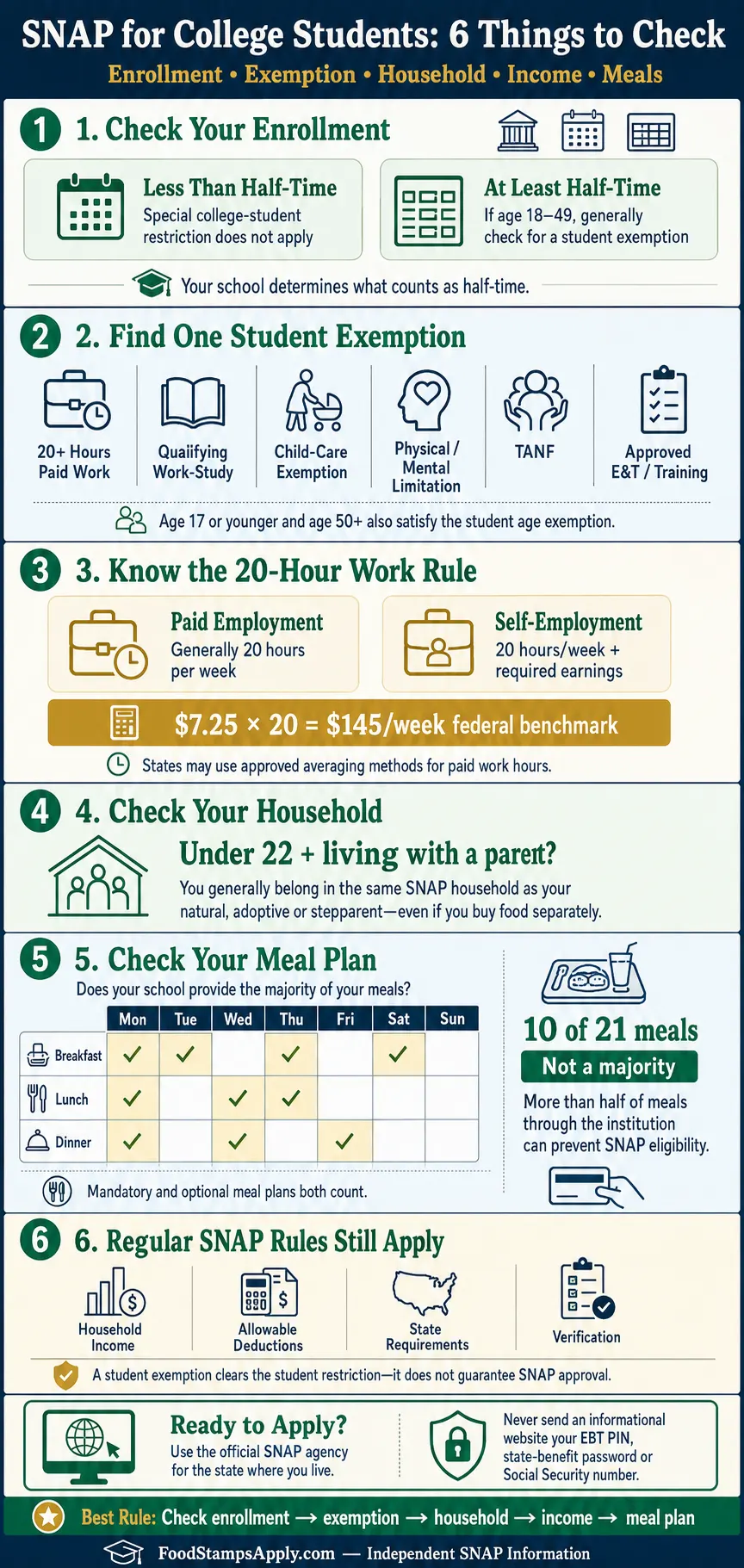
SNAP for college students is available in 2026, but students ages 18–49 who are enrolled at least half-time in an institution of higher education generally face an extra eligibility rule. In addition to meeting the regular Supplemental Nutrition Assistance Program (SNAP) requirements for household circumstances and income, these students normally need at least one qualifying student exemption.
Common exemptions include working at least 20 hours a week in paid employment, participating in qualifying work-study, caring for a dependent child, receiving TANF, having a qualifying physical or mental limitation, or attending college through certain approved employment and training programs.
Students enrolled less than half-time are not subject to this special college-student restriction. The easiest way to evaluate your situation is to check six things: enrollment status, age, student exemption, household, income and meal plan.
By FoodStampsApply.com Editorial
Last verified: August 26, 2026
Quick Answer
College students can receive SNAP if they meet the rules that apply to their situation. Students ages 18–49 who are enrolled at least half-time generally need one student exemption, such as working 20 hours weekly, qualifying work-study, certain caregiving circumstances, TANF, a physical or mental limitation, or an approved employment/training pathway. Meeting a student exemption does not guarantee SNAP eligibility; household, income and meal-plan rules still apply.
Independent information: FoodStampsApply.com SNAP information helps readers understand SNAP rules and locate official resources. We do not process applications, determine student exemptions or make SNAP eligibility decisions. Your state SNAP agency makes the case-specific determination.
Quick Check: Which SNAP Student Rule Applies?
Before calculating income or collecting documents, identify whether the special student restriction applies at all.
| Your Situation | What It Usually Means |
|---|---|
| Enrolled less than half-time | The special college-student restriction does not apply, although regular SNAP requirements still do |
| Age 18–49 and at least half-time | Generally need at least one qualifying student exemption |
| Age 17 or younger | Student age exemption applies |
| Age 50 or older | Student age exemption applies |
| Working 20+ hours per week | May meet the paid-employment exemption |
| Qualifying work-study | May meet the work-study exemption |
| Caring for a dependent child | One of several caregiver exemptions may apply |
| Physically or mentally unfit for work | May meet a student exemption under the applicable state verification procedure |
| School provides most meals | The meal-plan/institution rule can prevent SNAP eligibility |
| Under 22 and living with a parent | The student generally must be included in the same SNAP household as the parent |
Passing the student test is not the same as being approved for SNAP. A student exemption only clears the special higher-education restriction. The household still has to meet the other SNAP eligibility requirements that apply.
When Does SNAP Consider You a College Student?
The special SNAP student restriction does not apply simply because someone takes a class at a college.
For this rule, a person is generally considered a student when enrolled at least half-time in an institution of higher education.
For SNAP purposes, an institution of higher education can include:
- a college or university offering degree programs; or
- a business, technical, trade or vocational school that normally requires a high school diploma or equivalent for admission to the curriculum.
USDA FNA provides a current overview in its SNAP eligibility guidance for students.
Your School Determines Half-Time Enrollment
SNAP does not use one universal number of credits to define half-time enrollment.
Your college, university or school determines whether you are:
- less than half-time;
- half-time;
- more than half-time; or
- full-time.
That means you should use the enrollment classification on your school record rather than assuming a particular number of credits is always half-time nationwide.
If your institution considers you less than half-time, the special student restriction does not apply. You still need to meet the normal SNAP rules.
Not Every Program Offered by a College Triggers the Student Rule
This can be particularly important for community-college and workforce students.
USDA explains that some programs offered through colleges are outside the institution’s regular higher-education curriculum. Depending on the program, examples can include certain:
- remedial education;
- continuing or community education;
- professional development;
- English-language instruction; and
- workforce-development or training programs.
Someone taking a short workforce course through a community college therefore should not automatically assume the same student restriction applies as it would to a person enrolled half-time in an associate or bachelor’s degree program. The actual curriculum and enrollment classification matter.
SNAP Student Exemptions for 2026
A student who is subject to the restriction normally needs one qualifying exemption—not all of them.
| Exemption | Basic Rule |
|---|---|
| Age | Age 17 or younger, or age 50 or older |
| Paid employment | Work at least 20 hours per week and be paid for the employment |
| Self-employment | Work at least 20 hours weekly and meet the federal minimum-wage earnings benchmark |
| Work-study | Participate in qualifying state- or federally financed work-study during the regular school year |
| On-the-job training | Participate while actually being trained by the employer |
| Physical or mental limitation | Be physically or mentally unfit under the applicable SNAP standard |
| Child under 6 | Be responsible for a dependent household member younger than 6 |
| Child age 6–11 | Lack adequate child care needed to attend school and meet the applicable work or work-study requirement |
| Single parent | Full-time student responsible for a dependent child under 12, subject to the federal household conditions |
| TANF | Receive qualifying Temporary Assistance for Needy Families assistance |
| Approved E&T/workforce pathway | Attend higher education through one of the qualifying employment or training pathways permitted under federal SNAP rules |
USDA’s student-exemption policy resources and the federal student regulation provide the detailed rules used by state agencies.
Working 20 Hours a Week, Self-Employment and Work-Study
Paid work and work-study are two of the most common ways college students satisfy the special student rule, but they are not the same exemption.
Paid Employment: The 20-Hour Rule
A student can generally meet the paid-employment exemption by working at least 20 hours per week and being paid for that employment.
The hours can come from more than one job. For example:
12 paid hours at a campus bookstore + 8 paid hours at a restaurant = 20 hours
Federal regulations also give state agencies an option to evaluate compliance by averaging work hours over a month, quarter, trimester or semester. A state using that option must identify the averaging method in its SNAP state plan.
That means one unusually short week does not necessarily settle the question when your state uses an approved averaging method. Follow the method your state agency actually applies.
Self-Employment Has an Earnings Test Too
A self-employed student generally needs both:
- at least 20 hours of self-employment work per week; and
- weekly earnings at least equal to the federal minimum wage multiplied by 20 hours.
The federal minimum wage remains $7.25 per hour. The current federal benchmark is therefore:
20 × $7.25 = $145 per week
This distinction can matter for freelancers, tutors, delivery workers, online sellers and other self-employed students who spend substantial time working but have relatively low earnings.
The U.S. Department of Labor maintains the current federal minimum wage.
Qualifying Work-Study
State- or federally financed work-study can also provide a student exemption during the regular school year.
Under the regular federal rule, the student must generally:
- be approved for work-study when applying for SNAP;
- have work-study approved for the school term; and
- anticipate actually working during that term.
The exemption begins in the month the school term starts or the month work-study is approved, whichever is later. Once it begins, it generally continues through the month in which the school term ends unless the agency learns the student refused a work-study assignment.
A break between terms lasting a full month or longer normally interrupts this exemption unless the student is participating in work-study during the break.
The 20-Hour Student Rule Is Not the Same as Every SNAP Work Rule
The special college-student employment exemption should not be confused with SNAP’s separate general work requirements or time-limit rules.
For the broader distinction between work registration, the current SNAP time limit and qualifying activity rules, see our latest guide to SNAP work requirements.
Old Pandemic Work-Study and EFC Rules No Longer Apply
This remains important because older articles and social-media posts still surface in search results.
During the COVID-19 public health emergency, temporary federal rules expanded student eligibility for some people who were:
- eligible to participate in federal or state work-study, even without the normal participation requirements; or
- students with a $0 Expected Family Contribution under the former federal financial-aid system.
USDA FNA states that those temporary exemptions ended for SNAP applications and recertifications beginning July 1, 2023.
A 2026 application should therefore be evaluated under the regular student exemptions, not the pandemic-era rules.
Does FAFSA, a Pell Grant or Financial Aid Qualify You for SNAP?
A Pell Grant, FAFSA filing or low Student Aid Index does not by itself satisfy the current special SNAP student exemption.
That is separate from the question of whether financial aid is counted when SNAP calculates household income.
Question 1: Does the financial aid make me exempt from the student restriction?
Usually not by itself. You still need a current student exemption such as qualifying work-study, paid work, caregiving or another listed federal pathway.
Question 2: Does the financial aid count as SNAP income?
Not necessarily. Federal student aid and other educational assistance can receive excluded treatment under federal law or SNAP’s educational-assistance rules, depending on the source and type of assistance.
Federal law specifically protects qualifying federal student financial assistance from being counted in determining eligibility or benefit amounts under federally funded assistance programs. Other educational assistance can have additional rules based on its source and purpose.
For SNAP financial calculations more broadly, the treatment of scholarships, grants, work-study funds, loans and other educational assistance can differ. Do not assume every dollar shown on a financial-aid award letter is ordinary countable household income.
For the separate financial eligibility test, see our SNAP income limits guide.
SNAP Exemptions for Students Caring for Children
The federal student rules contain several caregiver exemptions rather than one universal “parent exemption.”
The child’s age, child-care availability, the student’s enrollment status and household circumstances determine which provision may apply.
| Student’s Situation | Possible Student Exemption |
|---|---|
| Responsible for dependent child under 6 | Caregiver exemption can apply |
| Responsible for dependent child age 6–11 | May qualify when adequate child care is unavailable for school plus the applicable 20-hour work or work-study requirement |
| Single parent, full-time student, dependent child under 12 | Separate single-parent exemption can apply when the federal household conditions are met |
A student does not need to be a single parent to use the under-6 caregiver exemption.
For children ages 6 through 11, the rule is more specific. Adequate child care must be unavailable in a way that prevents the student from attending class and meeting the applicable paid-work or work-study requirement.
The single-parent provision is different again. It applies to a full-time student responsible for a dependent child under 12 when the household circumstances meet the federal definition.
For example, a full-time single parent caring for an 8-year-old may qualify through the single-parent exemption even though that child is too old for the straightforward under-6 caregiver exemption.
Physical or Mental Limitations, TANF and Other Student Exemptions
Not every student needs to qualify through employment or caregiving.
Physical or Mental Limitation
A student considered physically or mentally unfit under SNAP rules can be exempt from the special student restriction.
This does not necessarily mean the person must already be receiving SSI or Social Security disability benefits. The state SNAP agency determines whether the exemption applies and what verification is needed.
USDA FNA maintains specific guidance on the student physical or mental unfitness exemption.
TANF
Receiving qualifying Temporary Assistance for Needy Families (TANF) assistance can satisfy a federal student exemption.
On-the-Job Training
A student participating in an on-the-job training program can qualify under the student exemption during the period the person is actually being trained by the employer.
SNAP Employment and Training and Other Workforce Programs
A student can also qualify when enrollment in higher education occurs through or in compliance with certain approved employment and training pathways.
Current federal categories can include:
- qualifying SNAP Employment and Training (SNAP E&T) placements;
- certain equivalent state or local E&T programs for low-income households;
- qualifying Workforce Innovation and Opportunity Act programs; and
- Trade Adjustment Assistance programs under the applicable federal provision.
Some state SNAP E&T programs work with community colleges and other training providers to help participants complete career or technical education.
Because available programs differ considerably by state, use USDA FNA’s SNAP E&T state plans to see how your state’s program is structured.
Can College Students With Meal Plans Get SNAP?
Sometimes. Having any campus meal plan does not automatically make a student ineligible for SNAP.
The important question is whether the institution provides the majority of the student’s meals through its normal services.
The More-Than-Half Rule
USDA FNA states that a person receiving the majority of meals through either a mandatory or optional institutional meal plan is generally ineligible for SNAP under the institutional-resident rule.
The state agency should examine the actual scope of the meal plan rather than deny an applicant simply because a meal plan exists.
See USDA FNA’s current college meal-plan guidance.
USDA’s 10-Meal Example
A seven-day week has 21 meal opportunities when using three meals per day.
USDA gives an example of a student receiving breakfast and lunch every weekday:
10 meals per week
10 of 21 is less than a majority.
That student would not be treated as an institutional resident based on that meal plan alone.
Meal Swipes, Points and Dining Dollars
Not every campus dining plan is sold as a fixed number of meals.
States may need to evaluate plans structured around:
- meal swipes;
- dining points;
- dollar values; or
- other campus dining arrangements.
The practical question remains how much of the student’s meals the institution is providing.
Living in a Dorm Does Not Automatically Prevent SNAP
Campus housing and campus meals are separate issues.
A student living in a dorm with a limited meal plan may potentially receive SNAP if the institution does not provide the majority of the student’s meals and all other applicable SNAP requirements are met.
Under 22 and Living With a Parent? This Household Rule Matters
A person under age 22 who lives with a natural, adoptive or stepparent generally must be included in the same SNAP household as that parent.
Buying groceries separately or cooking separately normally does not override this required household combination.
Example
A 20-year-old community-college student lives with her mother. She buys many of her own groceries, stores some food separately and usually cooks for herself.
For SNAP purposes, she generally still cannot create a separate one-person SNAP household while living with her mother because she is under 22.
That can substantially change the household size and income used for eligibility. See our SNAP eligibility checker and screening information for the broader eligibility factors.
A Student Exemption Does Not Guarantee SNAP Approval
The student restriction is only one part of eligibility.
A student can work 20 hours every week and satisfy the student employment exemption but still have household income or other circumstances that prevent eligibility.
The opposite can happen too: a student may have very little income but still fail the special student test because the person is enrolled at least half-time and has no qualifying student exemption.
After the student rule is resolved, SNAP can still consider factors such as:
- household composition;
- gross and net income;
- allowable deductions;
- resource rules where applicable;
- residency; and
- other applicable federal and state eligibility requirements.
Current FY 2026 federal SNAP income standards apply from October 1, 2025 through September 30, 2026, although states can have additional options that affect financial screening.
For current figures, use our SNAP income limits resource and USDA FNA’s official SNAP cost-of-living adjustment tables.
Working 20 Hours Can Solve One Rule While Increasing Countable Earnings
The paid-employment exemption creates an important balance.
Working enough hours can satisfy the special student requirement, but ordinary wages still enter the SNAP financial calculation.
SNAP generally allows a 20% earned-income deduction when determining net income, but that does not mean all earnings disappear from the eligibility calculation.
Documents College Students May Need for SNAP
The most useful documents are the ones that prove the exemption and household circumstances that actually apply to you.
| Situation | Commonly Useful Proof |
|---|---|
| Enrollment status | School record showing enrollment and the institution’s half-time/full-time classification |
| 20-hour employment | Recent pay stubs, work schedule or employer verification |
| Self-employment | Records showing work hours and earnings |
| Work-study | Current work-study approval and school-term information |
| Child-related exemption | Household/child information and child-care information where relevant |
| Single-parent exemption | Full-time enrollment plus household and dependent-child information |
| Physical or mental limitation | Verification requested under the state agency’s procedure, if the limitation is not otherwise evident |
| TANF | Current TANF assistance information |
| E&T/workforce pathway | Program placement or enrollment verification |
| Meal plan | Dining-plan terms showing meals, swipes, points or other coverage information |
A class schedule may show that you attend college, but it may not establish the school’s half-time classification or prove a work-study, employment or caregiver exemption.
For a broader application checklist, see documents commonly needed for SNAP.
How to Apply for SNAP as a College Student
There is no separate national SNAP application just for college students. You apply through the SNAP agency in the state where you currently live.
1. Confirm Your Enrollment Status
Find out whether your school officially considers you less than half-time, half-time or full-time.
If you are enrolled less than half-time, you do not need a special student exemption, although ordinary SNAP eligibility rules still apply.
2. Identify the Student Exemption That Fits Your Situation
If you are age 18–49 and enrolled at least half-time, determine whether one current exemption applies through employment, self-employment, work-study, caregiving, physical or mental fitness, TANF, on-the-job training or another approved education/workforce pathway.
3. Check Your Household and Income
A student exemption does not replace ordinary SNAP eligibility.
Pay particular attention to the under-22 household rule if you live with a parent.
4. Apply Through Your State SNAP Agency
Application portals, phone routes, paper forms and local-office procedures vary by state.
Use our SNAP information by state section for state-specific information available on FoodStampsApply.com.
You can also use the official USDA FNA SNAP State Directory to find the agency responsible for your state.
5. Complete the Interview and Requested Verification
The state agency may need to verify both your ordinary SNAP eligibility and the student exemption you are using.
A student using the 20-hour exemption may need employment records. A work-study student may need school documentation. A student whose eligibility depends on meal-plan coverage may need dining-plan information.
Ready to find the official application route?
Use USDA FNA’s state directory to locate the SNAP agency for the state where you currently live.
Which Student SNAP Rules Can Vary by State?
The core student restriction and federal exemptions come from federal SNAP law, but states control several administrative details.
Work-Hour Averaging
Federal regulations allow states to choose an approved method for averaging paid-employment hours over a month, quarter, trimester or semester.
SNAP E&T Programs
Education and training opportunities differ because each state designs and operates its own SNAP E&T program within federal requirements.
Verification
States determine how enrollment, employment, caregiving, physical or mental fitness, and other circumstances are documented within federal verification rules.
Application Process
Benefits portals, local-office systems, phone routes and interview processes are state-specific.
That is why students should check the process where they actually live rather than relying on instructions written for another state’s SNAP program.
Frequently Asked Questions About SNAP for College Students
Can college students get SNAP in 2026?
Yes, potentially. Students ages 18–49 who are enrolled at least half-time generally need at least one qualifying student exemption in addition to meeting the ordinary SNAP household and financial eligibility requirements.
How many hours must a college student work for SNAP?
The paid-employment student exemption generally requires at least 20 hours of paid work per week. Federal rules allow states to use certain approved averaging methods. Self-employed students also have a separate earnings requirement.
Can a student enrolled less than half-time get SNAP?
Potentially. Someone enrolled less than half-time is not subject to the special higher-education student restriction, but the person must still meet the ordinary SNAP eligibility rules that apply to the household.
Does work-study qualify a student for SNAP?
Qualifying state- or federally financed work-study can provide a student exemption. Under the regular rule, the student generally must be approved for the current term and anticipate actually participating in work-study.
Does a Pell Grant make a student eligible for SNAP?
A Pell Grant by itself is not a current student exemption. Federal student aid can have favorable treatment in SNAP’s financial calculation, but the student still needs to satisfy the special student rule when it applies.
Can a college student with a meal plan get SNAP?
Possibly. Having a meal plan does not automatically make a student ineligible. USDA says a student receiving the majority of meals through the institution’s normal services is generally ineligible, whether the plan is mandatory or optional.
Can a student living in a dorm get SNAP?
Potentially. Dorm residence alone does not settle SNAP eligibility. Enrollment status, the student exemption, household circumstances, financial eligibility and how much of the student’s meals the institution provides all matter.
Can a 20-year-old living with parents apply for SNAP separately?
Generally not while living with a natural, adoptive or stepparent. SNAP normally requires a person under 22 living with a parent to be included in the same SNAP household even if food is purchased and prepared separately.
Can self-employed students meet the 20-hour exemption?
Yes, when the federal requirements are met. A self-employed student generally must work at least 20 hours per week and have weekly earnings at least equal to 20 hours multiplied by the federal minimum wage. At the current $7.25 federal rate, that benchmark is $145 per week.
Are students age 50 or older exempt from the special student restriction?
Yes. Age 50 or older satisfies the student age exemption. The person still must meet all other SNAP eligibility requirements that apply to the household.
Sources & Verification
Important current sources used to verify this guide include:
- USDA FNA SNAP Students for the current student definition, exemptions, meal-plan summary and expiration of the pandemic exemptions.
- USDA FNA Institutions of Higher Education and Student Eligibility Rules.
- USDA FNA Questions and Answers on Student Exemptions.
- USDA FNA College Meal Plan Guidance.
- USDA FNA SNAP E&T State Plans.
- USDA FNA SNAP Eligibility for current FY 2026 financial standards and general eligibility context.
- 7 CFR § 273.5 for federal student eligibility and exemption rules.
- 7 CFR § 273.1 for household composition and institutional-resident rules.
- 7 CFR § 273.9 for income, deductions and educational assistance.
- U.S. Department of Labor federal minimum wage guidance for the current $7.25 federal rate used in the self-employment formula.
For more about how FoodStampsApply.com selects and checks public-benefit sources, see our source methodology.
Conclusion
Being in college does not automatically make you ineligible for SNAP.
If you are enrolled less than half-time, the special student restriction does not apply. If you are 18–49 and enrolled at least half-time, check whether you meet one current student exemption through paid work, qualifying work-study, caregiving, a physical or mental limitation, TANF, on-the-job training or an approved employment and training pathway.
Then look at the regular SNAP rules, especially household composition and income.
Two details are especially easy to miss: a person under 22 who lives with a parent generally belongs in the parent’s SNAP household, and a student whose institution provides the majority of their meals through a meal plan can be ineligible under the institutional-resident rule.
When your situation is unclear, use the current USDA FNA student guidance and ask your state SNAP agency how the federal student exemption applies to your enrollment, work, household and meal-plan circumstances.