
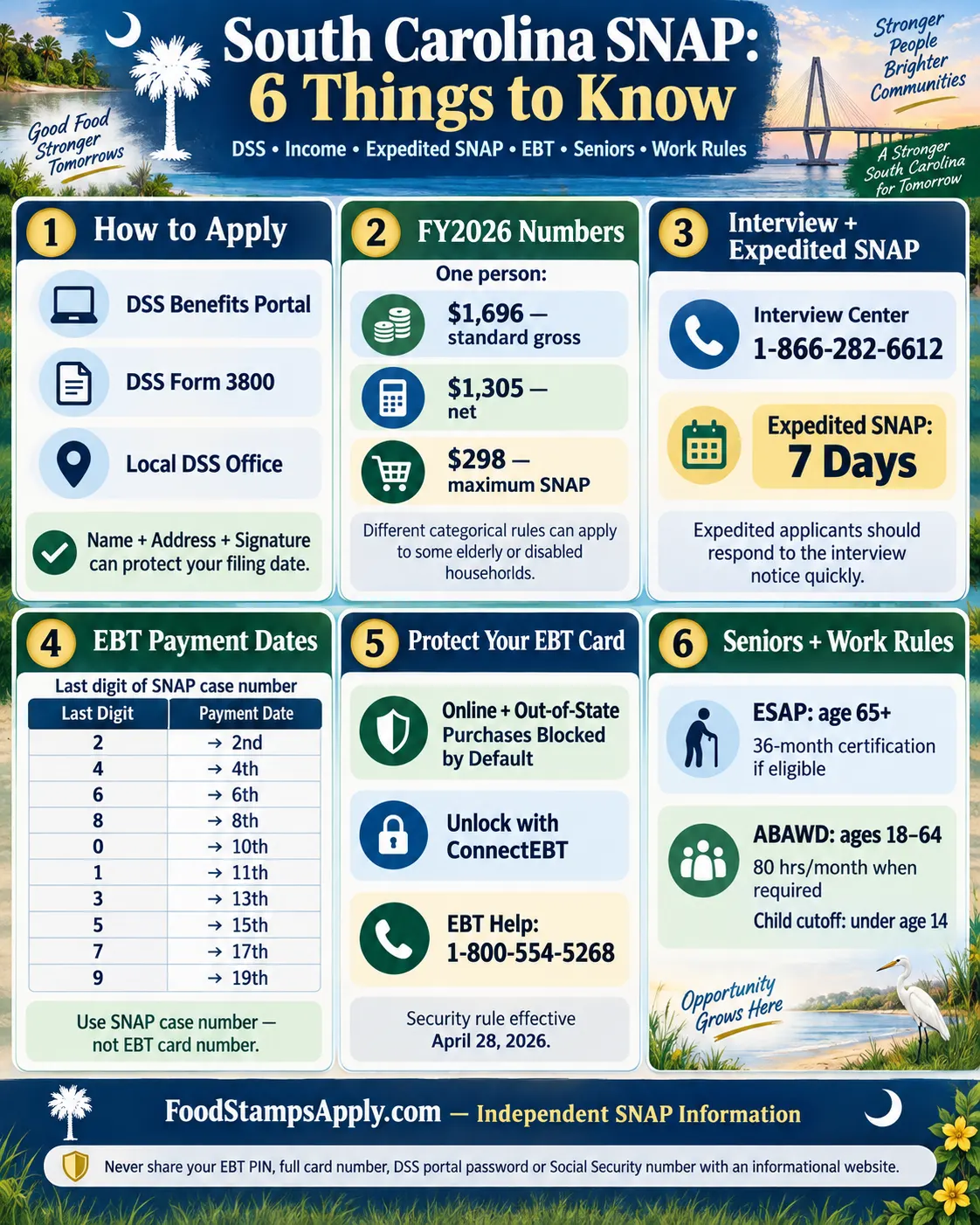
South Carolina SNAP helps eligible households pay for groceries through an Electronic Benefit Transfer, or EBT, card. You can apply online through the South Carolina DSS Benefits Portal, submit DSS Form 3800, or apply through your local Department of Social Services office.
The part that often catches applicants is what happens next. South Carolina currently directs many SNAP applicants to complete their interview by calling the Family Assistance Interview Center rather than simply waiting for DSS to call them.
South Carolina also has several 2026 rules worth knowing. Online and out-of-state EBT purchases are blocked by default until you temporarily unlock the card, ABAWD work rules now reach some adults through age 64, and the state’s Healthy Food SC purchase restrictions are scheduled to begin November 1, 2026.
By FoodStampsApply.com Editorial
Last verified: September 16, 2026
Quick Answer
Apply for South Carolina SNAP through the DSS Benefits Portal/SCCES, submit DSS Form 3800 or contact your local DSS office. Regular eligible applications generally have a 30-day processing standard, while qualifying expedited households can receive SNAP within 7 days. After filing, watch for your interview notice: many applicants are instructed to call the Family Assistance Interview Center at 1-866-282-6612.
Independent information: FoodStampsApply.com is an independent SNAP information website. We do not operate the DSS Benefits Portal, access South Carolina DSS cases, issue EBT cards or determine SNAP eligibility. Never send an informational website your Social Security number, EBT PIN, full card number or DSS portal password.

South Carolina SNAP Income Limits and Maximum Benefits for 2026
Current FY2026 SNAP income and benefit standards remain in effect through September 30, 2026.
| Household Size | 130% Gross Limit | 100% Net Limit | Maximum SNAP |
|---|---|---|---|
| 1 | $1,696 | $1,305 | $298 |
| 2 | $2,292 | $1,763 | $546 |
| 3 | $2,888 | $2,221 | $785 |
| 4 | $3,483 | $2,680 | $994 |
| 5 | $4,079 | $3,138 | $1,183 |
| 6 | $4,675 | $3,596 | $1,421 |
| 7 | $5,271 | $4,055 | $1,571 |
| 8 | $5,867 | $4,513 | $1,789 |
| Each additional person | +$596 | +$459 | +$218 |
Eligible one- and two-person households have a current minimum monthly SNAP allotment of $24.
How South Carolina Categorical Eligibility Changes the Income Test
South Carolina’s categorical rules need a little explanation because they differ from some neighboring states.
Expanded categorical eligibility generally applies when household gross income is at or below 130% of the federal poverty level. A higher 200% FPL threshold can apply when all adult household members are elderly or disabled.
For example, 200% FPL in FY2026 is $2,610 per month for one person and $3,526 for two people.
Once a household is categorically eligible, the ordinary resource, gross-income and net-income limits do not apply in the usual way.
Do not self-deny from one number. Elderly or disabled households can be treated differently, and DSS must apply the eligibility rules to the household’s actual circumstances.
Your Expenses Can Affect the Benefit Amount
SNAP is based on countable net income after allowable deductions.
Depending on your household, deductions can include:
- the 20% earned-income deduction;
- the standard household deduction;
- dependent-care expenses;
- legally owed child support;
- shelter and utility expenses; and
- qualifying medical expenses for an older or disabled household member.
For FY2026, South Carolina policy includes a $209 standard deduction for households of one to three people and a $744 maximum excess-shelter deduction where the federal cap applies.
Report expenses you actually pay. Leaving out rent, child care or qualifying medical costs can affect the amount DSS calculates.
Does South Carolina SNAP Have an Asset Limit?
For some households, yes.
For households subject to the normal resource test, South Carolina currently uses:
- $3,000 for most households; or
- $4,500 when the household includes a person age 60 or older or a qualifying person with a disability.
Categorically eligible households are not subject to the ordinary resource limit.
Not every vehicle, retirement account or household possession counts as an available SNAP resource, so owning something of value does not automatically mean you are ineligible.
How to Apply for SNAP in South Carolina
South Carolina accepts SNAP applications:
- online;
- in person;
- by mail;
- by fax;
- through an authorized representative; and
- by telephone in qualifying situations.
South Carolina’s online application system is the South Carolina Client Eligibility System (SCCES) inside the DSS Benefits Portal.
Step 1: Apply Through the DSS Benefits Portal
A portal account can be used to:
- apply for SNAP;
- save an unfinished application;
- check application status;
- upload documents; and
- renew benefits when due.
Open the South Carolina DSS Benefits Portal
The portal also includes an Am I Eligible? screening tool. Treat the result as an estimate, not an official DSS eligibility decision.
Save Your Submission Confirmation
After submitting online, save the confirmation email, text or screen showing the application was successfully filed. That gives you proof of the application date if the case later appears delayed or missing.
Step 2: Protect Your South Carolina SNAP Filing Date
Do not wait until every verification document is ready.
South Carolina’s current DSS Form 3800 says an application is valid when it contains at least:
Name
Address
Signature of a responsible household member or authorized representative
That lets you establish the filing date first and provide the additional information DSS requests afterward.
Step 3: Use DSS Form 3800 if You Prefer Paper
South Carolina’s main application is:
DSS Form 3800 — Application for Supplemental Nutrition Assistance Program (SNAP), Temporary Assistance for Needy Families (TANF), and/or Refugee Cash Assistance (RCA)
The form can be mailed, faxed or delivered to DSS.
Keep a complete copy. If you fax the application, keep the transmission confirmation.
Step 4: Find Your Local DSS Office
South Carolina has DSS offices serving all 46 counties.
DSS Connect: 1-800-616-1309
Your local DSS can help with:
- paper applications;
- verification;
- case-status questions;
- renewals;
- work-rule questions; and
- appeals.
Step 5: Read the Interview Notice — Then Call
This is one of the most important South Carolina-specific application details.
Do not automatically wait for DSS to call you.
Current DSS interview material directs applicants whose SNAP application has been received to call:
Family Assistance Interview Center
1-866-282-6612
During the interview, expect questions about:
- household members;
- income and employment;
- who buys and prepares food together;
- rent or mortgage;
- utilities;
- child care;
- child-support payments;
- medical expenses when applicable; and
- resources when a resource test applies.
Keep your interview notice until the application has been decided.
What If You Miss the First Interview?
Contact DSS quickly. South Carolina policy allows another opportunity to complete the interview when the household contacts DSS within the original application-processing period. Do not automatically submit a second application just because the first interview was missed.
Step 6: Submit the Verification DSS Requests
DSS may ask for proof such as:
- identification;
- recent pay stubs;
- employer information;
- Social Security, pension or unemployment income;
- rent or mortgage;
- utilities;
- child care;
- child support; and
- medical expenses for qualifying older or disabled members.
Send what DSS actually requests instead of uploading a large pile of unrelated paperwork.
When possible, upload verification through the DSS Benefits Portal.
Save a screenshot or confirmation. A file can be in the system before a worker has reviewed it.
Step 7: Follow Up on the Existing Case
Registered portal users can check application status online.
You can also call DSS Connect at 1-800-616-1309 for SNAP case questions.
Have these details ready:
- application date;
- interview date;
- documents requested;
- date each document was submitted; and
- case number, if assigned.
How Long Does South Carolina SNAP Take?
Regular eligible application: generally no later than the 30th day after filing.
Qualifying expedited application: generally no later than the 7th calendar day.
If day 30 is getting close and you have completed the interview and provided every requested document, follow up on the existing application.
Need Food Fast? South Carolina Expedited SNAP
DSS must screen applications for expedited service.
You may qualify when:
- gross monthly income is under $150 and liquid resources are $100 or less;
- you are part of a qualifying destitute migrant or seasonal farmworker household with no more than $100 in liquid resources; or
- combined monthly gross income and liquid resources are less than monthly rent or mortgage plus utilities.
Qualifying households can receive SNAP within 7 calendar days.
Expedited Applicants Still Need the Interview
South Carolina has an important expedited-service timing rule.
When DSS properly screens the application and sends the interview notice, an expedited household generally needs to contact the interview center by the sixth day after filing.
If the sixth day falls on a weekend or holiday, timing can move to the next business day. DSS policy also allows good cause when circumstances outside the applicant’s control prevented a timely call.
If you need emergency SNAP, do not ignore the interview notice. Call the interview center promptly even if you are still gathering other documents.
South Carolina SNAP Help Where You Live
Columbia and Richland County
Richland County DSS — Columbia
3220 Two Notch Road
Columbia, SC 29204
Phone: 803-714-7300
DSS also maintains an Eastover office for Richland County. Check the current DSS directory before traveling.
Greenville County
Greenville County DSS
352 Halton Road
Greenville, SC 29607
Phone: 864-467-7700
Spartanburg County
Spartanburg County DSS
630 Chesnee Highway
Spartanburg, SC 29303
Phone: 864-596-3001
Charleston and the Lowcountry
Use Charleston County DSS for the SNAP case itself.
If groceries are short while the application is pending, the Lowcountry Food Bank serves Charleston and surrounding communities.
Find Food Through the Lowcountry Food Bank
Call the pantry before traveling when possible because local distribution schedules can change.
Anywhere in South Carolina: Text DSS to 211211
South Carolina DSS offers a useful statewide text shortcut.
Text DSS to 211211 for information about SNAP and other DSS programs. The service is also available in Spanish.
For food pantries and broader community resources, use South Carolina 211.
South Carolina ESAP: A Simpler SNAP Process for Some Older Households
South Carolina operates the Elderly Simplified Application Project (ESAP).
Current 2026 DSS guidance says ESAP generally applies when:
- all household members who buy and prepare food together are age 65 or older;
- the household has no earned income;
- no household member is already receiving SNAP through SCCAP;
- the household meets the applicable SNAP income requirements; and
- the required interview is completed at application and reapplication.
The current application is:
DSS Form 16176 — Application for the Elderly Simplified Application Project
Current South Carolina ESAP Form 16176
ESAP help: 1-888-898-0055
Use the current age rule. Some older South Carolina brochures say age 60, but the June 2026 Form 16176 and current outreach materials use age 65 or older.
ESAP Has a 36-Month Certification Period
Qualifying ESAP households receive a 36-month certification period.
DSS uses an interim-contact form around months 12 and 24, followed by full recertification in month 36.
The longer certification period reduces paperwork, but it does not mean a household can ignore DSS notices for three years.
What About South Carolina SCCAP?
South Carolina also operates the South Carolina Combined Application Project (SCCAP) for certain Supplemental Security Income recipients.
Some SSI recipients who meet SCCAP criteria can receive SNAP without completing the ordinary DSS Form 3800 process.
If you receive SSI, live alone or normally buy and prepare food separately from other people, ask DSS whether SCCAP applies before assuming you need a regular SNAP application.
What Happens After South Carolina Approves SNAP?
Approved SNAP benefits are issued through a South Carolina EBT card.
South Carolina EBT Customer Service
1-800-554-5268
Use EBT Customer Service for:
- balance questions;
- PIN problems;
- lost or damaged cards;
- transaction problems; and
- EBT security and unlocking help.
Use DSS Connect at 1-800-616-1309 instead for eligibility, application or case-processing questions.
South Carolina SNAP Payment Dates
For most current SNAP cases, monthly benefits are issued according to the last digit of the SNAP case number.
| Case Number Ends In | Payment Date | Case Number Ends In | Payment Date |
|---|---|---|---|
| 0 | 10th | 5 | 15th |
| 1 | 11th | 6 | 6th |
| 2 | 2nd | 7 | 17th |
| 3 | 13th | 8 | 8th |
| 4 | 4th | 9 | 19th |
Example: a case ending in 7 normally receives its regular SNAP issuance on the 17th.
Do not use the EBT card number. Use the SNAP case number.
Some very old continuously active cases can follow legacy issuance timing. If your official DSS notice or established EBT history shows a different schedule, follow your case information or confirm through EBT Customer Service.
Why Is My South Carolina EBT Card Declined Online or Out of State?
Since April 28, 2026, South Carolina DSS has automatically placed EBT cards into a high-risk-transaction block that prevents:
- online EBT purchases; and
- out-of-state EBT purchases.
Ordinary in-person purchases inside South Carolina can continue normally.
When you need an online or out-of-state purchase, temporarily unlock the card using:
- the ConnectEBT mobile app;
- the ConnectEBT website; or
- EBT Customer Service at 1-800-554-5268.
If an online grocery purchase suddenly declines, check the security block before assuming your SNAP case closed.
Other ConnectEBT Lock Options
South Carolina also allows cardholders to choose:
- Lock My Card Everywhere — blocks in-state, out-of-state and online purchases; or
- Lock My Card Outside of SC — blocks physical out-of-state purchases while allowing South Carolina and online purchases when the default high-risk block has been lifted.
Healthy Food SC Purchase Restrictions Start November 1, 2026
As of September 16, 2026, this rule is not in effect yet.
South Carolina DSS currently says Healthy Food SC will begin on November 1, 2026.
Beginning on that date, SNAP will no longer pay for categories including:
- candy;
- energy drinks;
- soft drinks with added sugar; and
- other sweetened beverages covered by the state’s rule.
Diet and zero-sugar soft drinks remain SNAP-eligible under the current South Carolina guidance.
Until November 1, use the current SNAP food rules. This article should be checked again on or immediately after November 1 before the future-tense wording is changed.
Keeping South Carolina SNAP: Renewal and Reporting
Most SNAP households must complete a renewal when the certification period ends.
The DSS Benefits Portal can be used to renew eligible benefits online.
South Carolina also uses simplified reporting rules for many households. The exact reporting requirement depends on case type and certification period.
Current policy can require a report when, for example:
- gross household income exceeds the applicable reporting threshold;
- a person subject to the ABAWD requirement falls below the required work level; or
- a household member receives substantial lottery or gambling winnings.
Read the change-reporting instructions on your DSS notice because ESAP, SCCAP and regular SNAP households can have different reporting schedules.
South Carolina SNAP Work Requirements in 2026
South Carolina has general SNAP work-registration rules and a separate ABAWD time limit.
General SNAP Work Registration
General work-registration rules usually apply to nonexempt adults under age 60.
A work registrant can be required to:
- register for work;
- provide information about employment and job availability;
- accept suitable employment; and
- avoid voluntarily quitting a job of 30 or more hours per week or reducing work below that level without good cause.
Common exemptions can include age, disability or inability to work, qualifying caregiving, treatment-program participation, unemployment-benefit status, sufficient employment hours and certain student situations.
ABAWD Time-Limit Rule — Ages 18–64
South Carolina’s current SNAP manual defines an ABAWD as an able-bodied SNAP household member who:
- is age 18 through 64;
- is able to work; and
- does not have a dependent child under age 14 in the SNAP household.
An adult subject to the time limit generally needs 20 hours per week, averaged as 80 hours per month, through qualifying work, approved training, workfare or an allowed combination.
Without meeting the work requirement or an exception, SNAP can generally be limited to 3 countable months in a 36-month period.
Important 2026 change: adults living with children ages 14–17 can now still be subject to the ABAWD time limit. The dependent-child protection is now tied to a child under age 14.
Some Former ABAWD Exemptions Changed
South Carolina’s current manual says homelessness, veteran status and being age 24 or younger after aging out of foster care no longer automatically create the former standalone ABAWD exemptions.
Other exemptions still exist, including circumstances involving age 65+, pregnancy, health limitations, general-work-rule exemptions and qualifying Indian status.
If DSS says the rule applies and you believe you meet an exemption, ask the worker to review the exemption rather than assuming the initial classification is final.
For a broader explanation, see our SNAP work requirements guide.
South Carolina and North Carolina Use Different SNAP Systems
Federal SNAP rules apply in both states, but application portals, program terminology, EBT schedules and local case handling are different.
If you are moving between the Carolinas or comparing procedures, see our latest North Carolina SNAP/FNS guide. North Carolina uses ePASS and Food and Nutrition Services, while South Carolina uses SCCES through the DSS Benefits Portal.
What If South Carolina Denies, Reduces or Stops SNAP?
You have the right to request a fair hearing if you disagree with a South Carolina SNAP decision.
SNAP fair-hearing requests may be made orally or in writing.
The general SNAP hearing deadline is 90 days from the action or notice you want to challenge.
South Carolina Office of Administrative Hearings
1-800-311-7220
TTY: 1-800-311-7219
South Carolina also provides DSS Form 2633 — Request for Fair Hearing.
Want Benefits to Continue During the Appeal?
Act much sooner than the 90-day appeal deadline.
If DSS is reducing or stopping current SNAP and your certification period has not ended, requesting the hearing and continuation within the applicable 10-day advance-notice period can allow the old benefit level to continue while the dispute is pending.
If the final decision goes against you, continued benefits can have to be repaid.
South Carolina Legal Services: 1-888-346-5592 for people who may qualify for free legal help.
South Carolina SNAP FAQs
Where do I apply for South Carolina SNAP?
Apply through the DSS Benefits Portal/SCCES, submit DSS Form 3800 or use your local DSS office. Applications may be submitted online, in person, by mail or fax, and telephone filing can be available in certain situations.
What is the South Carolina SNAP application form?
The regular application is DSS Form 3800 — Application for SNAP, TANF and/or Refugee Cash Assistance.
What is the 2026 South Carolina SNAP income limit for one person?
The standard FY2026 gross-income limit is $1,696 per month, and the net-income limit is $1,305. The maximum benefit is $298 per month through September 30, 2026. Different categorical rules can apply to some elderly or disabled households.
Does South Carolina SNAP have an asset limit?
For households subject to the resource test, the limit is generally $3,000, or $4,500 when the household contains someone age 60 or older or a qualifying person with a disability. Categorically eligible households are not subject to the normal resource limit.
Can I apply before I have all my documents?
Yes. South Carolina Form 3800 says a basic application is valid when it contains a name, address and required signature. DSS can request the remaining information afterward.
Do I wait for DSS to call me for the SNAP interview?
Do not assume that. Current South Carolina interview material directs many applicants to call the Family Assistance Interview Center at 1-866-282-6612 after the application is received.
How long does South Carolina SNAP approval take?
Regular SNAP generally has a 30-day processing standard. Qualifying expedited households can receive SNAP within seven calendar days.
What is the South Carolina EBT phone number?
Call 1-800-554-5268 for balance, PIN, card replacement, transaction and EBT-unlocking help.
What day does South Carolina load SNAP?
For most current cases, the regular payment date is based on the last digit of the SNAP case number and falls between the 2nd and 19th. Use the case number rather than the EBT card number.
Why is my South Carolina EBT card declined online?
Since April 28, 2026, DSS has blocked online and out-of-state EBT purchases by default. Temporarily unlock the card through ConnectEBT or EBT Customer Service before making one of those purchases.
Does South Carolina have a simpler SNAP process for seniors?
Yes. ESAP currently uses age 65 or older for its age-based household requirement, requires no household earned income and has a 36-month certification period for qualifying households.
When do South Carolina’s Healthy Food SC restrictions begin?
The current scheduled implementation date is November 1, 2026. As of September 16, 2026, the restrictions are not yet active.
Who can be affected by South Carolina’s ABAWD rule?
The current rule can apply to able-bodied adults ages 18 through 64 who do not have a child under age 14 in the SNAP household, unless another exception applies. A person subject to the rule generally needs 80 qualifying hours per month.
Where can I get food while my SNAP application is pending?
Use SC 211, a regional food bank or a local food pantry. You can also text DSS to 211211 for information about DSS programs and services.
How long do I have to appeal a South Carolina SNAP decision?
The general SNAP fair-hearing period is 90 days. If existing benefits are being reduced or stopped and you want continued benefits while the hearing is pending, a much shorter 10-day advance-notice deadline can apply.
Sources & Verification
- South Carolina DSS Benefits Portal
- South Carolina Department of Social Services
- DSS Form 3800
- DSS Form 16176 — ESAP
- South Carolina EBT High-Risk Transaction Blocking
- DSS Form 2633 — Request for Fair Hearing
For more about how FoodStampsApply.com verifies public-benefit information, see our source methodology.
Conclusion: File First, Then Pay Attention to the Interview Notice
If SNAP could help with groceries, start through the DSS Benefits Portal or DSS Form 3800 and protect the filing date. Do not unnecessarily delay the application because one document is missing.
Then pay close attention to the interview notice. In South Carolina, you may need to call 1-866-282-6612 yourself instead of waiting for DSS to call you.
After approval, use the last digit of your SNAP case number to find the regular EBT payment date. If an online or out-of-state grocery purchase is declined, check the EBT security block before assuming your SNAP case has closed.
If the application stalls, check the DSS portal and follow up through DSS Connect at 1-800-616-1309 before starting another application.