SNAP Benefit Amounts 2026: How Much Could You Receive?
If you qualify for the Supplemental Nutrition Assistance Program (SNAP), the next question is usually simple: how much could you actually receive each month? The answer depends on more than household size. SNAP starts with a maximum allotment for your household, then generally uses your SNAP net income after allowable deductions to calculate the monthly amount.
For FY 2026, maximum SNAP benefits in the 48 contiguous states and Washington, D.C. range from $298 for one person to $1,789 for eight people. Many eligible households receive less than the maximum because the benefit calculation also considers net income.
Use the benefit tables and examples below to compare current amounts, understand how the calculation works, and see why two households of the same size can receive different allotments. Your state SNAP agency makes the official eligibility and benefit determination.
By FoodStampsApply.com Editorial
Last verified: August 15, 2026
Quick Answer
For FY 2026, the maximum monthly SNAP allotment in the 48 states and D.C. is $298 for one person, $546 for two, $785 for three, and $994 for four. Eight people can receive up to $1,789, with $218 added for each additional member. Your actual benefit may be lower because SNAP generally subtracts 30% of net monthly income from the household-size maximum.
Independent information: FoodStampsApply.com SNAP resources explain program rules and help readers locate official resources. FoodStampsApply.com is not USDA, a state SNAP agency, an application processor, or an EBT account provider.

SNAP Benefits in 2026: Maximums, Calculations and What You Could Receive
2026 Maximum SNAP Benefits by Household Size
USDA calls the amount of SNAP a household receives each month its allotment.
The following maximum monthly allotments apply in the 48 contiguous states and Washington, D.C. for FY 2026, which runs from October 1, 2025 through September 30, 2026.
| Household Size | Maximum Monthly SNAP Benefit |
|---|---|
| 1 | $298 |
| 2 | $546 |
| 3 | $785 |
| 4 | $994 |
| 5 | $1,183 |
| 6 | $1,421 |
| 7 | $1,571 |
| 8 | $1,789 |
| Each additional person | +$218 |
These are maximum regular full-month amounts, not guaranteed payments. Source: USDA Food and Nutrition Administration FY 2026 SNAP standards.
A four-person household has a $994 maximum, for example, but an eligible household could receive $900, $600, $300, or another amount depending largely on its SNAP net income and the applicable calculation.
Household size determines the maximum allotment, but it does not by itself determine the exact amount deposited to an EBT account.
Maximum Benefit vs. Actual Benefit vs. EBT Deposit
These terms are related, but they do not mean exactly the same thing.
Maximum benefit: The highest regular full-month allotment for the household size and location.
Calculated benefit: The amount produced after SNAP applies the benefit formula and relevant rules.
EBT deposit: The amount issued to the household’s Electronic Benefit Transfer account. An initial-month deposit may differ from a normal full-month allotment because initial benefits can be prorated.
For example, a four-person household might have:
- Maximum benefit: $994
- Calculated regular monthly benefit: $679
- Normal full-month EBT issuance: $679
If the household is receiving benefits for an initial partial month, the first issuance may be lower because federal rules generally prorate initial benefits from the application date.
How Your SNAP Benefit Is Calculated
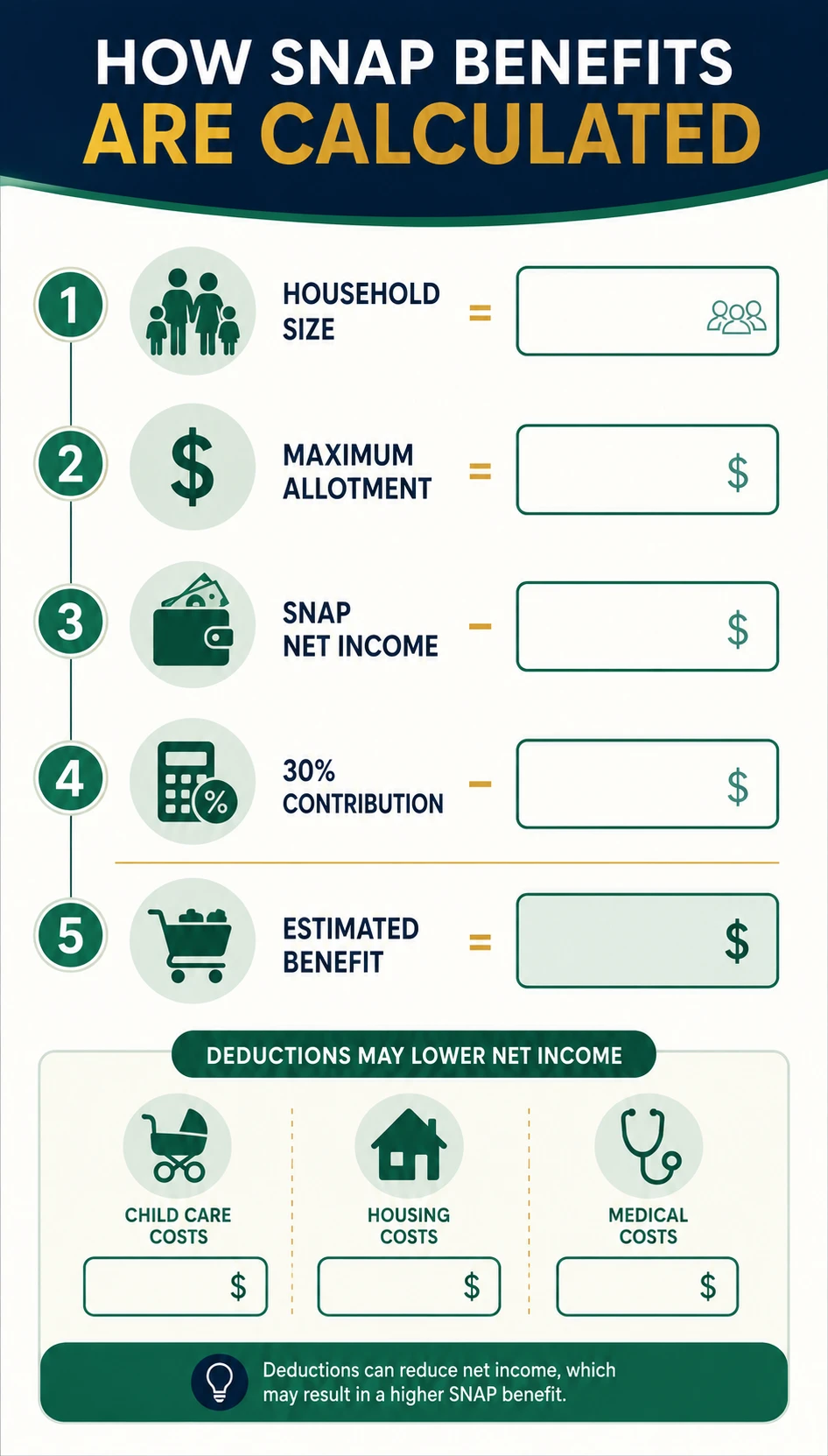
For a regular full month, the basic federal SNAP benefit calculation is:
Maximum allotment – 30% of SNAP net monthly income = calculated SNAP allotment
Federal rounding rules also apply. Depending on the method used by the state, 30% of net income may be rounded up to the next whole dollar, or the resulting allotment may be rounded down after subtraction.
USDA explains that SNAP households with net income are generally expected to contribute about 30% of their own resources toward food. The important word here is net.
SNAP does not simply use:
- your gross salary;
- your take-home paycheck;
- income after payroll taxes; or
- the amount currently in your bank account.
SNAP calculates a program-specific net-income amount after applying allowable deductions.
Those deductions can include:
- a 20% earned-income deduction;
- the standard household deduction;
- qualifying dependent-care expenses;
- qualifying medical expenses for an elderly or disabled household member;
- applicable child-support treatment; and
- qualifying shelter and utility expenses.
This is why two households earning the same gross salary can receive different SNAP benefits.
Related: If you need to understand gross income, net income and deduction limits first, read our updated guide to SNAP income limits by household size.
Example: One Person With $500 in SNAP Net Income
Example only
Maximum benefit: $298
SNAP net income: $500
30% of $500: $150
$298 – $150 = $148 estimated full-month benefit
The household does not receive the full $298 maximum because part of its SNAP net income is included in the household contribution used by the benefit formula.
Example: Three-Person Household With $1,200 in Net Income
Example only
Maximum benefit: $785
SNAP net income: $1,200
30% household contribution: $360
$785 – $360 = $425 estimated full-month benefit
The household-size maximum is $785, but the net-income contribution lowers the estimated allotment to $425.
Example: Four-Person Household
Consider a four-person household with $1,047.50 in SNAP net monthly income.
Maximum four-person allotment: $994
SNAP net income: $1,047.50
30% of net income: $314.25
Household contribution after rounding up: $315
$994 – $315 = $679
The important comparison is:
- Maximum possible regular benefit: $994
- Calculated full-month benefit in this example: $679
This is why a maximum-benefit table should be treated as a ceiling rather than a promise of what an eligible household will receive.
How Net Income Can Change a Four-Person Benefit
A four-person household in the 48 states and D.C. has a FY 2026 maximum monthly allotment of $994.
These simplified examples show the general effect of different SNAP net-income amounts when the 30% contribution produces a whole-dollar figure.
| SNAP Net Income | Approx. Household Contribution | Approx. Monthly Benefit |
|---|---|---|
| $0 | $0 | $994 |
| $500 | $150 | $844 |
| $1,000 | $300 | $694 |
| $1,500 | $450 | $544 |
| $2,000 | $600 | $394 |
These are simplified educational examples, not official eligibility or benefit determinations.
The general pattern is straightforward: lower SNAP net income usually produces an allotment closer to the household maximum, while higher net income usually produces a smaller allotment.
Every $100 difference in SNAP net income changes the basic 30% household contribution by about $30, assuming the rest of the calculation remains the same. That does not mean every $100 household expense creates $30 more in SNAP. The expense must qualify under SNAP rules and actually reduce the net income used in the case.
Why Two Families With the Same Income Can Get Different SNAP Amounts
Comparing your SNAP amount with a friend, coworker, or relative can be misleading.
Suppose two four-person households both have $3,000 in gross monthly income.
| Family A | Family B |
|---|---|
|
|
Both families start with the same gross income. Family B may have a lower SNAP net income after allowable deductions are applied. Because the benefit formula generally uses net income, Family B could receive a larger monthly allotment if all other applicable eligibility conditions are met.
The gross salary is the same. The SNAP calculation may not be.
Which Expenses Can Affect Your SNAP Benefit?
Not every household expense affects SNAP. Certain allowable deductions, however, can reduce SNAP net income and therefore influence the monthly benefit calculation.
Child-Care and Dependent-Care Costs
Qualifying dependent-care expenses needed so a household member can work, attend applicable training, or pursue qualifying education may be deducted in the net-income calculation.
For a working parent who pays qualifying child-care costs, this can be an important part of the SNAP budget.
Rent, Mortgage and Utilities
Housing costs can affect SNAP through the excess shelter calculation.
Depending on the household and applicable state rules, relevant shelter expenses may include qualifying:
- rent;
- mortgage costs;
- certain property-related expenses;
- heating and cooling;
- electricity;
- water; and
- other eligible utility costs.
SNAP does not simply subtract the entire rent, mortgage, or utility bill from income. A specific shelter-deduction calculation is used.
Medical Expenses
Households containing an elderly or qualifying disabled member can receive special treatment for allowable unreimbursed medical expenses.
Qualifying unreimbursed medical expenses above $35 per month may reduce SNAP net income.
Depending on the circumstances, allowable medical costs can include certain:
- prescription costs;
- medical or dental care;
- health insurance premiums;
- medical transportation; and
- other allowable medical expenses.
This can make a meaningful difference for an older adult or person with a qualifying disability who has recurring medical costs. USDA provides additional detail in its SNAP rules for elderly or disabled households.
Why Higher Rent Does Not Mean the Same Increase in SNAP
Suppose monthly rent increases by $300. That does not automatically mean the SNAP allotment increases by $300.
Instead:
- The qualifying shelter expense enters the SNAP shelter calculation.
- The resulting shelter deduction may reduce SNAP net income.
- SNAP then uses the resulting net-income figure in the benefit calculation.
- The household contribution is generally based on 30% of the calculated net income, subject to rounding rules.
Housing expenses can therefore affect the benefit in some cases, but the change is not dollar-for-dollar.
SNAP Benefits for Older Adults and People With Disabilities
There is not a separate maximum-benefit table simply because a household includes an older adult or a person with a qualifying disability. Household size and geographic location still determine the maximum allotment.
What can differ is the net-income calculation. Qualifying households may benefit from:
- deductions for qualifying unreimbursed medical expenses above $35 per month;
- different treatment of excess shelter expenses; and
- a lower SNAP net-income figure when allowable expenses are significant.
A lower net-income figure can produce a larger monthly allotment.
For example, if allowable expenses ultimately reduce SNAP net income by $200, the basic 30% household contribution could be about $60 lower, although the actual case calculation can involve additional steps and rounding.
For a broader informational screening of SNAP eligibility factors, you can also use our SNAP eligibility checker. It is an educational resource and does not determine eligibility.
What Is the Minimum SNAP Benefit in 2026?
For FY 2026, eligible one- and two-person households in the 48 contiguous states and Washington, D.C. generally receive a minimum regular monthly allotment of:
$24
FY 2026 federal minimum for eligible 1-2 person households in the 48 states and D.C., outside the initial-month exception
Federal regulation sets the minimum benefit at 8% of the one-person maximum allotment, rounded to the nearest whole dollar.
For FY 2026:
$298 × 8% = $23.84
Rounded to the nearest whole dollar = $24
Does the $24 Minimum Apply to Families of Three or More?
No. The federal minimum-allotment protection applies specifically to eligible one- and two-person households, subject to initial-month and other federal provisions.
Households with three or more people do not receive the same $24 minimum when the normal benefit calculation produces no benefit.
Why Someone Might Receive Only $24
Receiving $24 per month can seem surprisingly low.
For an eligible one- or two-person household in the 48 states and D.C., that amount can occur when:
- the household remains eligible for SNAP;
- its net income produces a very small allotment under the normal formula; and
- the federal minimum-benefit rule applies.
A $24 regular monthly benefit therefore does not automatically mean that the calculation is wrong. If income or allowable expenses change, the state agency may recalculate the allotment.
Can a State Provide Additional Food Assistance?
Some states may separately fund food-assistance supplements or related programs in addition to the federal SNAP allotment framework. Those programs are not the same thing as changing the federal SNAP minimum itself.
State-funded programs can change independently, so check current information from the responsible state agency rather than assuming a separate supplement is available in your state.
Your First SNAP Payment May Be Smaller Than Your Regular Benefit
A newly eligible household may notice that the first EBT issuance is lower than the regular monthly amount shown elsewhere in its eligibility notice.
That can happen because federal rules generally prorate initial-month SNAP benefits from the application date through the end of the month.
Simplified example
Regular full-month benefit: $500
Application submitted: around halfway through the month
The first allotment may cover only the eligible portion of the initial month. The exact proration is determined under federal rules and the state’s calculation.
The following full-month issuance can therefore be larger even when the household’s income and circumstances have not otherwise changed.
Can Your SNAP Benefit Change During the Year?
Yes. An approved SNAP allotment is not necessarily fixed until the next annual federal adjustment.
A household’s benefit can change when:
- countable income increases or decreases;
- regular work hours change;
- someone joins or leaves the SNAP household;
- qualifying dependent-care expenses change;
- allowable medical expenses change for an elderly or disabled household member;
- rent, mortgage, or applicable utility circumstances change;
- other allowable deductions change; or
- federal allotment amounts change for a new fiscal year.
The effect is not always dollar-for-dollar because the state agency recalculates the household’s SNAP budget under applicable program rules.
A Federal SNAP Increase Does Not Mean Everyone Gets the Same Raise
An increase in the maximum SNAP allotment does not necessarily mean every participating household receives the same increase.
Suppose the maximum benefit for a household size rises by $20, while the household’s calculated contribution also rises by $30 because its net income increased.
In that simplified situation, the calculated monthly benefit could be about $10 lower even though the maximum allotment increased.
The opposite can also happen. If the maximum rises while the household’s net income falls, the calculated allotment could increase by more than the change in the maximum alone.
The relevant comparison is the maximum allotment minus the household contribution, not simply the old maximum versus the new maximum.
What Happens When Your Household Size Changes?
Adding or removing a household member can change several parts of the calculation at once.
FY 2026 two-person maximum: $546
FY 2026 three-person maximum: $785
Difference: $239
Adding a third household member increases the maximum allotment by $239 in this example, but it does not guarantee a $239 increase in the actual benefit.
If the new household member brings countable income, that income can increase SNAP net income and reduce some of the potential benefit increase.
Household-size changes can affect both the maximum-allotment side and the income side of the calculation.
Why Larger Families Do Not Receive the One-Person Amount Multiplied
SNAP maximum allotments do not increase by simply multiplying $298 by every person in the household.
- 1 person: $298 total, or $298 per person
- 4 people: $994 total, or about $248.50 per person
- 8 people: $1,789 total, or about $223.63 per person
USDA’s Thrifty Food Plan calculations account for household-size economies of scale. Smaller households generally receive a somewhat higher amount per person than larger households.
SNAP Benefits in Alaska, Hawaii, Guam and the U.S. Virgin Islands
The regular 48-state benefit table does not apply everywhere.
Alaska, Hawaii, Guam and the U.S. Virgin Islands have separate federal maximum-allotment schedules.
| Location | 1 Person | 4 People | 8 People |
|---|---|---|---|
| 48 States + D.C. | $298 | $994 | $1,789 |
| Alaska Urban | $385 | $1,285 | $2,314 |
| Alaska Rural 1 | $491 | $1,639 | $2,950 |
| Alaska Rural 2 | $598 | $1,995 | $3,591 |
| Hawaii | $506 | $1,689 | $3,040 |
| Guam | $439 | $1,465 | $2,637 |
| U.S. Virgin Islands | $383 | $1,278 | $2,300 |
Source: USDA FNA FY 2026 maximum-allotment table. These figures are maximums, not guaranteed household payments.
Alaska is particularly different because it has three geographic allotment categories:
- Urban;
- Rural 1; and
- Rural 2.
For a four-person household, the FY 2026 maximum ranges from $1,285 in Urban Alaska to $1,995 in Rural 2 Alaska, a difference of $710 at the maximum-allotment level.
Minimum Benefits Also Vary by Location
Eligible one- and two-person households also have different FY 2026 federal minimum allotments depending on location.
| Location | Minimum Monthly Benefit |
|---|---|
| 48 States + D.C. | $24 |
| Alaska Urban | $31 |
| Alaska Rural 1 | $39 |
| Alaska Rural 2 | $48 |
| Hawaii | $41 |
| Guam | $35 |
| U.S. Virgin Islands | $31 |
These minimums apply under the applicable federal schedules to eligible one- and two-person households, subject to federal initial-month and other rules.
What About Puerto Rico and Other U.S. Territories?
Puerto Rico, American Samoa and the Commonwealth of the Northern Mariana Islands do not use the regular SNAP allotment schedule shown above.
Instead, these territories operate Nutrition Assistance Programs under separate federal block-grant arrangements. Their governments establish their own eligibility and benefit levels within the applicable federal framework.
The $298 one-person maximum, $994 four-person maximum, and other regular SNAP allotments should therefore not be used to estimate benefits under those separate territorial programs. See the USDA Nutrition Assistance Program block-grant information for the federal distinction.
Why an Online SNAP Calculator May Show a Different Amount
Online SNAP calculators can be useful for estimating a possible benefit, but two calculators can produce different results.
The official SNAP calculation can involve details such as:
- income averaging;
- pay frequency and anticipated income;
- state utility allowances;
- shelter deductions;
- dependent-care expenses;
- medical deductions;
- household composition;
- federal and state rounding procedures;
- initial-month proration; and
- recent or anticipated income changes.
Even a well-designed calculator is an estimate. The responsible state SNAP agency has the case information needed to make the official determination.
What to Check If Your SNAP Benefit Looks Too Low
If the amount shown in your SNAP notice is lower than expected, review the calculation and case information before assuming the maximum-benefit table was applied incorrectly.
Check:
- Household size: Were the correct household members included?
- Income used: Does it reflect the circumstances the agency is required to consider?
- Pay frequency: Was weekly, biweekly, semimonthly, or other income handled correctly?
- SNAP net income: What net-income amount did the agency calculate?
- Dependent-care costs: Were qualifying expenses considered?
- Medical expenses: Were qualifying costs considered if an elderly or disabled member is present?
- Housing information: Is the rent or mortgage information current?
- Utilities: Was the applicable utility treatment used?
- Final allotment: Does your eligibility notice explain the monthly amount?
If something appears outdated, missing, or incorrect, contact the responsible state SNAP agency and ask how the allotment was calculated.
An official notice should also provide information about applicable appeal or fair-hearing rights if you disagree with an agency decision.
SNAP Benefit Amount vs. Payment Date
These are two different questions.
Benefit amount: How much SNAP the household receives.
Payment date: When that amount is issued to the EBT account.
Two households could receive the same monthly allotment but have different issuance dates because payment schedules are administered by state agencies and vary by state.
Use our SNAP information by state to locate state-specific information, or use USDA FNA’s official SNAP State Directory for agency resources.
How to Estimate Your SNAP Benefit
You can make a rough educational estimate in a few steps.
- Find your household’s maximum allotment.
Use the FY 2026 benefit table for the appropriate household size and location. - Determine the relevant SNAP net income.
This is the program’s net-income calculation after allowable deductions, not simply gross pay or take-home pay. - Calculate 30% of the net income.
SNAP net income × 0.30 - Subtract the household contribution from the maximum.
Maximum allotment – household contribution = estimated allotment - Remember the additional rules.
Federal rounding, minimum-benefit provisions, initial-month proration, geographic schedules, and case-specific circumstances can affect the final amount.
Do not treat the estimate as an approval or payment quote. The state agency calculates the official SNAP allotment using the household’s verified case information.
Need your state’s official SNAP resource?
Application systems, case contacts and EBT resources are handled by state agencies. Use the federal directory to find the responsible SNAP agency.
Frequently Asked Questions About SNAP Benefits
What is the maximum SNAP benefit for one person in 2026?
For FY 2026, the maximum regular monthly allotment is $298 for a one-person household in the 48 contiguous states and Washington, D.C. Higher maximums apply in Alaska, Hawaii, Guam and the U.S. Virgin Islands.
How much SNAP can two people receive?
A two-person household can receive up to $546 per month in the 48 states and D.C. for FY 2026. The actual allotment may be lower depending mainly on SNAP net income and other applicable rules.
How much SNAP can a family of three receive?
The FY 2026 maximum regular monthly allotment for a three-person household is $785 in the 48 contiguous states and Washington, D.C.
How much SNAP can a family of four receive?
A four-person household can receive up to $994 per month in the 48 states and D.C. for FY 2026. The maximum does not guarantee a $994 payment because the benefit formula generally subtracts a household contribution based on net income.
What is the maximum SNAP benefit for five people?
The FY 2026 maximum is $1,183 per month for a five-person household in the 48 contiguous states and D.C.
What is the maximum SNAP benefit for eight people?
An eight-person household can receive up to $1,789 per month in the 48 states and D.C. for FY 2026. The maximum increases by $218 for each additional household member after eight.
Does everyone who qualifies for SNAP receive the maximum?
No. The maximum is the highest regular allotment for the household size and location. SNAP generally reduces that amount based on 30% of the household’s calculated net monthly income, subject to applicable rules.
What is the minimum SNAP benefit in 2026?
Eligible one- and two-person households generally have a $24 minimum regular monthly allotment in the 48 states and D.C. Different minimums apply in Alaska, Hawaii, Guam and the U.S. Virgin Islands, and initial-month rules are different.
Why did I receive only $24 in SNAP?
For an eligible one- or two-person household, the normal benefit calculation may produce a very small allotment. Outside applicable initial-month exceptions, the federal minimum-benefit rule can bring the regular monthly allotment to $24 in the 48 states and D.C.
Can a family of three receive the $24 minimum?
The federal $24 minimum-benefit rule is specifically for eligible one- and two-person households. It does not provide the same minimum protection to households of three or more people.
Can my SNAP benefit increase if my income goes down?
Potentially. A qualifying decrease in countable income can lower SNAP net income and the household contribution used in the benefit formula, which can result in a larger allotment depending on the complete case calculation.
Can higher rent increase my SNAP benefit?
Possibly. Qualifying shelter costs can affect the excess shelter deduction and therefore SNAP net income. The effect is not dollar-for-dollar, so a $200 rent increase does not automatically mean $200 more in SNAP.
Can child-care costs affect my SNAP benefit?
Qualifying dependent-care expenses can affect SNAP net income when the care is needed for applicable employment, training or education purposes. A lower calculated net income can potentially result in a larger allotment.
Can medical bills affect SNAP benefits?
For households containing an elderly or qualifying disabled member, allowable unreimbursed medical expenses above $35 per month can reduce SNAP net income and affect the final allotment.
Why was my first SNAP payment smaller than expected?
Initial-month SNAP benefits are generally prorated from the application date. The first issuance may therefore cover only part of a month, while a later full-month issuance can be larger.
Can my SNAP benefit change from month to month?
It can change when countable income, household composition, allowable expenses or other relevant case circumstances change. Some households have relatively stable allotments, while others may see adjustments after changes are processed.
Can two families with the same income receive different SNAP benefits?
Yes. Two households with the same gross income can have different SNAP net incomes because their allowable deductions, shelter costs, dependent-care expenses or qualifying medical expenses differ.
Why does an online SNAP calculator give me a different amount?
Calculators may handle income averaging, state utility allowances, deductions, household composition, rounding and initial-month rules differently. Treat online calculations as estimates. The state SNAP agency makes the official determination.
Are SNAP benefits higher in Alaska and Hawaii?
Their maximum allotment schedules are higher than the 48-state schedule. For FY 2026, the one-person maximum is $298 in the 48 states and D.C., $506 in Hawaii, and from $385 to $598 depending on the Alaska geographic area.
Who determines my exact SNAP benefit?
The responsible state SNAP agency reviews household information and determines the official monthly allotment using applicable federal and state program rules.
Sources & Verification
Important current sources used to verify this guide include:
- USDA FNA SNAP Cost-of-Living Adjustment information for FY 2026 maximum and minimum allotments and geographic schedules.
- USDA FNA SNAP eligibility and benefit calculation guidance for the federal 30% net-income framework and deductions.
- USDA FNA special rules for elderly or disabled households.
- 7 CFR § 273.10 for benefit calculations, rounding, minimum allotments and initial-month proration.
- USDA FNA Nutrition Assistance Program block-grant information for Puerto Rico, American Samoa and the Commonwealth of the Northern Mariana Islands.
You can learn more about how this site reviews public-benefit information in our source methodology.
Conclusion: Your SNAP Maximum and Actual Benefit Are Not the Same
For FY 2026, maximum SNAP benefits in the 48 contiguous states and Washington, D.C. range from $298 for one person to $1,789 for eight people, with $218 added for each additional household member after eight.
But the maximum is only the starting point.
Household size determines the benefit ceiling, while SNAP net income is a major factor in determining how much of that maximum the household receives. Allowable deductions for dependent care, shelter expenses, utilities and certain medical costs can reduce net income and affect the calculation.
Eligible one- and two-person households may receive a minimum allotment, an initial month’s benefit can be prorated, and Alaska, Hawaii, Guam and the U.S. Virgin Islands use different federal benefit schedules.
For an educational estimate, start with the maximum allotment for the household size and location, determine the applicable SNAP net income, and apply the federal benefit formula with the required qualifications.
The responsible state SNAP agency makes the official eligibility and benefit determination.