
California CalFresh is the state’s version of the federal Supplemental Nutrition Assistance Program (SNAP), commonly called food stamps. You can apply online through BenefitsCal or work with your county social services agency. Regular applications are generally processed within 30 days, while households that meet California’s expedited-service rules can receive CalFresh within three calendar days.
If approved, CalFresh benefits are issued through California’s Golden State Advantage EBT card. Your county handles interviews, verification, and eligibility decisions, while BenefitsCal is used for much of the online case-management process and ebtEDGE provides important EBT card-management tools.
Whether you are applying for the first time, checking a Pending case, looking for your next EBT deposit, completing a SAR 7 or preparing for recertification, this guide explains how CalFresh works in California and where to go next.
By FoodStampsApply.com Editorial
Last verified: August 28, 2026
Quick Answer
Apply for California CalFresh through BenefitsCal or your county social services agency. California’s current FY2026 public screening table starts at $2,610 gross monthly income for a one-person household under its Modified Categorical Eligibility framework, with a $1,305 net-income standard and a $298 maximum monthly allotment. Regular applications are generally processed within 30 days; eligible expedited cases can receive benefits within three calendar days. Approved benefits are issued on a Golden State Advantage EBT card.
Independent information: FoodStampsApply.com SNAP resources are published independently. We do not process CalFresh applications, operate BenefitsCal or ebtEDGE, access individual cases, issue EBT cards or make eligibility decisions. California counties and the responsible state/federal agencies handle official program administration.

Quick Answer: What Do You Need From CalFresh?
| If You Want To | Start Here |
|---|---|
| Apply for CalFresh | BenefitsCal or your county social services agency |
| Check whether you may qualify | Review the current income and eligibility section below |
| Check a Pending application | BenefitsCal, county notices and your local county office |
| Check EBT balance or transactions | ebtEDGE or California EBT Customer Service |
| Find your regular deposit date | Use the last digit of your county case number |
| Complete SAR 7 or recertification | BenefitsCal and your county instructions |
| Report a lost or compromised EBT card | 1-877-328-9677, ebtEDGE, BenefitsCal or your county as appropriate |
| Appeal a county decision | California State Hearings Division |
How CalFresh Works in California
CalFresh is California’s version of SNAP. The California Department of Social Services (CDSS) supervises the program at the state level, while county welfare or social services departments handle individual applications and cases.
That division matters. Californians can use the statewide BenefitsCal system, but your county remains responsible for matters such as:
- eligibility interviews;
- verification requests;
- approval or denial decisions;
- benefit calculations;
- SAR 7 processing;
- recertification; and
- case-specific notices.
California CalFresh Quick Facts
| Item | California Information |
|---|---|
| Program name | CalFresh |
| State agency | California Department of Social Services |
| Application/case portal | BenefitsCal |
| CalFresh Benefits Helpline | 1-877-847-3663 |
| Hearing/speech assistance | 711 Relay |
| EBT card | Golden State Advantage EBT card |
| EBT Customer Service | 1-877-328-9677 |
| EBT app/portal | ebtEDGE |
| Regular application processing | Generally up to 30 days for eligible households completing the process |
| California expedited processing | Within 3 calendar days when the household meets expedited-service criteria |
| Regular CalFresh deposits | 1st through 10th of the month |
| Deposit-day factor | Last digit of county case number |
For case-specific help, use the official California CalFresh contact resources.
How to Apply for CalFresh in California
Apply Online Through BenefitsCal
For most applicants who want to apply online, BenefitsCal is the main statewide starting point.
After creating or linking an account, BenefitsCal can also be used for many case-management tasks, including:
- viewing benefits information;
- reviewing notices and appointments;
- uploading documents and reports;
- reporting certain changes;
- completing tasks requested by the county;
- submitting recertification; and
- following up on case information.
Open the Official BenefitsCal Website
Older GetCalFresh instructions are outdated for new applications. GetCalFresh stopped transmitting new CalFresh applications after June 30, 2025. The GetCalFresh site may continue providing general information and support, but CDSS directs new online applications to BenefitsCal.
You can review the official GetCalFresh-to-BenefitsCal transition information.
Apply by Paper or Through Your County
California also maintains the CF 285 Application for CalFresh Benefits. Depending on county procedure, applicants may be able to work with the county in person, by mail, by fax or through another county-supported application method.
If you want help applying by phone or another method, contact the county responsible for your case.
CalFresh Benefits Helpline: 1-877-847-3663
Official CalFresh forms are available through the California forms directory.
You Can File Before Every Document Is Ready
Do not automatically delay an application because you are still waiting for one pay stub, utility bill or another piece of verification.
California gives applicants the right to turn in an application when they ask to apply. The county can request additional verification needed to complete the eligibility decision afterward.
Because an eligible household’s application date can affect when benefits begin, filing promptly can matter.
For examples of documents that may be requested later, see our SNAP application documents guide.
California CalFresh Income Limits for 2026
California’s current FY2026 CalFresh figures apply from October 1, 2025 through September 30, 2026.
Important California distinction: the gross figures in California’s current public screening table are based on the state’s Modified Categorical Eligibility (MCE) 200% federal poverty framework. They should not be confused with USDA’s ordinary 130% federal gross-income table. The net-income figures shown below are the applicable 100% poverty standards. Your county determines which financial tests apply to your household.
| Household Size | California Gross Monthly Screening Limit | Net Monthly Limit | Maximum Monthly CalFresh Allotment |
|---|---|---|---|
| 1 | $2,610 | $1,305 | $298 |
| 2 | $3,526 | $1,763 | $546 |
| 3 | $4,442 | $2,221 | $785 |
| 4 | $5,360 | $2,680 | $994 |
| 5 | $6,276 | $3,138 | $1,183 |
| 6 | $7,192 | $3,596 | $1,421 |
| 7 | $8,110 | $4,055 | $1,571 |
| 8 | $9,026 | $4,513 | $1,789 |
| Each additional person | +$918 | +$459 | +$218 |
These figures are useful for screening, but CalFresh is not decided by salary alone. Household composition, countable income, and allowable deductions can change both eligibility and the amount of CalFresh a household receives.
Relevant expenses can include housing and utilities, dependent care, certain child-support payments and qualifying medical expenses for an older or disabled household member.
The maximum allotment is also not a promise that an eligible household will receive that amount. Actual benefits depend on the household’s SNAP calculation.
For broader federal concepts, see our guides to SNAP income limits and SNAP benefit amounts.
Do Savings or a Car Automatically Disqualify You?
No, not automatically. California uses Modified Categorical Eligibility for qualifying CalFresh households.
For households conferred MCE status, resources are generally excluded from the regular CalFresh resource test. California also uses the broader 200% federal poverty gross-income framework when determining MCE.
That means owning a vehicle or having savings should not, by itself, be treated as proof that a household cannot receive CalFresh. Your county determines whether MCE and other eligibility rules apply to your case.
College Students Have an Extra SNAP Rule
Income is not the only issue for students enrolled in higher education. Students ages 18–49 who are enrolled at least half-time can also face the federal SNAP student restriction and may need a qualifying exemption.
If that applies to you, see our latest guide to SNAP for college students before assuming low income alone is enough.
California CalFresh Eligibility Changes to Know in 2026
Several federal changes are now reflected in California’s CalFresh rules. This makes older application guides particularly risky to rely on without checking the date.
Utility Deduction Rules Changed
Beginning November 1, 2025, the rules California uses for the Standard Utility Allowance (SUA) changed for some households.
Households that do not include a person age 60 or older or a person with a disability generally need heating or cooling costs separate from housing costs to claim the SUA.
Previously, certain households without separate heating/cooling expenses could receive a small annual state energy-assistance payment that made them eligible to claim the SUA. Under the new federal rule, California says that route is now limited to households with an older or disabled member.
Because a smaller utility deduction can raise countable net income, the change can reduce benefits for some households. See California’s current H.R. 1 and CalFresh FAQ.
Federal Noncitizen Eligibility Rules Changed April 1, 2026
California implemented major federal SNAP noncitizen-eligibility changes beginning April 1, 2026.
California’s current guidance says several categories of lawfully present immigrants who previously qualified for federally funded CalFresh can no longer qualify under the new federal restrictions. Those categories include various refugee, asylee, parole, trafficking-victim, and other immigration classifications.
Immigration categories are legally specific. Do not assume a general internet label such as “refugee,” “parolee,” or “green-card holder” fully determines eligibility. The county should apply the current rules to the applying household member’s actual status.
Use CDSS’s current CalFresh federal-change guidance for the categories affected beginning April 1, 2026.
California Food Assistance Program May Still Apply
California separately operates the state-funded California Food Assistance Program (CFAP) for certain noncitizens who are ineligible for federally funded CalFresh solely because of immigration status.
CFAP and CalFresh use the same application. You do not need to determine the correct program yourself before applying; the county reviews the application and determines which program may apply.
See official California CFAP application information.
What Happens After You Apply for CalFresh?
After the application is submitted, your county reviews the case, handles the interview and verifies information needed to determine eligibility.
Not every applicant needs every document below, but commonly verified information can include:
| What May Be Verified | Possible Examples |
|---|---|
| Identity | ID or another acceptable identity record |
| Income | Pay stubs, employer information, or benefit statements |
| Housing costs | Rent or mortgage information |
| Utilities | Utility information where relevant to the deduction |
| Dependent care | Child-care or adult-care expenses |
| Child support paid | Payment or court records where applicable |
| Medical expenses | Qualifying unreimbursed expenses for an older or disabled household member |
| Immigration status | For applying household members when relevant to eligibility |
BenefitsCal Shows My Document as Uploaded. Why Is My Case Still Pending?
An uploaded document is not necessarily a reviewed document.
If you submitted proof but the case still shows Pending or a task remains open, check:
- the most recent county notice;
- appointment or interview information;
- your BenefitsCal Things to Do section;
- the exact verification requested; and
- whether another deadline is approaching.
The county may still be reviewing your upload, waiting for an interview or requesting something different. Re-uploading the same file repeatedly will not fix a case if another item is actually missing.
What If My CalFresh Application Is Still Pending?
California generally provides eligible households that complete the regular initial process an opportunity to participate within 30 days of filing.
If your case is approaching that point, look beyond the word Pending and check whether the county is waiting for:
- an interview;
- income verification;
- household information;
- another requested document; or
- clarification of an eligibility issue.
Our SNAP application status guide explains what Pending, verification, and interview messages commonly mean.
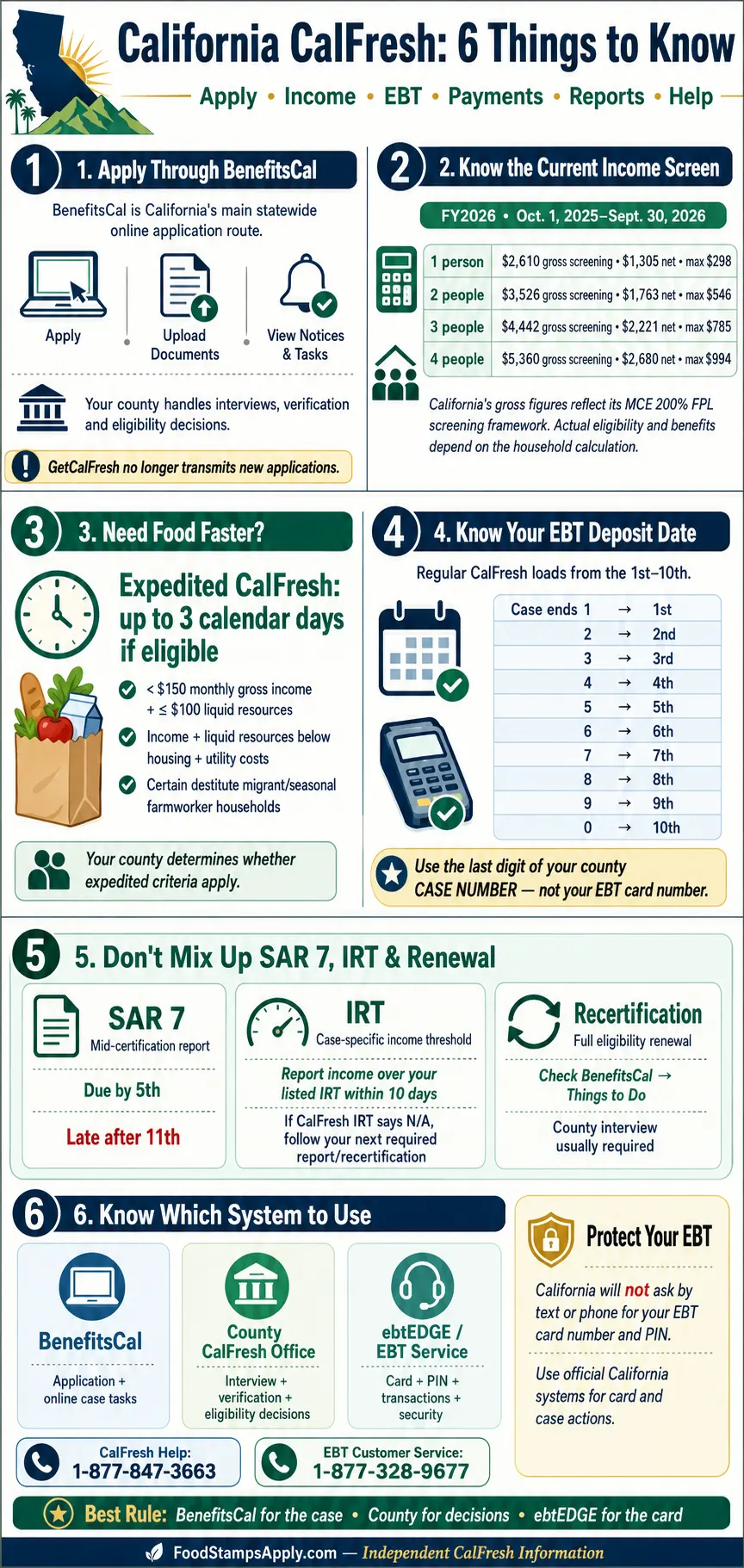
Need Food Help Faster? Check Expedited CalFresh
California provides expedited CalFresh to households that meet its emergency-processing criteria. Eligible households receive expedited benefits no later than the third calendar day after filing the application under California’s processing standard.
A household may meet an expedited-service category when, for example:
- monthly gross income is less than $150 and liquid resources are $100 or less;
- combined monthly gross income and liquid resources are less than monthly rent or mortgage plus utilities; or
- the household includes a qualifying destitute migrant or seasonal farmworker and meets the applicable liquid-resource rule.
These are screening rules, not a promise of expedited approval. The county determines whether the household meets the applicable criteria.
If money for food is extremely limited: answer the expedited-service questions on the application accurately. Do not skip them because you assume every CalFresh case has the same 30-day timetable.
California’s CalFresh rights and responsibilities confirm the state’s three-day expedited standard for eligible households.
After Approval: California EBT and ebtEDGE
Approved CalFresh benefits are issued through the Golden State Advantage (GSA) EBT card.
For card help:
- California EBT Customer Service: 1-877-328-9677
- Use the ebtEDGE mobile app or cardholder portal for supported card-management features.
- BenefitsCal can also support certain EBT-card and electronic-theft tasks.
- Your county office can assist with CalFresh EBT issues when appropriate.
Depending on the current ebtEDGE function, California cardholders can use it to review card activity, change a PIN, request a replacement card, freeze or unfreeze a card, and manage certain transaction-security settings.
See CDSS’s official California EBT card information.
California Now Uses Chip-and-Tap EBT Cards
California completed its transition to chip- and tap-enabled EBT cards in 2025. The updated Golden State Advantage card is designed to provide stronger protection than relying only on magnetic-stripe transactions.
Use chip or tap at supported terminals when available, and protect your PIN just as carefully as the card itself.
Security warning: California says the state or county will not call or text asking you to provide your EBT card number and PIN. Do not enter those credentials into an informational website or give them to someone claiming they need them to “verify” benefits.
What If CalFresh Benefits Were Stolen Electronically?
If you still have the physical card but see transactions you do not recognize or a balance that is unexpectedly lower, review the transaction history and act promptly.
California allows electronic theft reports through applicable channels such as BenefitsCal, EBT customer service, and county offices. If you are seeking replacement of potentially eligible electronically stolen benefits, CDSS says the theft must be reported to the local county office within 90 days of the theft.
See California’s official EBT electronic-theft resources.
For general card activation, PIN, balance, and replacement information, see our EBT card guide.
California CalFresh Payment Dates for 2026
Regular CalFresh benefits are issued from the 1st through the 10th of each month.
The regular deposit date is based on the last digit of your county case number—not the final digit of your EBT card number.
| Last Digit of County Case Number | Regular Deposit Date |
|---|---|
| 1 | 1st |
| 2 | 2nd |
| 3 | 3rd |
| 4 | 4th |
| 5 | 5th |
| 6 | 6th |
| 7 | 7th |
| 8 | 8th |
| 9 | 9th |
| 0 | 10th |
For example, a county case number ending in 4 normally corresponds with the 4th of the month, while a case ending in 0 corresponds with the 10th.
This is why two CalFresh households living in the same city can have different regular deposit dates.
Common California CalFresh Problems and What to Check
| Situation | What to Check |
|---|---|
| Pending after interview | Look for a new verification request, task or county notice |
| Document uploaded but task stays open | The county may not have reviewed it yet or may need different information |
| No benefit on the 1st | California does not issue everyone on the 1st; check the last digit of your county case number |
| Can’t find EBT transactions in BenefitsCal | Use ebtEDGE or the California EBT system for card activity |
| Old GetCalFresh application route no longer works | New online applications moved to BenefitsCal |
| Benefits suddenly stopped | Check for a SAR 7, recertification, IRT-related action or another county Notice of Action |
| Card is still with you but benefits disappeared | Review ebtEDGE transactions and report suspected electronic theft promptly |
These problems belong to different parts of California’s system. A missing EBT deposit, unfinished verification and late SAR 7 should not be troubleshot in exactly the same way.
Keeping CalFresh: Recertification, SAR 7 and IRT
Recertification, SAR 7 and the Income Reporting Threshold (IRT) are related to maintaining eligibility, but they are not the same requirement.
Recertification Is Your Full Renewal
CalFresh is approved for a certification period. Before that period ends, the household must complete recertification if it wants benefits to continue.
BenefitsCal generally makes the recertification task available through the account’s Things to Do area.
California CalFresh recertification also generally includes an interview. Counties commonly complete interviews by telephone, although other arrangements may be available when appropriate.
BenefitsCal publishes current CalFresh recertification instructions.
SAR 7 Is a Mid-Certification Report
Many households using California’s semi-annual reporting system receive a SAR 7 Eligibility Status Report between full recertifications.
California’s SAR 7 instructions say:
- the report is due by the 5th of the submit month;
- it is considered late if received after the 11th;
- required questions must be answered;
- requested proof must be included;
- required signatures must be present; and
- a form signed before the first day of the submit month may need to be signed again.
Uploading a SAR 7 does not automatically make it complete. Missing answers, proof or signatures can still create a reporting problem.
See California’s official SAR 7 instructions.
IRT Is an Income-Change Reporting Rule
The Income Reporting Threshold is a case-specific level that can create a mandatory mid-period income-reporting requirement.
Your actual IRT is provided by the county. If your household’s total monthly income goes above the IRT listed for CalFresh, California generally requires the increase to be reported within 10 days.
If your CalFresh IRT is shown as N/A, California’s reporting form says that specific income-change report is not required before the next SAR 7 or recertification, whichever comes first.
Do not copy an IRT amount from another household. Use the threshold shown on your own county notice. California’s CalFresh reporting form explains the rule.
California CalFresh Work Requirements in 2026
California implemented major federal CalFresh work and community-engagement changes beginning June 1, 2026.
The separate SNAP time-limit rules can now generally reach adults ages 18–64 unless an applicable exception, exemption, or waiver applies.
One important current exception involves responsibility for a dependent child under age 14. Other exceptions can involve pregnancy, physical or mental limitations, applicable caregiving circumstances, and other categories recognized under current federal and California rules.
Do not confuse this time-limit rule with California’s separate general CalFresh work requirements.
For the full distinction, see our SNAP work requirements guide and California’s official CalFresh Work and Community Engagement Requirements.
Current California Time-Limit Waiver Counties
California currently lists the following counties under an approved time-limit waiver through October 31, 2026:
- Alpine
- Colusa
- Imperial
- Merced
- Monterey
- Plumas
- Tulare
The waiver affects the ABAWD/SNAP time limit for covered residents. It does not automatically remove every general CalFresh work requirement.
Time-sensitive: this county list is approved through October 31, 2026. Recheck the CDSS work-requirements page after that date rather than assuming the same counties remain waived.
California Restaurant Meals Program
California’s Restaurant Meals Program (RMP) allows qualifying CalFresh households to buy prepared meals from approved participating restaurant vendors.
The program is available statewide, although the number and location of participating restaurants vary.
Who Can Use the Restaurant Meals Program?
California’s current RMP rule is based on the composition of the CalFresh household. All household members must fit an RMP-eligible category.
Eligible categories include:
- an adult age 60 or older;
- a person with a disability;
- a person experiencing homelessness; or
- the spouse of an individual who qualifies through age or disability.
A spouse does not separately have to meet the age or disability criterion, but a household containing another member who does not meet an RMP category can be ineligible for the Restaurant Meals Program.
Eligible CalFresh recipients can use participating RMP restaurants outside their county of residence.
Use CDSS’s California Restaurant Meals Program locator and information.
For normal grocery rules, see what you can buy with SNAP EBT. To find ordinary SNAP-authorized retailers, see our guide to stores that accept EBT.
What If CalFresh Is Denied, Reduced or Stopped?
A California Notice of Action should explain the county’s decision and why the action was taken.
If you disagree with a county action, California generally requires a State Hearing request within 90 days of the county’s action.
California State Hearings Division: 1-800-743-8525
Request a California State Hearing
Requesting a Hearing Before the Effective Date Can Matter
If the Notice of Action says current benefits will be reduced or stopped, requesting a hearing before the effective date can allow the household to request continuation of existing aid while the dispute is pending.
For CalFresh, California explains that this continuation generally lasts only through the end of the current certification period, even if the hearing occurs later.
If the final hearing decision is not in the household’s favor, benefits received as aid pending can become subject to repayment.
Do not ignore a Notice of Action simply because you believe the county made an error. Hearing and effective-date deadlines still matter.
California CalFresh Phone Numbers and Official Help
| What You Need | Official Starting Point |
|---|---|
| CalFresh information/application help | 1-877-847-3663 |
| Hearing/speech assistance | 711 Relay |
| EBT card/customer service | 1-877-328-9677 |
| California State Hearing | 1-800-743-8525 |
| Pending case, interview, documents or renewal | County social services/human services agency handling the case |
If you are elsewhere in the country, use our SNAP information by state directory rather than using California contacts for another state’s SNAP case.
California residents can use CDSS’s official CalFresh contacts page to locate county assistance.
California CalFresh FAQs
Where do I apply for CalFresh in California?
For online applications, use BenefitsCal. You can also work with your county social services agency. GetCalFresh stopped transmitting new CalFresh applications after June 30, 2025.
What is the CalFresh income limit for one person in 2026?
California’s FY2026 public screening table lists a $2,610 gross monthly MCE screening limit and $1,305 net monthly limit for a one-person household. These figures apply October 1, 2025 through September 30, 2026. The county applies the eligibility tests appropriate to the household.
What is the maximum CalFresh benefit for one person in 2026?
The FY2026 maximum allotment for a one-person household is $298 per month. That is a maximum, not a guaranteed benefit amount. Actual CalFresh depends on the household’s eligibility calculation.
How long does a CalFresh application take?
Regular eligible households that complete the application process generally receive an opportunity to participate within 30 days of filing. Households that meet California’s expedited-service criteria can receive CalFresh within three calendar days.
How do I check my CalFresh application status?
Start with BenefitsCal and review notices, appointments and Things to Do. If the online information does not explain what remains unresolved, contact the county responsible for your application.
When does CalFresh load in California?
Regular CalFresh deposits are scheduled from the 1st through the 10th of each month based on the final digit of the household’s county case number.
Are BenefitsCal and ebtEDGE the same?
No. BenefitsCal is used to apply for and manage much of the CalFresh eligibility case. ebtEDGE focuses on EBT card functions such as transactions, PIN and supported card-security controls.
What is a SAR 7?
SAR 7 is a semi-annual eligibility status report used by many California households between full recertifications. It is due by the 5th of the submit month and is considered late after the 11th.
Can I use CalFresh at restaurants?
Qualifying households can use CalFresh at participating restaurants through California’s Restaurant Meals Program. RMP eligibility depends on the household meeting the program’s age, disability, homelessness or spouse criteria.
Does California have an asset limit for CalFresh?
Many California households receive Modified Categorical Eligibility, which generally removes the regular CalFresh resource test. However, MCE and other eligibility rules must be applied to the specific household by the county.
Can I appeal a CalFresh denial?
Yes. California generally requires a state-hearing request within 90 days of the county action being challenged. If current benefits are being reduced or stopped, requesting the hearing before the effective date can also matter for aid-pending rules.
Sources & Verification
Important official sources used to verify this California guide include:
- California Department of Social Services — CalFresh for state program administration and current CalFresh resources.
- BenefitsCal for California’s online benefits application and case-management system.
- CDSS GetCalFresh Transition for the move of new online CalFresh applications to BenefitsCal.
- California FY2026 CalFresh Income & Eligibility Limits for the current income and maximum-allotment table.
- CDSS H.R. 1 & CalFresh FAQ for current utility, immigration and work-rule changes.
- California CalFresh Rights and Responsibilities for regular and expedited application-processing standards.
- California EBT Card and EBT Electronic Theft Resources.
- California SAR 7 Instructions and CalFresh IRT Reporting Form.
- California CalFresh Work and Community Engagement Requirements for the June 2026 changes and current waiver information.
- California Restaurant Meals Program.
- California State Hearing Requests.
For information about how FoodStampsApply.com selects and verifies public-benefit sources, see our source methodology.
Conclusion: Know Which California System Handles What
For a new California food-stamp application, BenefitsCal is the main statewide online starting point. Apply promptly, complete the county interview and respond to verification requests rather than waiting to collect every possible document before filing.
After approval, remember how California’s system is divided:
BenefitsCal: application and much of your online eligibility-case management
Your county: interviews, verification, eligibility decisions, SAR 7 and recertification processing
ebtEDGE / California EBT: card, PIN, transaction and supported security-management functions
If you already receive CalFresh, know your county-case-number payment date, pay attention to SAR 7 and recertification notices, protect your EBT card and review a Notice of Action promptly when benefits change.
For a case-specific eligibility decision or unresolved application issue, use BenefitsCal and the county social services agency responsible for your case rather than sending personal case information to an independent information website.