SNAP Income Limits 2026 by Household Size
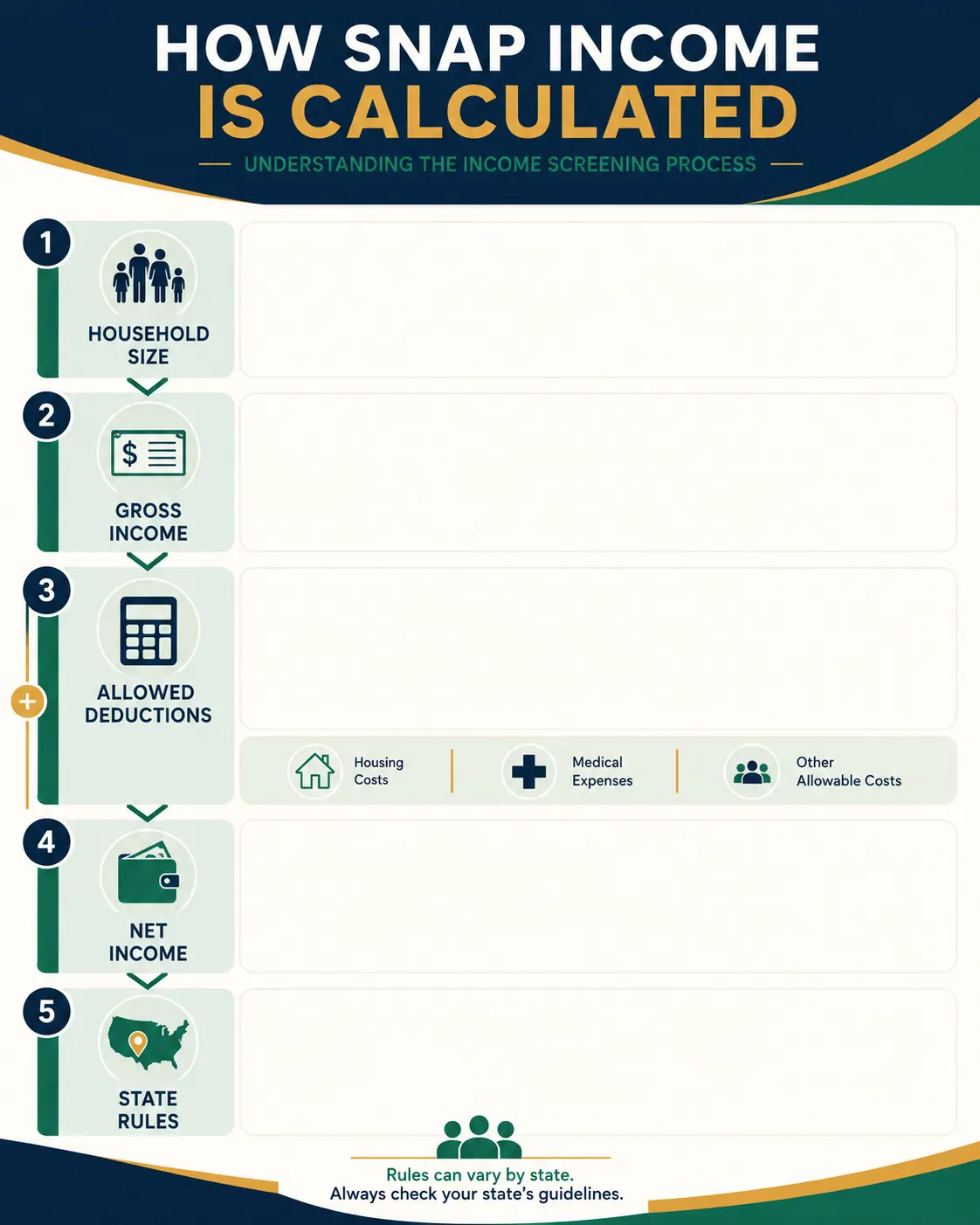
If you’re checking whether your income may fit within SNAP limits, start with the basics: household size, gross monthly income, net income after allowable deductions, and the rules used by your state. Many working households, older adults, people with disabilities, and households with changing income may still have additional factors to consider before deciding their income is too high.
Use the FY 2027 income tables below to compare your household size and income. If you are close to a limit, review deductions and state-specific rules before making assumptions about eligibility. The state SNAP agency makes the official determination.
By FoodStampsApply.com Editorial
Last verified: October 4, 2026
Quick Answer
For FY 2027, regular federal SNAP gross monthly income limits in the 48 contiguous states and D.C. start at $1,729 for one person, $2,345 for two, $2,960 for three, and $3,575 for four. Net limits start at $1,330, $1,804, $2,277, and $2,750. These standards apply October 1, 2026 through September 30, 2027. Alaska and Hawaii have higher federal limits, and BBCE can affect income screening in many states.
Independent information: FoodStampsApply.com is an independent SNAP information publisher. Our national SNAP information helps readers understand program rules and locate official resources, but we do not process applications, access EBT accounts, or decide eligibility.

SNAP Income Limits for FY 2027
When Do the FY 2027 SNAP Income Limits Apply?
The current income standards are for Federal Fiscal Year 2027. USDA’s Food and Nutrition Administration, formerly the Food and Nutrition Service, publishes SNAP income standards for each federal fiscal year.
- FY 2027 runs from October 1, 2026 through September 30, 2027.
- SNAP income eligibility standards are adjusted for the start of each federal fiscal year.
- The regular federal gross-income limit is based on 130% of the applicable poverty level.
- The regular net-income limit is based on 100% of the applicable poverty level.
You can review USDA’s current FY 2027 SNAP standards and deductions for the federal source tables.
Date note: These FY 2027 figures remain applicable through September 30, 2027. Do not use them for a later federal fiscal year without checking USDA’s updated standards.
FY 2027 SNAP Income Limits for the 48 States and D.C.
Under the regular federal rules, the following gross and net monthly income standards apply in the 48 contiguous states and Washington, D.C. USDA’s FY 2027 income table also uses these same gross and net figures for Guam and the U.S. Virgin Islands.
| Household Size | Gross Monthly Limit | Net Monthly Limit |
|---|---|---|
| 1 | $1,729 | $1,330 |
| 2 | $2,345 | $1,804 |
| 3 | $2,960 | $2,277 |
| 4 | $3,575 | $2,750 |
| 5 | $4,191 | $3,224 |
| 6 | $4,806 | $3,697 |
| 7 | $5,421 | $4,170 |
| 8 | $6,037 | $4,644 |
| Each additional person | +$616 | +$474 |
These are regular federal income standards, not an individual eligibility guarantee. State categorical-eligibility policies can affect how financial screening works.
Alaska and Hawaii SNAP Income Limits for FY 2027
Alaska and Hawaii use higher federal poverty standards, so their regular SNAP gross and net income limits are different from the table above.
| Household | Alaska Gross | Alaska Net | Hawaii Gross | Hawaii Net |
|---|---|---|---|---|
| 1 | $2,162 | $1,663 | $1,989 | $1,530 |
| 2 | $2,931 | $2,255 | $2,697 | $2,075 |
| 3 | $3,700 | $2,846 | $3,404 | $2,619 |
| 4 | $4,469 | $3,438 | $4,112 | $3,163 |
| 5 | $5,238 | $4,030 | $4,819 | $3,707 |
| 6 | $6,008 | $4,621 | $5,527 | $4,251 |
| 7 | $6,777 | $5,213 | $6,234 | $4,795 |
| 8 | $7,546 | $5,805 | $6,941 | $5,340 |
| Each additional | +$770 | +$592 | +$708 | +$545 |
Want to look beyond the income table?
The SNAP eligibility checker explains additional eligibility factors and can help you organize what to review next. It is informational and does not replace a state agency eligibility decision.
Gross vs. Net Income: Which SNAP Limit Matters?
SNAP uses both gross and net income, but they do not mean the same thing.
What Is Gross Monthly Income?
Gross income generally means countable household income before SNAP deductions are applied.
Example
Gross wages: $2,000
Taxes and payroll deductions: $300
Take-home pay: $1,700
You should not automatically compare the $1,700 deposited into your account with the SNAP gross-income limit. The gross-income test generally begins with countable income before SNAP deductions, not simply your paycheck after taxes.
What Is Net Monthly Income?
SNAP net income is calculated after deductions specifically allowed under SNAP rules.
Simplified SNAP net-income calculation
Gross countable income
– 20% earned-income deduction, when applicable
– standard deduction
– qualifying dependent-care deduction
– qualifying medical expenses for an elderly or disabled member
– applicable child-support deduction where allowed
– qualifying excess shelter deduction
= SNAP net income
Your SNAP net income is therefore not the same thing as take-home pay after payroll taxes.
Do You Have to Meet Both SNAP Income Limits?
Under regular federal SNAP rules, most households without an elderly or disabled member generally must meet both:
- the gross-income limit; and
- the net-income limit after allowable deductions.
A household containing an elderly or disabled member generally only has to meet the regular net-income test. USDA explains this distinction in its current SNAP eligibility guidance.
Categorically eligible households can be treated differently because the regular gross and net income eligibility tests may not apply in the same way.
Make Sure You Are Using the Correct Household Size
Household size determines which income limit applies. A monthly income of $2,500 can produce a very different initial comparison depending on whether the SNAP household contains one, two, three, four, or more people.
Regular FY 2027 gross limits for comparison
- 1 person: $1,729
- 2 people: $2,345
- 3 people: $2,960
- 4 people: $3,575
- 5 people: $4,191
Who Counts as Part of Your SNAP Household?
SNAP household rules are not always based simply on everyone living at the same address.
People who live together and normally purchase and prepare meals together are generally grouped together as one SNAP household. Some relationships have special rules:
- Spouses who live together are generally included in the same SNAP household.
- Most children under age 22 who live with a parent are included with the parent even if food is purchased or prepared separately.
- Unrelated roommates who purchase and prepare their food separately may be separate SNAP households.
USDA’s SNAP household and eligibility guidance provides the federal framework.
What Income Counts Toward SNAP?
SNAP can consider several types of earned and unearned household income. Federal rules generally count income unless a specific exclusion applies.
Wages and Salaries
- Income from employment generally counts as earned income.
- This can include regular wages, salary, and other countable employment earnings.
- A 20% earned-income deduction is generally applied later when SNAP net income is calculated.
Self-Employment Income
SNAP does not necessarily treat total business revenue as household income. Federal rules require the calculation of self-employment income to account for allowable costs of producing that income. States can use approved methods for determining those costs.
This can be important for:
- freelancers;
- independent contractors;
- small-business owners;
- farmers; and
- gig workers with allowable business expenses.
Social Security, SSI, Pensions and Disability Benefits
Social Security, Supplemental Security Income (SSI), pensions, retirement benefits, unemployment compensation, veterans benefits, and certain disability payments can generally be treated as unearned income for SNAP purposes.
Households containing an elderly or disabled member can receive important differences in the income tests and available deductions.
Not Every Payment Counts as SNAP Income
Federal SNAP rules contain specific income exclusions. Depending on the payment and circumstances, exclusions can include:
- certain in-kind benefits;
- loans that meet the applicable rules;
- qualifying educational assistance;
- qualifying reimbursements that do not exceed the covered expense;
- certain nonrecurring lump-sum payments, including income tax refunds; and
- allowable costs of producing self-employment income.
A deposit appearing in a bank account does not automatically establish that the payment is countable SNAP income. The source and nature of the payment matter.
How SNAP May Convert Weekly or Biweekly Pay to Monthly Income
A common mistake is treating four weekly checks or two biweekly checks as a full month in every situation.
Federal SNAP regulations permit states to convert a full month’s anticipated income using 4.3 for weekly pay and 2.15 for biweekly pay. The regulations also allow a state’s public-assistance conversion standard or an exact monthly figure when the amount can be anticipated. This means the method used on an actual case can depend on state procedure.
Weekly Pay Example
$400 per week × 4.3 = $1,720 per month
Simply multiplying $400 by four would produce $1,600, which is lower than the result under the 4.3 conversion method.
Biweekly Pay Example
$800 every two weeks × 2.15 = $1,720 per month
Multiplying $800 by two would produce only $1,600.
Biweekly vs. Twice Per Month
These are not the same pay schedules.
- A biweekly worker normally receives 26 checks during a full year.
- A worker paid twice each month normally receives 24 checks.
That difference is why simply counting two biweekly checks per month can understate monthly income under a conversion-factor method.
SNAP Deductions That Can Lower Net Income
Deductions are an important part of SNAP because they can reduce the income used for the net-income test. They do not simply erase income for the regular gross-income test.
20% Earned-Income Deduction
SNAP generally provides a deduction equal to 20% of qualifying earned income.
If qualifying earned income is $2,500 per month:
$2,500 × 20% = $500 earned-income deduction
FY 2027 Standard Deduction
For the 48 contiguous states and Washington, D.C., the FY 2027 standard deductions are:
| Household Size | Standard Deduction |
|---|---|
| 1-3 people | $217 |
| 4 people | $229 |
| 5 people | $268 |
| 6 or more | $308 |
Dependent-Care Deduction
Qualifying dependent-care expenses may be deductible when the care is necessary for a household member to work, attend qualifying training, or pursue qualifying education.
For example, an eligible working parent paying child-care costs may receive a dependent-care deduction when the state calculates SNAP net income.
Medical Expense Deduction
Households containing an elderly or qualifying disabled member may deduct qualifying unreimbursed medical expenses above $35 per month.
Depending on the expense, allowable costs can include certain medical care, prescriptions, insurance premiums, medical equipment, and other permitted expenses. USDA provides more detail in its special SNAP rules for elderly or disabled households.
Homeless Shelter Deduction
The FY 2027 standard homeless shelter deduction is $205.66 for qualifying households.
Rent, Mortgage and Utility Costs
Housing costs can affect SNAP through the excess shelter deduction. SNAP does not simply subtract the household’s full rent or mortgage payment from gross income.
Instead, qualifying shelter expenses are compared with part of the household’s adjusted income. For FY 2027, the maximum excess shelter deduction for households that are subject to the cap is:
- 48 states and D.C.: $769
- Alaska: $1,229
- Hawaii: $1,306
Different treatment applies when the household contains an elderly or disabled member. Under the regular rules, qualifying excess shelter costs for those households are not subject to the standard shelter cap.
Why Some States Show Higher SNAP Income Limits
The regular federal table is not always the only income threshold you will see on a state’s SNAP website. A major reason is Broad-Based Categorical Eligibility (BBCE).
What Is Broad-Based Categorical Eligibility?
BBCE is a policy under which households may become categorically eligible for SNAP through eligibility for certain non-cash Temporary Assistance for Needy Families (TANF) or state maintenance-of-effort benefits.
USDA’s June 2026 BBCE chart reports 46 states using BBCE in some form.
Depending on the state and household, BBCE can be associated with:
- a gross-income threshold above the regular federal 130% level;
- a different resource or asset limit; or
- no asset limit under the state’s BBCE policy for certain households.
Important: BBCE cannot be used to make the regular federal rules more restrictive. A household that does not qualify through a state’s BBCE pathway may still be considered under regular SNAP rules when applicable.
Examples of Current State BBCE Thresholds
USDA’s June 2026 BBCE information shows substantial differences among states. The examples below are not a substitute for checking the current policy in your own state.
| State | BBCE Gross-Income Threshold | BBCE Asset Limit |
|---|---|---|
| California | 200% FPG | No limit |
| Arizona | 200% FPG | No limit |
| Illinois | 165% FPG | No limit |
| Iowa | 160% FPG | No limit |
| Texas | 165% FPG | $5,000, subject to USDA-listed vehicle treatment |
| Georgia | 130% FPG | No limit |
FPG means Federal Poverty Guidelines. Some states use more than one BBCE threshold depending on household circumstances.
Does a 200% BBCE Threshold Mean Everyone Below It Qualifies?
No. A higher BBCE threshold does not mean every household below that amount automatically receives SNAP.
Other eligibility requirements still apply, and the household must ultimately meet the applicable SNAP rules. The state SNAP agency makes the official eligibility and benefit determination.
Can BBCE Matter If You Are Above the Regular Federal Gross Limit?
Potentially. Suppose a one-person household earns slightly more than the regular FY 2027 gross limit of $1,729 in the 48 states and D.C.
If the household lives in a state using a higher BBCE threshold and meets that state’s categorical-eligibility conditions, being above $1,729 may not automatically end the financial eligibility analysis.
That is why a household close to the regular federal limit should review its state’s current SNAP policy rather than relying only on one national table.
What If Your Income Changes From Month to Month?
SNAP can account for income that changes from month to month. This is common for hourly workers, gig workers, seasonal employees, contractors, and people who receive overtime.
Variable Hours and Overtime
SNAP generally considers income that the household and state agency can reasonably anticipate receiving. Past income should not automatically be treated as future income when circumstances have changed.
- If work hours have permanently increased, the higher expected income may be considered.
- If temporary overtime has ended, the state should evaluate income based on the circumstances and income reasonably expected going forward.
- One unusually high or low paycheck does not always represent a household’s normal anticipated monthly income.
Seasonal and Self-Employment Income
Seasonal, contract, and self-employment income may require averaging or another approved calculation when one month does not accurately represent normal earnings.
The state SNAP agency determines how irregular income should be calculated under the federal rules and the state’s approved procedures.
Special Income Rules for Older Adults and People With Disabilities
Households with a person age 60 or older or a member who meets SNAP’s disability definition can receive different treatment under regular SNAP income and deduction rules.
Important Income Differences
- These households generally need to meet the regular net-income limit rather than both the regular gross and net-income tests.
- Qualifying unreimbursed medical expenses above $35 per month may reduce net income.
- Qualifying excess shelter costs can receive more favorable treatment because the standard shelter cap does not apply in the same way.
Example: One-Person Older-Adult Household Receiving $1,500 Per Month
Suppose a one-person elderly household receives $1,500 in countable monthly Social Security income.
Countable income: $1,500
FY 2027 standard deduction: -$217
Amount after this deduction: $1,291
FY 2027 one-person regular net-income limit: $1,330
In this intentionally simplified example, the amount after the standard deduction is below the regular one-person net-income limit before any additional qualifying medical or shelter deductions are considered.
It is not a complete eligibility calculation. The state SNAP agency calculates countable income, deductions, household status, and other eligibility factors.
Check the rules for your state
State SNAP policies and application systems differ. FoodStampsApply.com can help you locate SNAP information by state. For official application and case resources, use USDA FNA’s state directory.
Frequently Asked Questions
What is the SNAP income limit for one person in 2027?
For FY 2027, the regular one-person monthly limit is $1,729 gross and $1,330 net in the 48 contiguous states and D.C. Alaska’s limits are $2,162 gross and $1,663 net. Hawaii’s are $1,989 gross and $1,530 net.
What is the SNAP income limit for two people?
The regular FY 2027 limit in the 48 contiguous states and D.C. is $2,345 gross per month and $1,804 net per month for a two-person household.
What is the food stamp income limit for a family of four?
For FY 2027, the regular four-person limit in the 48 contiguous states and D.C. is $3,575 gross per month and $2,750 net per month.
Does SNAP use gross income or net income?
Both can matter. Under regular federal rules, most households without an elderly or disabled member must meet both gross and net income standards. A household with an elderly or disabled member generally only has to meet the regular net-income test.
Does SNAP use income before or after taxes?
SNAP gross income generally refers to countable income before SNAP deductions. SNAP net income is then calculated using deductions allowed by program rules. It is not the same as the amount left in a paycheck after taxes.
How does SNAP calculate weekly income?
Federal regulations permit a state to convert anticipated weekly income using a 4.3 factor. They also permit certain alternative state conversion methods or an exact monthly amount when it can be anticipated. For example, $400 × 4.3 equals $1,720.
How does SNAP calculate biweekly income?
Federal regulations permit a 2.15 conversion factor for anticipated biweekly income, while also allowing other approved state methods. Under the 2.15 method, $800 every two weeks converts to $1,720 per month.
Does Social Security count as income for SNAP?
Social Security generally counts as unearned income. Households containing an elderly or disabled member, however, have important differences in the regular income tests and deduction rules.
Does unemployment count as SNAP income?
Unemployment compensation is generally treated as unearned income for SNAP purposes. The state agency determines the countable amount and how it applies to the household’s circumstances.
Does rent reduce my income for SNAP?
Qualifying shelter expenses can reduce SNAP net income through the excess shelter deduction. SNAP does not simply subtract the entire rent or mortgage payment from gross income.
Does child care reduce SNAP income?
Qualifying dependent-care expenses needed for work, qualifying training, or education can be deductible when SNAP net income is calculated.
Can I still be considered if I make more than the regular federal gross-income limit?
Possibly. Many states use Broad-Based Categorical Eligibility and may have a higher BBCE gross-income threshold. That does not guarantee eligibility, but it is a reason to check your state’s current rules before assuming your income is too high.
Why does my state show a different SNAP income limit?
The regular USDA table shows federal income standards. A state may use BBCE or another categorical-eligibility policy that affects its financial screening threshold. Alaska and Hawaii also have separate, higher federal income limits.
Do SNAP income limits change every year?
SNAP income eligibility standards are adjusted for each federal fiscal year. The FY 2027 limits on this page apply from October 1, 2026 through September 30, 2027.
Sources & Verification
This page was fact-checked against current federal SNAP sources. Important sources used include:
- USDA FNA SNAP Cost-of-Living Adjustment information for FY 2027 income limits and deductions.
- USDA FNA SNAP Eligibility for household, income-test, deduction, and eligibility guidance.
- USDA FNA Broad-Based Categorical Eligibility chart for current state BBCE examples.
- USDA FNA special rules for elderly or disabled households.
- 7 CFR § 273.9 and 7 CFR § 273.10 for federal income, deduction, exclusion, anticipated-income, and conversion rules.
For more information about how FoodStampsApply.com evaluates government-benefit sources, see our source methodology.
Conclusion
The regular FY 2027 SNAP gross-income limit begins at $1,729 per month for one person, $2,345 for two people, $2,960 for three, and $3,575 for four in the 48 contiguous states and Washington, D.C.
Those numbers are important, but they do not provide the complete income answer.
A SNAP income evaluation can also depend on:
- the correct SNAP household size;
- countable earned and unearned income;
- weekly, biweekly, or other income-conversion procedures;
- allowable SNAP deductions;
- elderly or disability rules;
- Alaska or Hawaii standards; and
- state BBCE policies.
If household income is near, or in some cases above, the regular federal gross limit, check the state’s current rules before assuming SNAP is unavailable.
The responsible state SNAP agency makes the official eligibility determination and calculates any benefit amount.