
Texas SNAP, commonly called food stamps, is administered by the Texas Health and Human Services Commission (HHSC). The main online place to apply and manage a case is Your Texas Benefits. If approved, SNAP benefits are loaded onto the Texas Lone Star Card.
Regular SNAP applications are generally processed within 30 days when the required application steps are completed. Texas also screens applications for expedited service, which can provide qualifying households benefits much faster. Regular monthly benefits are issued from the 1st through the 28th based on the last two digits of the household’s SNAP EDG number.
Texas also has several state-specific rules worth knowing. Many households subject to the regular resource test face a $5,000 countable-resource limit, and beginning April 1, 2026, Texas SNAP stopped covering candy and certain sweetened drinks under a USDA-approved demonstration waiver.
By FoodStampsApply.com Editorial
Last verified: August 29, 2026
Quick Answer
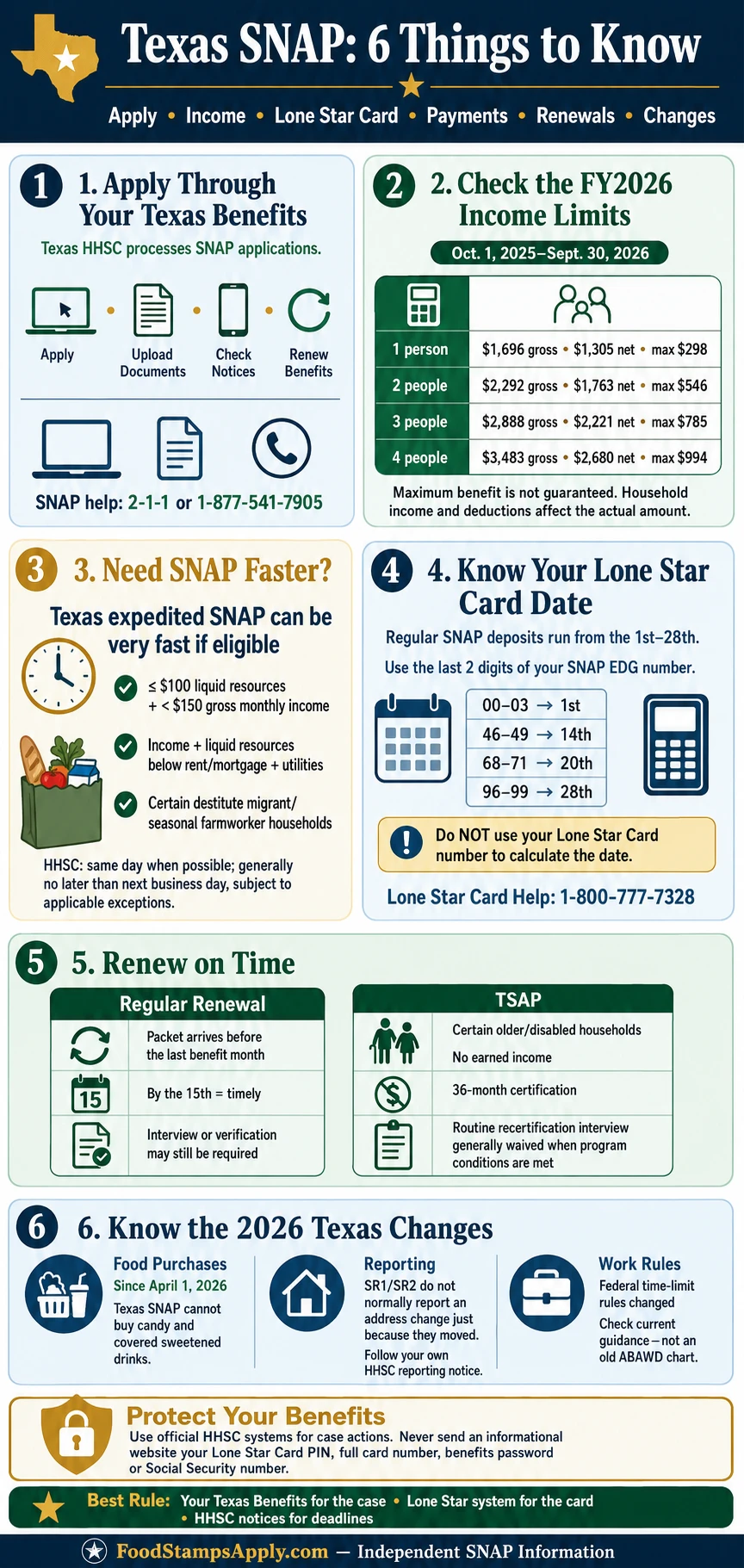
Apply for Texas SNAP through Your Texas Benefits or an HHSC-supported application route. For FY2026, the ordinary one-person income standards are $1,696 gross and $1,305 net per month, with a maximum monthly allotment of $298. Regular applications are generally processed within 30 days. Qualifying expedited cases can be processed much faster. Approved benefits go to the Lone Star Card, and regular deposits are scheduled from the 1st through the 28th using the last two digits of the SNAP EDG number.
Independent information: FoodStampsApply.com is an independent SNAP information publisher. We do not operate Your Texas Benefits, process applications, access HHSC cases, issue Lone Star Cards or determine eligibility. Do not send us your Social Security number, Lone Star Card number, PIN, Your Texas Benefits password or confidential case documents.
Texas SNAP at a Glance
| Texas SNAP | Current Information |
|---|---|
| Program | Supplemental Nutrition Assistance Program (SNAP) |
| State agency | Texas Health and Human Services Commission (HHSC) |
| Application/case portal | Your Texas Benefits |
| Benefits help | 2-1-1 or 1-877-541-7905 |
| EBT card | Lone Star Card |
| Lone Star Card Help Desk | 1-800-777-7328 |
| Regular application processing | Generally within 30 days when the application process is completed |
| Expedited processing | Same day when possible and generally no later than the next business day for qualifying cases, subject to applicable exceptions |
| Regular deposits | 1st through 28th |
| Payment-date factor | Last two digits of SNAP EDG number |
Useful distinction: Your Texas Benefits manages the eligibility case and related tasks. The Lone Star Card is the EBT card used to access approved benefits.
How to Apply for SNAP in Texas
For online applications, Your Texas Benefits is the main Texas portal. It is also useful later for notices, document uploads, renewals and case information.
Texas also uses Form H1010, Texas Works Application for Assistance. Applications submitted online, through an office, or through other HHSC-supported channels enter the same state eligibility system.
Texas SNAP Application in 5 Steps
- Submit the application. Use Your Texas Benefits or another HHSC-supported application method.
- Do not wait unnecessarily for every document. A valid application establishes a filing date. HHSC can request additional verification afterward.
- Complete the interview. Texas normally requires an interview for an initial SNAP application.
- Provide requested proof. HHSC may request information about income, household members, resources, expenses or another eligibility factor.
- Follow the case until a decision is issued. Check notices and requested actions instead of relying only on a dashboard label.
Texas policy makes the filing date important because, when eligible, SNAP eligibility normally begins based on the date HHSC receives a valid application, subject to the program’s proration and other rules.
If you are collecting proof, see our SNAP application documents guide.
Find a Texas HHSC Benefits Office
If you need in-person assistance, use the official office locator rather than relying on an address copied from an old directory.
Find a Texas HHSC benefits office.
How to Check Your Texas SNAP Application Status
Your Texas Benefits can show where an application or renewal is in the process. The exact notice is more important than the status word alone.
Received: HHSC received the application or renewal.
In Review: HHSC has started reviewing it.
Information Needed: HHSC needs additional information or action before completing the review.
Reviewed: HHSC completed the review; check the decision notice for the actual outcome.
One common frustration is uploading pay stubs and expecting the status to change immediately. An uploaded document is not necessarily a reviewed document. If a task remains open, read the newest HHSC notice before repeatedly uploading the same files.
Texas also provides a public application-status tool. It asks for identifying application information such as the main contact’s name and Application ID.
Check a Your Texas Benefits application status.
For a deeper explanation of Pending, interview and verification problems, see our SNAP application status guide.
Need SNAP Faster? Texas Expedited SNAP
Texas screens SNAP applications and qualifying redeterminations for expedited service.
A household can meet an expedited category when, for example:
- liquid resources are $100 or less and countable gross monthly income is less than $150;
- the household’s liquid resources plus actual countable gross monthly income are less than its current rent or mortgage plus utilities; or
- the household meets applicable destitute migrant or seasonal farmworker rules.
Texas-specific timing: HHSC policy says qualifying expedited households should receive benefits the same day they apply when possible and generally no later than the next business day. Certain special cases and applicant-caused delays can follow different timing rules.
Expedited service is not a separate SNAP program and is not guaranteed merely because food is urgently needed. HHSC screens the household against the applicable criteria.
See the current Texas expedited-service policy.
Texas SNAP Income Limits and Maximum Benefits for 2026
The current FY2026 standards apply from October 1, 2025 through September 30, 2026.
| Household Size | Gross Monthly Limit 130% FPL |
Net Monthly Limit 100% FPL |
Maximum Monthly SNAP |
|---|---|---|---|
| 1 | $1,696 | $1,305 | $298 |
| 2 | $2,292 | $1,763 | $546 |
| 3 | $2,888 | $2,221 | $785 |
| 4 | $3,483 | $2,680 | $994 |
| 5 | $4,079 | $3,138 | $1,183 |
| 6 | $4,675 | $3,596 | $1,421 |
| 7 | $5,271 | $4,055 | $1,571 |
| 8 | $5,867 | $4,513 | $1,789 |
| Each additional person | +$596 | +$459 | +$218 |
The maximum benefit column shows the highest monthly allotment for the household size in the 48 contiguous states and Washington, D.C. It is not a guarantee that an eligible household will receive that amount.
SNAP uses countable gross income, net income and applicable deductions. Earned-income deductions, shelter costs, dependent care and qualifying medical expenses for an older or disabled household member can affect the final calculation.
For the federal calculation and current deductions, see our SNAP income limits and SNAP benefit amounts guides.
What Is the 165% Texas SNAP Income Figure?
Texas also publishes a 165% federal poverty level column. For FY2026, that figure is $2,152 per month for one person.
Do not use the 165% figure as the ordinary gross-income limit for every Texas applicant.
HHSC identifies specific uses for this column, including determining whether certain older adults or people with disabilities who live with others can claim separate SNAP household status and as an income figure connected with categorical-eligibility policy.
See the current Texas SNAP income-limit table.
What About Savings, Cars and Other Resources?
For a Texas SNAP household that is subject to the regular resource test, total countable resources—liquid resources plus countable excess vehicle value—cannot be over $5,000.
That does not mean having $5,000 worth of possessions or owning a car automatically makes a household ineligible.
Texas Has Separate Vehicle Exclusions
Texas excludes several types of vehicles entirely, including certain income-producing vehicles, a vehicle needed to transport a person with a physical disability, certain employment-related vehicles, and vehicles used as a home or to carry a household’s primary fuel or water.
For other countable vehicles, Texas currently provides substantial fair-market-value exclusions. Under the current handbook:
- up to $22,500 of fair market value is excluded for the highest-valued countable vehicle; and
- up to $8,700 of fair market value is excluded for other vehicles covered by the standard vehicle exclusion rules.
Only applicable excess value enters the countable-resource calculation.
Categorical Eligibility Can Change the Resource Test
Some Texas households qualify for categorical eligibility. HHSC policy provides different treatment for those households, and certain categorically eligible SNAP households are not subject to the regular resource or gross/net income limits after the categorical-eligibility requirements are met.
Bottom line: “Texas has a $5,000 SNAP resource limit” is useful as a description of the regular test, but it should not be read as a rule that is applied identically to every household.
See the Texas handbook’s SNAP resource-limit policy and vehicle-resource rules.
Your Lone Star Card: Texas SNAP EBT
Once HHSC approves SNAP benefits, they are accessed through the Texas Lone Star Card.
Lone Star Card Help Desk: 1-800-777-7328
Use the Lone Star Card Help Desk or supported Your Texas Benefits card tools for issues such as:
- a lost, stolen or damaged card;
- a forgotten or compromised PIN;
- questions about EBT account activity;
- a balance dispute; or
- suspected unauthorized use.
Texas HHSC directs households with EBT account questions that are unrelated to eligibility to the Lone Star Help Desk or Your Texas Benefits mobile app.
Protect your benefits: never give your Lone Star Card PIN to an informational website or to someone contacting you unexpectedly and claiming they need it to increase, verify or protect your SNAP benefits.
For general EBT information, see our EBT card guide.
When you are ready to shop, see how to find stores that accept SNAP EBT.
Texas SNAP Payment Dates: 1st Through 28th
Texas does not load every SNAP household’s benefits on the same day.
For households using the current issuance schedule, the payment date is determined by the last two digits of the SNAP EDG number. Do not use the digits printed on the Lone Star Card.
| EDG Ending | Day | EDG Ending | Day |
|---|---|---|---|
| 00–03 | 1st | 50–53 | 15th |
| 04–06 | 2nd | 54–57 | 16th |
| 07–10 | 3rd | 58–60 | 17th |
| 11–13 | 4th | 61–64 | 18th |
| 14–17 | 5th | 65–67 | 19th |
| 18–20 | 6th | 68–71 | 20th |
| 21–24 | 7th | 72–74 | 21st |
| 25–27 | 8th | 75–78 | 22nd |
| 28–31 | 9th | 79–81 | 23rd |
| 32–34 | 10th | 82–85 | 24th |
| 35–38 | 11th | 86–88 | 25th |
| 39–41 | 12th | 89–92 | 26th |
| 42–45 | 13th | 93–95 | 27th |
| 46–49 | 14th | 96–99 | 28th |
Some Longtime Households Can Still Have an Older Schedule
Texas has a grandfathering rule for older cases.
The current Texas Works Handbook states that households certified before May 1, 2023 can retain the issuance schedule associated with their original certification unless they later have a break in benefits of at least six months and reapply.
So if your Lone Star Card has loaded on the same date for years, do not assume the payment is late only because a newer chart suggests another date.
Use the official Texas SNAP issuance schedule or your case notice to confirm the date assigned to your household.
Renewing SNAP and Keeping Your Texas Benefits Active
SNAP does not continue indefinitely without another eligibility review. Texas refers to SNAP renewal as a redetermination or recertification.
HHSC’s system sends the SNAP redetermination packet during the first week of the month before the household’s last benefit month.
The 15th Is an Important Texas Renewal Date
Under current Texas policy:
- a renewal received by the 15th of the last benefit month is considered timely;
- a renewal received from the 16th through the 30th day after the certification period ends is treated as untimely under the redetermination procedures; and
- a packet received on or after the 31st day after the certification period ends is treated as a new application and screened for expedited service when appropriate.
Submitting early matters because the household may still need an interview or additional verification before the certification period ends.
What Happens After You Submit the Renewal?
For ordinary SNAP redeterminations requiring an interview, HHSC attempts telephone contact. If those attempts are unsuccessful, an appointment notice is issued with instructions for completing the interview.
If HHSC requests additional verification during a renewal, the household must generally be given at least 10 calendar days to provide it.
Texas also allows a limited desk-review process for certain SNAP redeterminations. That is why one household can renew without a new interview while another is required to complete one.
See the current Texas SNAP redetermination policy.
TSAP: A Simpler SNAP Process for Some Texans
Texas operates the Texas Simplified Application Project (TSAP) for certain households made up of older adults or people receiving disability payments.
TSAP can apply when:
- every household member is age 60 or older, receives disability payments, or both;
- the household has no earned income; and
- no household member receives SNAP through SNAP-CAP.
TSAP’s main simplification
Qualifying households receive a 36-month certification period. An interview is required at initial application, but routine TSAP recertification generally does not require another interview unless information is incomplete, questionable or contradictory, or the household requests one.
Texas checks households for TSAP eligibility during the SNAP process. A household does not need to know the acronym before seeking food assistance.
See the current Texas TSAP policy.
Reporting Changes Between Texas SNAP Renewals
Not every Texas SNAP household has the same mid-certification reporting duties. HHSC assigns households a streamlined-reporting designation such as SR1, SR2 or SR3.
Important correction: SR1 and SR2 households do not normally have to report a change of residence or related changes in rent, mortgage or utilities during the certification period simply because they moved. SR3 households have broader change-reporting duties.
Common SR1 and SR2 Reporting Triggers
Current Texas policy identifies required changes such as:
- ongoing gross monthly household income exceeding 130% of the federal poverty level for the household size for two consecutive months under the applicable streamlined-reporting rule;
- the work or participation hours of a person subject to the ABAWD/time-limit rule dropping below an average of 20 hours per week; and
- substantial lottery or gambling winnings above the current Texas reporting threshold.
SR3 Households Have Broader Reporting Duties
SR3 reporting can include changes involving residence and shelter costs, income sources, household composition, vehicles, certain resources and other circumstances.
After certification, Texas generally requires a change that is mandatory for your reporting group to be reported within 10 days after the household knows about the change.
Changes can be reported through Your Texas Benefits and other HHSC-supported routes.
Do not use another household’s reporting obligations as your own. Follow Form H1019 or the reporting instructions issued for your specific case.
See Texas’s current SNAP reporting-requirement policy.
Texas SNAP Rules That Changed in 2026
Two areas deserve particular attention because older Texas SNAP articles can now give misleading answers.
Texas Now Restricts Candy and Certain Sweetened Drinks
Beginning April 1, 2026, Texas began operating a USDA-approved SNAP food-restriction demonstration.
Under the waiver, Texas SNAP benefits can no longer be used for candy and covered sweetened drinks.
This means a product that could be purchased with the Lone Star Card before April 2026 may now be declined even when the card is active and the household has sufficient SNAP benefits.
Do not interpret the restriction as a ban on every snack or every flavored beverage. Texas and USDA use specific definitions for the restricted products.
This is a Texas-specific SNAP waiver—not a nationwide SNAP rule.
Review the current USDA FNA Texas food-restriction waiver. For the broader federal food rules and other state restrictions, see what you can buy with EBT.
SNAP Work Requirements Also Changed
Federal SNAP time-limit rules changed under the 2025 law, and this creates a source-quality problem: some older or not-yet-updated SNAP work-rule pages can still show the former age and exception rules.
Current federal implementation materials generally expand the SNAP time-limit age band through age 64 and change several exception categories, including the child-related rule.
Do not rely on an old Texas ABAWD chart without checking its update date. USDA FNA is implementing Section 10102 of the 2025 law through newer work-requirement memoranda. Follow the current federal rule and your HHSC case notice when determining whether the time limit applies.
Someone who is subject to the time limit generally needs qualifying work or activity averaging about 80 hours per month unless an applicable exception, exemption or waiver applies.
See our current SNAP work requirements guide and USDA FNA’s 2025 law implementation resources.
Texas Rules Do Not Automatically Apply in Another State
SNAP has a federal framework, but application portals, resource policies, payment schedules, state waivers and administrative procedures can differ substantially.
For example, California uses a different eligibility framework, BenefitsCal and a different EBT issuance system. If you are comparing states or moving, see our latest California CalFresh guide rather than carrying Texas rules into a California case.
If Your Texas SNAP Case Is Delayed or Something Looks Wrong
Before starting another application, identify which part of the existing case is causing the problem.
Status says Received: HHSC has the application or renewal, but the review may not be finished.
Status says Information Needed: open the newest notice and find the exact information or action HHSC requested.
Documents are uploaded but nothing changed: the files may still be awaiting review, or another step such as an interview may still be outstanding.
Lone Star Card did not load when expected: check your own SNAP EDG schedule and whether an older grandfathered issuance date applies.
Candy or a sweetened drink is suddenly declined: check whether the April 2026 Texas food restriction applies to that product.
These distinctions matter because a verification problem, issuance-date problem, card problem and renewal problem each need a different solution.
What If HHSC Denies, Reduces or Stops Texas SNAP?
HHSC should issue a notice explaining an adverse eligibility or benefit decision.
Under Texas’s current fair-hearing rules, an appeal generally can be filed within 90 calendar days from the effective date of the action or the notice-of-adverse-action date, whichever is later.
SNAP also has special fair-hearing protections, including the ability to challenge the current benefit level during the certification period under applicable federal rules.
If existing benefits are being reduced or stopped, read the notice promptly. The timing of a hearing request can matter when asking whether current assistance may continue while the appeal is pending.
For the formal timing rules, see the Texas fair-hearing request policy.
Texas SNAP Phone Numbers and Official Help
SNAP application or case help: 2-1-1 or 1-877-541-7905
Lone Star Card Help Desk: 1-800-777-7328
Application status: Your Texas Benefits
Document uploads: Your Texas Benefits
Local HHSC office: Your Texas Benefits Office Locator
Report required case changes: use the method permitted by HHSC for your case, including Your Texas Benefits or other listed HHSC channels
If you do not live in Texas, use our SNAP information by state directory rather than using Texas application or EBT contacts for another state’s case.
Need to start or manage a Texas SNAP case?
Use the official Your Texas Benefits system for applications, case information, notices and supported account tasks.
Texas SNAP FAQs
Where do I apply for food stamps in Texas?
Your Texas Benefits is the main online application portal. Texas also supports other HHSC application routes, including Form H1010 and benefits-office assistance.
What is the Texas SNAP income limit for one person in 2026?
For FY2026, Texas lists an ordinary gross monthly limit of $1,696 and a net monthly limit of $1,305 for a one-person household. The current maximum monthly allotment for one person is $298. These figures apply through September 30, 2026.
Does Texas have a SNAP asset limit?
Texas uses a regular $5,000 limit on countable liquid resources plus applicable excess vehicle value for households subject to that resource test. Categorical eligibility and resource exclusions can change whether and how the test applies.
Does owning a car disqualify you from Texas SNAP?
Not automatically. Texas excludes certain vehicles entirely and applies substantial fair-market-value exclusions to other vehicles before applicable excess value is counted toward the resource limit.
How long does Texas take to process SNAP?
A regular application is generally processed within 30 days when the household completes the required application process. Eligible expedited households can receive benefits substantially faster.
How fast can expedited SNAP arrive in Texas?
Current HHSC policy says qualifying expedited cases should receive benefits the same day when possible and generally no later than the next business day. Special cases and unresolved required steps can have different timing.
What is the Texas EBT card called?
Texas uses the Lone Star Card. For card or EBT-account assistance, call the Lone Star Card Help Desk at 1-800-777-7328.
What day do Texas SNAP benefits come?
Under the current issuance schedule, regular deposits are spread from the 1st through the 28th according to the last two digits of the SNAP EDG number. Certain households with older certifications can retain an earlier grandfathered schedule.
Can Texas SNAP buy candy or sweetened drinks in 2026?
Texas SNAP cannot be used for candy and covered sweetened drinks under a USDA-approved food-restriction waiver that took effect April 1, 2026. The restriction uses specific product definitions, so it should not be interpreted as excluding every snack or flavored beverage.
What is TSAP in Texas?
The Texas Simplified Application Project gives certain households in which all members are age 60 or older, receive disability payments, or both—and have no earned income—a simplified SNAP process. Qualifying TSAP households receive a 36-month certification period.
When should I renew Texas SNAP?
HHSC sends the SNAP renewal packet during the month before the final benefit month. A redetermination received by the 15th of the last benefit month is considered timely under current Texas SNAP policy.
Can I appeal a Texas SNAP denial?
Yes. Texas generally allows a fair-hearing request within 90 calendar days from the effective date of the action or the notice-of-adverse-action date, whichever is later. Read your HHSC notice for the case-specific appeal instructions.
Sources & Verification
Important official sources used to verify this Texas guide include:
- Your Texas Benefits for Texas benefits applications and case access.
- Texas Works Handbook C-120 for FY2026 SNAP income limits.
- USDA FNA FY2026 SNAP standards for maximum allotments and federal income standards.
- Texas Works Handbook A-140 for expedited-service screening and processing.
- Texas Works Handbook A-1220 for the regular $5,000 SNAP resource limit.
- Texas Works Handbook A-1230 for vehicle exclusions and valuation rules.
- Texas Works Handbook B-250 for the 1st–28th SNAP issuance schedule.
- Texas Works Handbook B-380 for Lone Star Card account assistance.
- Texas Works Handbook B-120 for recertification timing, interviews and verification.
- Texas Works Handbook B-470 for categorical eligibility and TSAP.
- Texas Works Handbook B-620 for SR1, SR2 and SR3 change-reporting rules.
- USDA FNA Texas SNAP Food Restriction Waiver for the April 1, 2026 candy and sweetened-drink restriction.
- USDA FNA 2025 law implementation resources for current federal SNAP work-rule changes.
- Texas Fair and Fraud Hearings Handbook for appeal timing.
For more information about how FoodStampsApply.com selects and verifies SNAP sources, see our source methodology.
Conclusion: Know Which Texas SNAP System Handles What
Texas SNAP is easier to manage once you separate the eligibility case from the EBT card.
Your Texas Benefits: application, notices, documents, case information, change reporting and renewal tools
HHSC: interviews, verification and eligibility decisions
Lone Star Card system: access to approved benefits, PIN and EBT-account help
Before applying, review the current income and resource rules. After filing, respond promptly to interview and verification requests. If you already receive SNAP, know your EDG-based payment date, renewal deadline and reporting category.
And when a Texas rule changes—especially food-purchase or work-requirement rules—check the current HHSC or USDA FNA source rather than assuming an older food-stamp guide is still accurate.