
New York SNAP, commonly called food stamps, is overseen by the New York State Office of Temporary and Disability Assistance (OTDA). The first thing to know is that New York City and the rest of New York use different online SNAP systems.
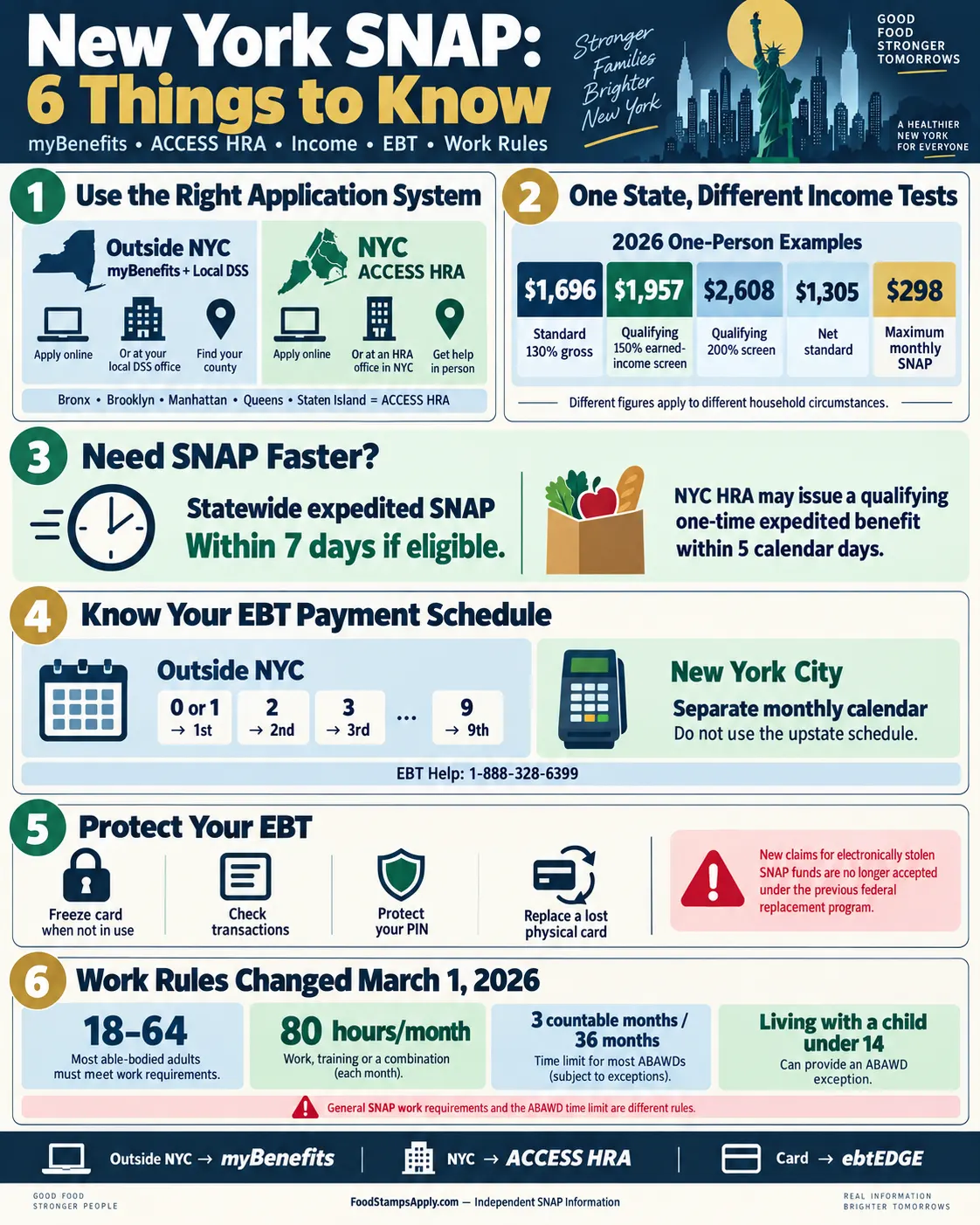
If you live outside New York City, you can generally apply through myBenefits or your local Department of Social Services. If you live in the Bronx, Brooklyn, Manhattan, Queens, or Staten Island, use ACCESS HRA instead.
New York also has important 2026 changes. Expanded ABAWD work requirements took effect statewide on March 1, 2026, and the state uses several different income-screening levels depending on household circumstances. That means one simple income number does not tell the whole story.
By FoodStampsApply.com Editorial
Last verified: September 5, 2026
Quick Answer
Outside New York City, apply for SNAP through myBenefits or your local Department of Social Services. NYC residents use ACCESS HRA. For FY2026, the ordinary one-person gross-income standard is $1,696 per month, but qualifying New York households can use higher 150% or 200% screening thresholds of $1,957 or $2,608. The net standard is $1,305, and the maximum monthly allotment is $298. Regular applications are generally processed within 30 days, while qualifying expedited cases must receive initial SNAP within seven days.
Independent information: FoodStampsApply.com is an independent SNAP information website. We do not operate myBenefits or ACCESS HRA, access individual SNAP cases, issue EBT cards or make eligibility decisions. Never send an informational website your Social Security number, EBT PIN, full card number, portal password, or confidential case documents.

New York SNAP at a Glance
| What You Need | New York SNAP Information |
|---|---|
| Outside NYC | myBenefits or local Department of Social Services |
| New York City | ACCESS HRA |
| State SNAP information | 1-800-342-3009 |
| NYC DSS OneNumber | 718-557-1399 |
| EBT Customer Service | 1-888-328-6399 |
| Regular application processing | Generally within 30 days |
| Statewide expedited standard | Initial SNAP within 7 days when eligible |
| Physical EBT card | Common Benefit Identification Card (CBIC) |
Remember the split: myBenefits handles most SNAP applications outside New York City. ACCESS HRA handles NYC SNAP applications. Your EBT/CBIC card is how approved benefits are used.
How to Apply for SNAP in New York
Where you apply depends on where you live.
If You Live Outside New York City
For most households outside the five boroughs, myBenefits is the main online route.
Current myBenefits functions include:
- applying for SNAP;
- continuing an unfinished application;
- tracking an application;
- viewing case details;
- submitting verification documents;
- reporting changes; and
- recertifying benefits.
You can also work with your local Department of Social Services or use New York’s paper SNAP application, Form LDSS-4826.
If You Live in New York City
Residents of the Bronx, Brooklyn, Manhattan, Queens and Staten Island should use ACCESS HRA rather than myBenefits for an online SNAP application.
ACCESS HRA can be used to:
- apply for SNAP;
- upload documents;
- check application or case status;
- view notices;
- see appointments;
- recertify;
- report supported changes; and
- review payment and benefit information.
NYC DSS OneNumber: 718-557-1399
Do not use an upstate myBenefits guide to troubleshoot an NYC HRA case. The two systems have different workflows, notices and payment schedules.
New York SNAP Application in 5 Steps
1. Submit the Application
Outside NYC, use myBenefits, your local DSS or the paper application. In NYC, use ACCESS HRA or another HRA-supported route.
Do not unnecessarily wait until every pay stub, utility record or other document is collected before filing. Your SNAP filing date can affect when eligible benefits begin.
2. Complete the Interview
An eligibility interview is normally part of the SNAP application process.
In New York City, HRA allows many applicants to complete the interview by phone rather than traveling to a SNAP Center.
During the interview, the worker can ask about household members, income, housing expenses and other eligibility factors.
3. Send the Proof Your District Requests
Depending on the case, requested proof can involve:
- identity;
- income;
- household composition;
- rent or mortgage;
- utility costs;
- dependent-care expenses;
- qualifying medical expenses; or
- another eligibility issue.
Do not assume every applicant needs every document listed on a generic internet checklist. Follow the verification request issued for your case.
For planning purposes, see our SNAP application documents guide.
4. Check Your Case and Uploads
Keep watching myBenefits, ACCESS HRA and official notices.
Uploading a pay stub does not mean a worker has already reviewed it. Save confirmation screens for important document uploads when possible.
5. Watch for the Decision
A regular SNAP application generally must be processed within 30 days.
If the case appears stuck, look for an interview requirement, verification request or new notice before submitting a second application.
What Your ACCESS HRA SNAP Status Means
NYC applicants may see several status labels in ACCESS HRA.
Application Received: HRA received the application, but you may still need an interview, documents or another action.
In Progress: HRA is still processing the case. In some expedited cases, an initial one-time benefit may already have been issued while the ongoing decision remains pending.
Active: your SNAP case is open and regular benefits are being issued.
Expiring Soon: your certification period is nearing its end and recertification is due.
Periodic Report Due: HRA requires a periodic report. Complete it by the stated deadline.
Rejected: the application was denied.
Closed: a previously active case is no longer open.
Outside NYC, myBenefits or the local district may use different wording. The newest official notice for your case controls.
Need SNAP Faster? New York Expedited SNAP
New York screens SNAP applications for expedited service when a household has an urgent food need and meets the applicable financial criteria.
A household can qualify when, for example:
- it has very little income and very little in liquid resources;
- its income and liquid resources are less than rent or mortgage plus qualifying utilities; or
- it meets special rules for a destitute migrant or seasonal farmworker household.
Under the statewide rule, an eligible expedited household must receive its initial SNAP benefit within seven calendar days.
NYC is even faster in current HRA guidance: qualifying ACCESS HRA applicants may receive a one-time expedited benefit within five calendar days, while the full ongoing application continues through the regular eligibility process.
If your household has almost no money available for food, answer the expedited-service questions carefully rather than skipping them as routine paperwork.
New York SNAP Income Limits for 2026
New York’s current SNAP standards took effect October 1, 2025 and remain in effect through September 30, 2026.
New York does not use one single gross-income threshold for every household. Different SNAP households can be evaluated under different gross-income tests.
| Household Size | 130% Gross | 150% Gross* | 200% Gross** | 100% Net | Maximum SNAP |
|---|---|---|---|---|---|
| 1 | $1,696 | $1,957 | $2,608 | $1,305 | $298 |
| 2 | $2,292 | $2,644 | $3,525 | $1,763 | $546 |
| 3 | $2,888 | $3,332 | $4,442 | $2,221 | $785 |
| 4 | $3,483 | $4,019 | $5,358 | $2,680 | $994 |
| 5 | $4,079 | $4,707 | $6,275 | $3,138 | $1,183 |
| 6 | $4,675 | $5,394 | $7,192 | $3,596 | $1,421 |
| 7 | $5,271 | $6,082 | $8,108 | $4,055 | $1,571 |
| 8 | $5,867 | $6,769 | $9,025 | $4,513 | $1,789 |
| Each additional person | +$596 | +$688 | +$917 | +$459 | +$218 |
*The 150% gross-income test can apply to qualifying households with earned income under New York’s categorical-eligibility rules.
**The 200% gross-income test can apply to qualifying households containing an aged or disabled member and to certain households paying out-of-pocket dependent-care expenses. Additional eligibility conditions apply.
Why you may see three different one-person SNAP limits: $1,696, $1,957 and $2,608 can all be legitimate New York figures. They refer to different household circumstances, not conflicting versions of the same rule.
What About the 165% FPL Rule?
New York also uses a 165% FPL test in a narrower household-composition rule.
An older or disabled person who is unable to purchase and prepare food separately because of a disability may sometimes qualify as a separate SNAP household when the income of the people they live with—excluding the older/disabled person and spouse—does not exceed the applicable 165% standard.
Gross Income Is Not the Same as SNAP Countable Income
A gross-income chart is only one part of the SNAP budget.
Depending on the household, SNAP deductions can include:
- the earned-income deduction;
- the standard deduction;
- dependent-care costs;
- eligible child-support payments;
- qualifying medical expenses for an aged or disabled household member;
- eligible shelter expenses; and
- utility allowances.
For FY2026, New York’s standard deduction is $209 for households of one to three people. The maximum excess shelter deduction is $744 for households subject to that cap.
Utility allowances can differ based on where the household lives and the utility expenses it is responsible for paying.
If your income is slightly above one number you found online, do not automatically assume you are ineligible. The district must apply the test and deductions that fit your household circumstances.
Does New York SNAP Have an Asset Limit?
For most New York SNAP households, there is no regular savings or resource test.
New York uses broad-based categorical eligibility for many households. As a result, savings, retirement accounts or other assets do not automatically make most applicants ineligible.
Practical takeaway: having money in a checking or savings account does not by itself mean most New York households cannot receive SNAP.
Some households that are not categorically eligible can still be subject to a resource test, so the county or HRA must determine which rules apply.
How Much SNAP Can You Get in New York in 2026?
The maximum allotments are already shown in the income table above, but it helps to remember what those numbers mean.
- 1 person: up to $298 per month
- 2 people: up to $546
- 3 people: up to $785
- 4 people: up to $994
- 8 people: up to $1,789
- Each additional person: +$218
Eligible one- and two-person households can receive a minimum allotment of $24 per month under the current standards.
These are maximum or minimum program amounts—not promises of what a particular household will receive.
For a detailed benefit calculation explanation, see our SNAP benefit amounts guide.
New York EBT Card and ebtEDGE
Once approved, SNAP benefits are placed in an Electronic Benefits Transfer account.
New York’s physical EBT card is formally known as the Common Benefit Identification Card (CBIC).
New York EBT Customer Service: 1-888-328-6399
The automated helpline is available 24 hours a day, seven days a week.
OTDA currently directs cardholders to ebtEDGE for functions such as:
- checking the available balance;
- reviewing transaction history;
- confirming recent deposits;
- selecting or changing a PIN;
- reporting a damaged, lost or stolen card; and
- requesting a replacement card.
New York SNAP Payment Dates
New York does not use one statewide SNAP deposit schedule.
The five boroughs of New York City follow a separate issuance calendar from the rest of the state.
Outside New York City
For counties outside NYC, benefits are generally issued over the first nine days of the month using the last digit of the case number.
| Case Number Ends In | Regular Benefit Date |
|---|---|
| 0 or 1 | 1st |
| 2 | 2nd |
| 3 | 3rd |
| 4 | 4th |
| 5 | 5th |
| 6 | 6th |
| 7 | 7th |
| 8 | 8th |
| 9 | 9th |
New York City Uses a Different Calendar
NYC benefits are spread across multiple non-Sunday, non-holiday issuance days during the first part of each month.
The exact dates change from month to month, so an NYC household should not use the upstate 1st–9th chart to decide that a payment is late.
ACCESS HRA can display payment information, or you can call EBT Customer Service at 1-888-328-6399.
USDA FNA also maintains separate SNAP directory entries for New York State and New York City.
Protect Your New York EBT Card From Theft
New York encourages SNAP recipients to monitor transactions, protect their PIN and use the card-freeze feature when the card is not being used.
The current ebtEDGE tools can help cardholders review activity and manage card security.
Security habit: freeze the EBT card when you do not expect to use it, then unfreeze it before shopping. Also avoid entering your PIN into a card reader that looks loose, altered or suspicious.
Can Electronically Stolen SNAP Benefits Still Be Replaced?
New applications for replacement of electronically stolen SNAP benefits are no longer being accepted under the previous federal replacement program.
New York stopped accepting new SNAP theft-replacement applications after September 30, 2025.
That is different from replacing the physical EBT card.
Lost/stolen physical card: replacement card is still available
Electronically stolen SNAP funds: the previous federal replacement program is no longer accepting new SNAP claims
If the physical card is lost, damaged or stolen, call 1-888-328-6399 promptly.
Renewing SNAP in New York
New York calls the SNAP renewal process recertification.
A normal recertification can require three separate steps:
- submit the recertification application;
- complete the required interview; and
- provide requested verification.
Submitting the form does not necessarily mean recertification is finished.
Outside New York City
Follow the recertification instructions issued by your local Department of Social Services. myBenefits currently supports SNAP recertification for eligible non-NYC cases.
Start early enough to leave time for an interview and any requested proof.
Recertifying in New York City
NYC SNAP certification periods are commonly about one year, and HRA currently allows households to begin recertification as early as 60 days before the certification period ends.
ACCESS HRA may display Expiring Soon when the recertification window opens.
HRA says most recipients need to:
- submit the recertification form;
- complete an interview; and
- return required documents.
NYC guidance also says that when an eligible household submits the recertification application by the 15th of the final certification month, HRA must complete the continuing-benefit decision by the end of the current certification period, assuming required steps are completed.
Do not wait for the final few days if you can avoid it.
Reporting Changes Between SNAP Renewals
Not every New York SNAP household has identical mid-certification reporting requirements.
The reporting rules assigned to your case determine which changes have to be reported before recertification.
For many simplified-reporting households, a particularly important trigger is gross monthly household income exceeding the applicable 130% FPL reporting threshold.
NYC Periodic Reports
If an NYC certification period is longer than six months, HRA can issue a Periodic Report during the certification period.
If ACCESS HRA displays Periodic Report Due, treat it as a required case action, not a general reminder.
Follow the reporting instructions on your own SNAP notices rather than another household’s experience.
New York SNAP Work Requirements Changed in 2026
Expanded SNAP ABAWD requirements took effect across New York State on March 1, 2026.
New York lost its existing geographic ABAWD waivers at that point, so the time-limit rules began applying statewide to people who are subject to them.
Under the current rules, a person can generally fall within the ABAWD/time-limit group if they are:
- age 18 through 64;
- not otherwise exempt;
- physically and mentally able to work; and
- not living in a SNAP household with a child under age 14.
Someone subject to the time limit generally needs 80 hours per month of qualifying work or approved activity to continue receiving SNAP beyond the limited countable months.
Depending on the assignment and federal rules, qualifying activity can include:
- paid employment;
- verified unpaid or in-kind work;
- approved employment or training programs;
- certain WIOA or Trade Act activities;
- workfare; or
- a permitted combination of qualifying activities.
Current ABAWD Exceptions
Exceptions can include people who are:
- under 18 or age 65 or older;
- pregnant;
- living in a SNAP household with a child under 14;
- physically or mentally unable to work at least 80 hours per month;
- otherwise exempt from applicable general SNAP work requirements; or
- within another current federal statutory exception.
The former standalone exceptions for veterans, people experiencing homelessness and certain former foster youth were removed by the 2025 federal law. A person in one of those groups may still qualify for another exception.
General SNAP Work Rules and the ABAWD Time Limit Are Different
General SNAP work requirements apply to a broader group.
The ABAWD rule is a separate time-limit framework for certain adults and adds the 80-hour monthly activity standard.
If your notice says a work requirement applies, check which rule the agency is actually using.
For the full federal distinction, see our SNAP work requirements guide.
New York and Florida Use Different SNAP Systems
SNAP has federal rules, but application portals, income screening, EBT issuance and state procedures differ.
For example, Florida uses MyACCESS and has its own 2026 Healthy SNAP purchase restrictions. If you are moving or comparing states, see our latest Florida SNAP guide rather than applying New York rules to a Florida case.
If Your New York SNAP Case Is Pending or Delayed
Application says Received: the agency has it, but an interview, verification or eligibility review may still be outstanding.
ACCESS HRA says In Progress: HRA is still processing the case. An expedited initial issuance does not necessarily mean the ongoing case decision is complete.
Documents were uploaded but nothing changed: the files may still be awaiting review, or another item may still be required.
An expected EBT deposit is missing: first identify whether the case is NYC or outside NYC because the payment calendars are different.
Case says Expiring Soon: start recertification. Do not assume the renewal is complete merely because the status appeared.
See our SNAP application status guide for more troubleshooting steps.
What If New York Denies, Reduces or Stops SNAP?
You can request a New York State Fair Hearing if you believe a SNAP decision is incorrect.
Keep the denial, reduction or closure notice. It should explain what action is being taken, why, when it becomes effective and how to challenge it.
Statewide Fair Hearing request number: 1-800-342-3334
The general SNAP fair-hearing deadline is 90 days.
Requesting the Hearing Before the Effective Date Can Matter
If a notice says existing SNAP benefits will be reduced or stopped, requesting a fair hearing before the effective date can generally allow you to request that the current benefit level continue while the hearing is pending.
If you receive continued benefits and later lose the hearing, you may have to repay benefits you were not ultimately entitled to receive.
New York allows hearing requests by phone, online, fax or mail.
New York SNAP Phone Numbers and Official Help
General New York SNAP information: 1-800-342-3009
NYC HRA / DSS OneNumber: 718-557-1399
EBT balance, PIN, lost card or replacement: 1-888-328-6399
New York State Fair Hearing: 1-800-342-3334
Outside NYC case-specific help: local Department of Social Services
Ready to apply for New York SNAP?
Use the official state application page to reach myBenefits outside NYC or the correct NYC application route.
New York SNAP FAQs
Where do I apply for food stamps in New York?
Outside New York City, apply through myBenefits or your local Department of Social Services. Residents of the five NYC boroughs should use ACCESS HRA.
What is the New York SNAP income limit for one person in 2026?
The standard 130% gross-income figure is $1,696 per month and the net standard is $1,305. Qualifying households may instead use a 150% gross threshold of $1,957 or a 200% threshold of $2,608, depending on household circumstances.
Why are there different New York SNAP income limits online?
New York uses different gross-income tests for different household situations. The 130%, 150%, 165% and 200% figures serve different eligibility or household-composition purposes, so one number should not automatically be applied to every applicant.
How much SNAP can one person get in New York?
The FY2026 maximum monthly allotment for a one-person household is $298. The actual amount can be lower depending on income and allowable deductions.
What is the minimum SNAP benefit in New York?
Qualifying one- and two-person households can receive a minimum allotment of $24 under the current FY2026 standards.
Does New York SNAP have an asset limit?
Most New York SNAP households do not face a regular savings or resource test because of categorical-eligibility rules. Some exceptions remain for households that are not categorically eligible.
How long does New York take to approve SNAP?
Regular applications are generally processed within 30 days. Eligible expedited households must receive initial SNAP within seven days; current NYC HRA guidance can provide a qualifying one-time expedited issuance within five calendar days.
What is the New York EBT phone number?
Call 1-888-328-6399 for balance information, PIN assistance, lost or damaged cards and other EBT-card issues.
What day do New York SNAP benefits come?
Outside NYC, benefits are generally issued from the 1st through the 9th based on the last digit of the case number. New York City uses a separate calendar with dates that can change from month to month.
Can I use myBenefits if I live in New York City?
For an NYC SNAP application or recertification, use ACCESS HRA. myBenefits directs NYC residents to ACCESS HRA for SNAP.
Did New York SNAP work requirements change in 2026?
Yes. Expanded ABAWD requirements took effect statewide March 1, 2026. The current time-limit rules can generally reach adults ages 18–64 unless an exception applies.
Can New York replace electronically stolen SNAP benefits?
New applications for replacement of electronically stolen SNAP funds are no longer accepted under the previous federal replacement program. A lost, stolen or damaged physical EBT card can still be replaced.
Can I appeal a New York SNAP denial?
Yes. You can request a New York State Fair Hearing. The general SNAP appeal period is 90 days, but request the hearing promptly if an existing benefit is about to be reduced or stopped because timing can affect aid-continuing rights.
Sources & Verification
- New York State — Apply or Recertify for SNAP
- New York myBenefits
- ACCESS HRA
- OTDA FY2026 SNAP Standards
- New York SNAP Source Book
- New York OTDA EBT Information
- OTDA Stolen SNAP Replacement Termination
- New York ABAWD Policy Update
- ACCESS NYC SNAP Work Requirements
- NYC SNAP Benefits Guide
- New York State Fair Hearings
For more about how FoodStampsApply.com checks public-benefit information, see our source methodology.
Conclusion: Start With the Correct New York SNAP System
Do not rule yourself out based on one New York SNAP income number. The state uses different gross-income tests for different household circumstances, and allowable deductions can change the final eligibility calculation.
Outside New York City, start with myBenefits or your local DSS. If you live in the five boroughs, use ACCESS HRA.
After applying, complete the interview, respond to the verification request actually issued for your case and keep checking the newest official notice rather than submitting another application simply because processing takes time.
If you already receive SNAP, know whether your payment schedule is NYC or non-NYC, protect your EBT card, start recertification early and pay attention to the expanded 2026 work requirements if they apply to anyone in your household.
Use official myBenefits, ACCESS HRA, OTDA and EBT resources for case-specific actions rather than sharing private SNAP information with an independent information website.