
Florida SNAP, commonly called food stamps, is officially administered through Florida’s Food Assistance Program by the Department of Children and Families (DCF). MyACCESS is the main online system for applying, checking case information, uploading requested verification and renewing benefits.
A regular Florida SNAP application may take up to 30 days to process, while households that meet expedited-service rules may receive food assistance within 7 days. Approved benefits are issued through Florida’s EBT/ACCESS card, with regular monthly deposits spread across the 1st through the 28th.
Florida also has several rules that make generic SNAP advice incomplete. Most households are screened using Florida’s broader 200% federal poverty level gross-income framework, certain households with a disqualified member face an asset test, ongoing income reporting can use a 130% FPL trigger, and Florida changed what SNAP can buy beginning April 20, 2026.
By FoodStampsApply.com Editorial
Last verified: September 3, 2026
Quick Answer
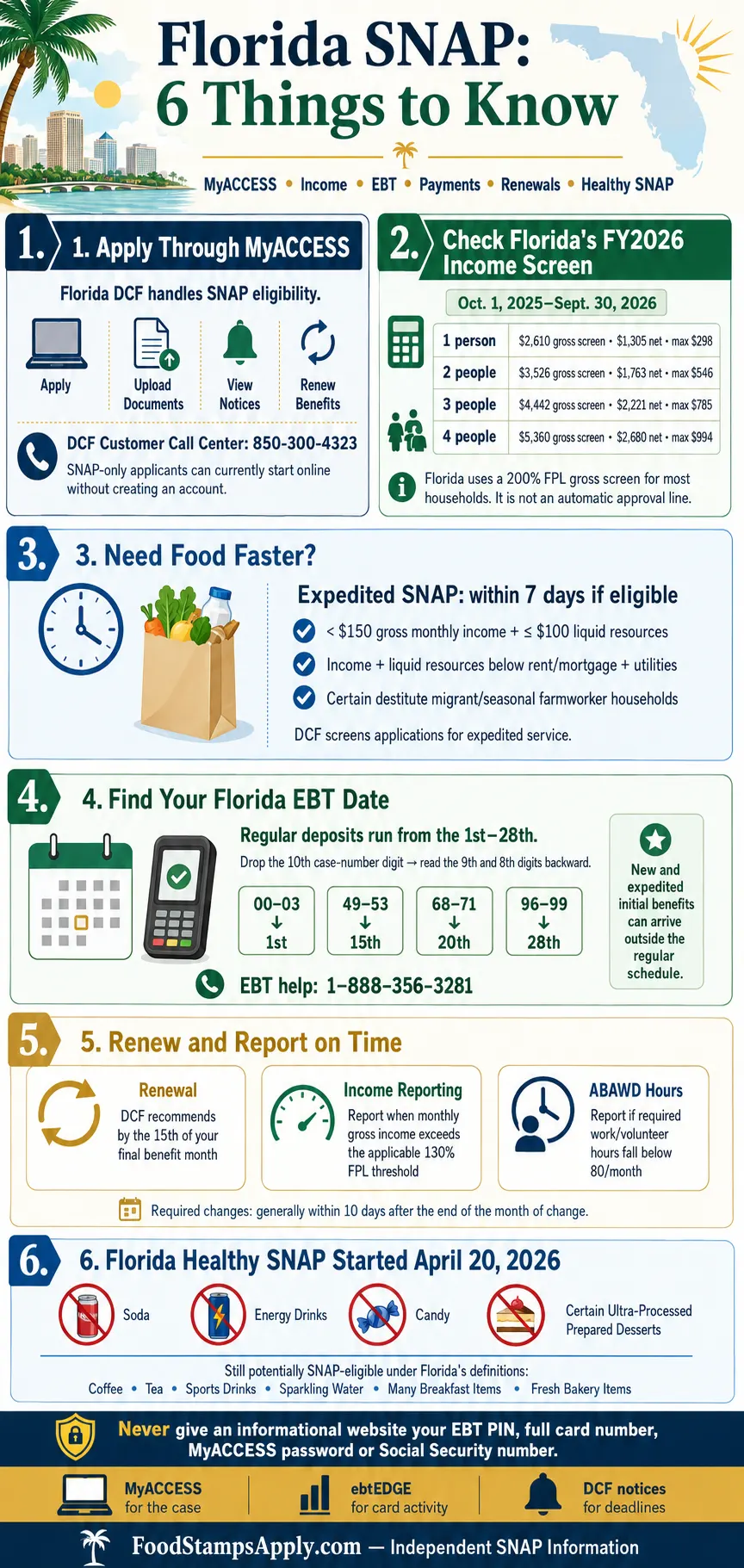
Apply for Florida SNAP through MyACCESS or another DCF-supported application route. For FY2026, Florida’s main gross screening limit for most one-person households is $2,610 per month, the net standard is $1,305, and the maximum monthly SNAP allotment is $298. Regular applications may take up to 30 days; qualifying expedited households may receive benefits within 7 days. Florida EBT benefits are normally issued from the 1st through the 28th using digits from the Florida case number.
Independent information: FoodStampsApply.com is an independent SNAP information website. We do not operate MyACCESS or ebtEDGE, process Florida applications, access DCF cases, issue EBT cards or decide eligibility. Never send an informational website your Social Security number, MyACCESS password, full EBT card number, PIN or private case documents.
Florida SNAP at a Glance
| Florida Food Assistance | Current Information |
|---|---|
| Program | Food Assistance Program / SNAP |
| State agency | Florida Department of Children and Families (DCF) |
| Application/case portal | MyACCESS |
| DCF Customer Call Center | 850-300-4323 |
| Florida Relay / TTY | 711 / 1-800-955-8771 |
| EBT card | Florida EBT / ACCESS card |
| EBT Customer Service | 1-888-356-3281 |
| EBT balance/transactions | ebtEDGE |
| Regular processing | Up to 30 days |
| Expedited SNAP | Within 7 days when eligible |
| Regular deposits | 1st through 28th of each month |
| Payment-date factor | 9th and 8th digits of the Florida case number, read backward after dropping the 10th digit |
DCF’s Public Benefits Customer Call Center is currently available Monday through Friday, 8 a.m. to 5 p.m. MyACCESS itself is available online outside call-center hours.
Visit the official MyACCESS website.
How to Apply for SNAP in Florida
For most Floridians applying online, MyACCESS is the main starting point.
Florida currently allows a person applying only for Food Assistance/SNAP to begin the application without first creating a MyACCESS account. Creating an account is still useful because it gives you access to application status, notices, document uploads and renewals.
Florida SNAP Application in 5 Steps
- Submit the application. Apply through MyACCESS, a DCF Family Resource Center or community partner, or submit the Government Assistance Application through an accepted DCF route.
- Check whether DCF requires an interview. Florida’s current application guidance says DCF reviews the application first and that not every application requires an interview. If one is required, DCF sends a pending notice.
- Provide requested verification. DCF may request proof involving identity, income, household circumstances, residency or applicable expenses.
- Check MyACCESS after uploading documents. DCF says to allow about three days for submitted information to appear as received in the account.
- Watch for the eligibility decision. A regular application can still take up to 30 days to complete.
Uploaded is not the same as reviewed. If MyACCESS shows that a document was submitted but the case remains pending, check the latest notice and deadline before uploading the same document again.
Apply by Paper, Mail, Fax or In Person
Florida maintains a Government Assistance Application for people who do not want to complete the process entirely online.
Office of Economic Self-Sufficiency Mail Center
P.O. Box 1770
Ocala, FL 34478-1770
Fax: 1-866-886-4342
Completed forms can also be hand-delivered to a DCF Family Resource Center.
Florida Economic Self-Sufficiency forms
Don’t Delay the Application Just to Collect Every Document
Florida treats the application date as the date DCF receives a signed application. Florida’s application-rights guidance also says that if a web or fax application is received after normal business hours or on a weekend or holiday, the application date can become the next business day.
That makes filing promptly useful. If you are still waiting for a recent pay stub or another verification item, you generally do not need to hold the entire application until your document folder is perfect.
For a practical document checklist, see documents commonly needed for SNAP.
Need Food Assistance Faster? Florida Expedited SNAP
Florida screens SNAP applications for expedited service. Eligible expedited households may receive food assistance within 7 days rather than waiting through the regular 30-day processing period.
Common expedited-service categories include households where:
- monthly gross income is less than $150 and liquid resources are $100 or less;
- combined monthly gross income and liquid resources are less than the household’s rent or mortgage plus applicable utility costs; or
- certain destitute migrant or seasonal farmworker rules are met.
Expedited SNAP is not a separate food-assistance program. DCF uses the information on the application to screen the household for faster processing.
If your household has almost no money available for food: answer the expedited-service questions carefully instead of assuming every Florida SNAP application has the same 30-day timetable.
Florida SNAP Income Limits and Maximum Benefits for 2026
Florida differs from states that use the ordinary 130% federal gross-income standard as the main initial screen for nearly every household.
DCF says most Florida households must have gross income at or below 200% of the Federal Poverty Level. Florida uses Broad-Based Categorical Eligibility (BBCE), which allows the state to use the broader gross-income screen for qualifying households.
The current figures apply from October 1, 2025 through September 30, 2026.
| Household Size | 200% Gross Monthly Screening Limit | 100% Net Monthly Limit | Maximum Monthly SNAP |
|---|---|---|---|
| 1 | $2,610 | $1,305 | $298 |
| 2 | $3,526 | $1,763 | $546 |
| 3 | $4,442 | $2,221 | $785 |
| 4 | $5,360 | $2,680 | $994 |
| 5 | $6,276 | $3,138 | $1,183 |
| 6 | $7,192 | $3,596 | $1,421 |
| 7 | $8,110 | $4,055 | $1,571 |
| 8 | $9,026 | $4,513 | $1,789 |
| Each additional person | +$918 | +$459 | +$218 |
Do not treat $2,610 as an automatic approval line. Florida’s complete eligibility appendix also contains a 130% gross standard because different rules can apply depending on the household. DCF still evaluates household composition, countable income, deductions and other eligibility requirements.
For reference, Florida’s ordinary FY2026 130% gross standard for one person is $1,696 per month, while the 100% net standard is $1,305.
Allowable deductions can include earned-income deductions, shelter and utility costs, dependent care, child support paid, and qualifying medical expenses for an older or disabled household member.
The maximum allotment is also not a promise that an eligible household will receive that amount. SNAP uses the household’s financial calculation to determine the actual monthly benefit.
For the broader federal calculation, see SNAP income limits and SNAP benefit amounts.
Do Savings, a Car or Other Assets Disqualify You in Florida?
Not for most households simply because the asset exists.
Florida DCF says most food-assistance households may have assets such as vehicles, bank accounts or property and still qualify for SNAP.
Florida currently applies an asset test to households containing a disqualified member. For FY2026, the published limits are:
$3,000: applicable asset limit for a household subject to the test without an elderly or disabled member
$4,500: applicable asset limit when the household includes an elderly or disabled member
That distinction is important. Someone should not see the $3,000 figure and assume every Florida household with more than $3,000 in savings is automatically denied.
Other Eligibility Rules Florida Applicants Often Miss
- Applicants must meet applicable Florida residency rules.
- Applying household members must meet applicable citizenship or qualified-noncitizen requirements.
- Applying household members generally must provide a Social Security number or proof that they have applied for one, subject to applicable federal rules.
- Florida requires certain individuals to cooperate with child-support enforcement. DCF says failure to cooperate can exclude the adult from benefits while children may remain potentially eligible.
- Some college students enrolled at least half-time face a separate SNAP student restriction.
If college enrollment applies to your household, see our guide to SNAP for college students.
Florida MyACCESS, EBT Card and ebtEDGE
Once approved, SNAP benefits are delivered through Florida’s Electronic Benefits Transfer card, also referred to as the ACCESS card.
First-time recipients are mailed an EBT card. Florida currently says the card should arrive in about 5–7 business days.
If you previously received Florida benefits and still have a usable EBT card, you may be able to continue using the existing card when benefits resume. If you are reapplying and no longer have the card, do not assume DCF will automatically send another one in every case.
Florida EBT Customer Service: 1-888-356-3281
MyACCESS vs. ebtEDGE
| What You Need | Use |
|---|---|
| Apply for SNAP | MyACCESS |
| Check case notices | MyACCESS |
| Upload requested documents | MyACCESS |
| Renew benefits | MyACCESS |
| Report supported case changes | MyACCESS |
| Check EBT balance | ebtEDGE / EBT Customer Service |
| Review EBT transactions | ebtEDGE |
| Card or PIN problem | 1-888-356-3281 |
Florida recommends checking the last shopping receipt for your EBT balance, using the cardholder portal or calling EBT Customer Service.
Open the ebtEDGE Cardholder Portal.
Protect your EBT PIN. Florida DCF warns cardholders to keep the PIN secret. Do not write it on the card or share it with someone contacting you unexpectedly about your benefits.
For broader card guidance, see our EBT card guide.
Florida SNAP Payment Dates: 1st Through 28th
Regular Florida SNAP benefits are issued over the first 28 calendar days of each month, including weekends and holidays.
Florida’s issuance system is unusual enough that it is easy to calculate the wrong date.
How Florida reads the case number
USDA’s schedule says to drop the 10th digit, then use the 9th and 8th digits read backward. Do not simply use the final two digits in normal left-to-right order.
For example, if a sample 10-digit case number ended in the sequence …890, you would drop the final 0 and read the preceding digits backward as 98. The 96–99 range corresponds with the 28th.
| Case Digits | Day | Case Digits | Day |
|---|---|---|---|
| 00–03 | 1st | 49–53 | 15th |
| 04–06 | 2nd | 54–57 | 16th |
| 07–10 | 3rd | 58–60 | 17th |
| 11–13 | 4th | 61–64 | 18th |
| 14–17 | 5th | 65–67 | 19th |
| 18–20 | 6th | 68–71 | 20th |
| 21–24 | 7th | 72–74 | 21st |
| 25–27 | 8th | 75–78 | 22nd |
| 28–31 | 9th | 79–81 | 23rd |
| 32–34 | 10th | 82–85 | 24th |
| 35–38 | 11th | 86–88 | 25th |
| 39–41 | 12th | 89–92 | 26th |
| 42–45 | 13th | 93–95 | 27th |
| 46–48 | 14th | 96–99 | 28th |
Florida’s policy manual excludes new case approvals and expedited-service approvals from the regular staggered table during the initial certification month.
So if this is the first month of a newly approved case, the initial benefit does not necessarily arrive on the regular monthly date.
USDA FNA also lists Florida’s current SNAP information and issuance resources in its Florida SNAP directory entry.
Florida Changed What SNAP Can Buy in April 2026
A Florida SNAP shopping guide published before April 2026 may now be incomplete.
Florida’s Healthy SNAP changes took effect on April 20, 2026.
Florida SNAP benefits can no longer be used to purchase these four categories:
- soda, including covered regular, diet, and artificially sweetened soda;
- energy drinks meeting Florida’s definition;
- candy; and
- ultra-processed prepared desserts covered by the state’s rules.
The rule does not mean that every sweet, snack or flavored beverage is prohibited.
Florida’s current guidance says SNAP can still cover examples such as:
- sports drinks such as Gatorade or Powerade;
- coffee and tea;
- plain or naturally flavored sparkling water;
- certain juice drinks meeting Florida’s criteria;
- granola bars;
- breakfast toaster pastries and certain breakfast biscuits; and
- freshly prepared bakery products that do not fall into the prohibited category.
If an item that previously worked with Florida SNAP is suddenly declined, check whether it falls within Healthy SNAP before assuming the EBT card or account is malfunctioning.
Check Florida Healthy SNAP recipient guidance.
For national rules and state-specific restrictions, see what you can buy with EBT.
Renewing Florida SNAP Benefits
Florida SNAP is approved for a limited benefit period. You must complete the renewal when that benefit period ends, even when nothing in the household has changed.
DCF recommends completing the renewal application on or before the 15th day of the month in which the benefit period ends.
MyACCESS can show the renewal due date and provide the online renewal process.
If the online renewal window has already closed, DCF says the Renew option may disappear from the dashboard. In that situation, the household may need to use Apply for Benefits instead.
Why the 15th matters: submitting early leaves more time to resolve an interview, verification request, or MyACCESS problem before the current certification period ends.
Florida SNAP Reporting Rules Can Be Confusing
Florida’s initial eligibility screen and its ongoing reporting rules use different income percentages.
DCF says most households are initially screened using a gross-income standard of up to 200% of FPL, but after approval, households must report when total monthly gross income exceeds the applicable 130% FPL threshold.
That 200%-versus-130% distinction is one of the easiest Florida SNAP rules to misunderstand.
Changes Florida Specifically Identifies for Reporting
Current Florida guidance identifies required reports including:
- total monthly gross income exceeding 130% of FPL for the household size;
- work or volunteer hours for someone subject to the ABAWD rule falling below 80 hours per month; and
- a household member receiving gross lottery or gambling winnings of $4,500 or more from a single game.
Florida says these changes generally must be reported within 10 days after the end of the month in which the change occurred.
Follow the reporting instructions issued for your own case rather than assuming every household has identical mid-certification reporting duties.
Florida SNAP Work Requirements in 2026
Florida’s current SNAP work page reflects the newer federal time-limit rules.
DCF currently defines an Able-Bodied Adult Without Dependents (ABAWD) for the time-limit rule as a person who is:
- age 18 through 64;
- physically and mentally able to work; and
- not a parent or household member responsible for a dependent child under age 14.
Florida also operates mandatory SNAP Employment and Training for certain participants through FloridaCommerce and local CareerSource centers.
Important mail detail: FloridaCommerce says the initial SNAP E&T referral letter is sent through regular postal mail even when you selected electronic DCF notices. If a work requirement applies to your case, keep your mailing address current in MyACCESS.
ABAWD Rules and Florida E&T Are Related but Not Identical
Do not assume every SNAP work-rule age band refers to exactly the same requirement. Florida’s current page defines the ABAWD/time-limit group through age 64 while also describing separate Florida E&T participation rules for certain adults.
For the federal distinctions between general work requirements, the ABAWD time limit, 80-hour rules, exceptions and waivers, see our SNAP work requirements guide.
Florida and Texas SNAP Rules Are Not the Same
SNAP has a federal foundation, but state application portals, gross-income screening policies, asset rules, food-restriction waivers and EBT issuance systems can differ substantially.
For example, Texas uses Your Texas Benefits, has different resource rules and operates its own 2026 food-restriction waiver. If you are moving or comparing states, see our latest Texas SNAP guide rather than carrying Florida rules into a Texas case.
If Your Florida SNAP Case Is Pending or Delayed
A Florida case can appear stuck even after documents have been submitted because document receipt, interview completion, eligibility review and EBT issuance are separate steps.
MyACCESS still says verification is needed: open the latest notice and confirm exactly what DCF requested and the deadline.
You just uploaded documents: Florida says to allow about three days for submitted information to appear as received.
You have not completed an interview: check whether DCF actually issued an interview requirement. Florida’s current guidance says not every application requires one.
The case was approved but no new card arrived: if you had Florida benefits previously, DCF may expect you to use an existing card. Call EBT Customer Service if you no longer have a usable card.
Your card has a balance but the product is declined: determine whether the April 2026 Healthy SNAP restriction applies before assuming there is a card problem.
For broader status troubleshooting, see our SNAP application status guide.
Appealing a Florida SNAP Decision
If DCF denies, reduces or terminates SNAP or unreasonably delays action on a claim, you can request an administrative fair hearing.
Florida currently says a SNAP hearing generally must be requested within 90 days of the Notice of Case Action.
Florida Appeal Hearings Section: 850-488-1429
Requests can be made online, by telephone or in writing through the Appeal Hearings Section.
Timing Can Matter if Benefits Are Being Reduced or Stopped
Florida’s current MyACCESS program rules say that if a hearing is requested by the end of the last day of the month before an adverse action becomes effective, benefits may continue at the prior level while the hearing is pending.
If the final hearing decision is not in your favor, benefits continued during that period can be subject to repayment.
Florida’s Appeal Hearings FAQ says SNAP hearing decisions are generally issued within 60 days of the hearing request, subject to permitted extensions.
Request a Florida Public Assistance Hearing
Florida SNAP Phone Numbers and Official Help
Application or case help: 850-300-4323
Florida Relay: 711
TTY: 1-800-955-8771
EBT card, balance or PIN: 1-888-356-3281
Fair hearing: 850-488-1429
Online case management: MyACCESS
Local in-person help: DCF Family Resource Center or Community Partner
DCF’s Public Benefits Customer Call Center is currently open Monday through Friday, 8 a.m.–5 p.m.
If you live outside Florida, use our SNAP information by state rather than using Florida contact details for another state’s case.
Ready to apply or manage your Florida SNAP case?
Use the official MyACCESS system for SNAP applications, notices, document uploads and supported case-management tasks.
Florida SNAP FAQs
Where do I apply for Florida food stamps?
MyACCESS is Florida’s main online application portal. You can also get assistance through DCF Family Resource Centers and community partners or use Florida’s paper Government Assistance Application.
What is the Florida SNAP income limit for one person in 2026?
For most households, Florida’s FY2026 200% gross screening limit is $2,610 per month for one person. The net-income standard is $1,305 and the maximum monthly allotment is $298. The state also publishes a $1,696 ordinary 130% gross standard because different SNAP rules can apply depending on the household.
Does Florida have a SNAP asset limit?
Most Florida SNAP households may have assets and still qualify. DCF says the $3,000 asset limit, or $4,500 when an elderly or disabled member is present, applies to households containing a disqualified member.
How long does Florida SNAP take?
DCF says a regular application may take up to 30 days. A household meeting the expedited-service criteria may receive food assistance within seven days.
Does every Florida SNAP applicant need an interview?
Florida’s current DCF application guidance says the application is first reviewed to determine whether an interview is needed and that not every application requires one. If an interview is required, DCF sends a pending notice.
How do I check my Florida SNAP application status?
Use MyACCESS to review your application or case, notices and requested verification. Florida recommends allowing about three days for newly submitted information to appear as received.
What is the Florida EBT customer service number?
Call 1-888-356-3281 for EBT card, PIN, balance, transaction, replacement-card and other card-specific assistance.
What day does Florida EBT load?
Regular SNAP deposits are spread from the 1st through the 28th. USDA says Florida uses the 9th and 8th digits of the case number read backward after dropping the 10th digit to determine the regular issuance date.
When should I renew Florida SNAP?
DCF recommends completing the renewal on or before the 15th day of the month in which your current benefit period ends.
Can Florida SNAP buy soda and candy in 2026?
No for products covered by Florida’s new restrictions. Since April 20, 2026, Florida SNAP excludes soda, energy drinks, candy and covered ultra-processed prepared desserts. Florida’s guidance still allows many products outside those definitions.
Can I appeal a Florida SNAP denial?
Yes. Florida generally allows 90 days from the Notice of Case Action to request a SNAP fair hearing. If benefits are being reduced or stopped, requesting a hearing before the adverse action becomes effective can also matter for benefit-continuation rules.
Sources & Verification
Important official sources used to verify this Florida guide include:
- Florida DCF SNAP.
- MyACCESS.
- Florida DCF Applying for Assistance.
- Florida SNAP Eligibility.
- Florida FY2026 Food Assistance Income Eligibility Standards and Deductions.
- Florida Electronic Benefits Transfer Card.
- USDA FNA Florida SNAP Directory.
- Florida Healthy SNAP Recipient Guidance.
- Florida SNAP Work Requirements.
- Florida Economic Self Sufficiency FAQ.
- Florida Appeal Hearings.
For more about how FoodStampsApply.com checks SNAP information, see our source methodology.
Conclusion: Know Which Florida SNAP System Handles What
Florida SNAP is easier to manage when you know which system handles each part of the case.
MyACCESS: applications, case information, notices, verification uploads, supported change reports and renewals
DCF: eligibility review, required interviews, verification and case decisions
ebtEDGE / EBT Customer Service: card balance, transactions, PIN and card-specific problems
Apply promptly rather than waiting for every possible document, respond to DCF notices by the stated deadlines and check MyACCESS instead of repeatedly submitting the same verification.
If you already receive SNAP, remember the separate 130% income-reporting trigger, keep track of your renewal month and make sure FloridaCommerce has a usable mailing address if SNAP work requirements apply.
And when shopping, use current Florida Healthy SNAP guidance rather than an older national EBT list—the state’s purchase rules changed on April 20, 2026.